

Year 4 H/V

DNS English Year 4 HAVO/VWO

Home

Dear students,

On this website you'll find (almost) all the information you'll need in year four HAVO/VWO. It is going to be a very exciting and challenging year!

In the menu you are able to select all the skills, topics, and different exercises.

Don't hesitate to contact us if you have any questions.

Kind regards,
Your teachers

Course Outline

Please push the button to find the course outline (don't forget to login with your DNS credentials):

Course Outline 4 HV

B1 - Goals

B1 - Goal

Reading

This year we'll try and improve our reading skill and vocabulary by using a magazine called WaspReporter.

WaspReporter is a magazine, with an accompanying student file, with all kinds of articles about various topics.

The articles are on different levels, stars are used to indicate the level of the various articles (* is easy and **** is difficult).

In class we'll be working together on those articles.

While reading, you should keep track of all difficult words. You could underline or highlight difficult words in the article. Afterwards, you should make a wordlist to improve your vocabulary. This can, of course, help you improve your other skills.  

Below you can find the texts-files and the exercise-files. Keep in mind that the exercises beloning to the text might start somewhere halfway on the page and not at the top.

WaspReporter:


Text: Assignments: Audiofiles
* A mountain of troubles 3, 4, 5, 6, 7  
* Multitasking for badasses 10*, 11, 12, 13, 14 Audio
* YouTube School 16, 17, 18, 19, 20 Audio
** Model M/F 24, 25, 26, 27 Audio
** As the shine rubs off 31, 32, 33  
** Why plead guilty? 36, 38, 39 Audio
*** Far-right millennials 43*, 44, 45 Audio
*** A good cry 49, 50, 51, 53, 54  
*** Ocean plastic clean-up 55, 57, 58, 59 Audio
*** Life after man 62, 64, 65  
**** Propagating the self 68, 69*, 70 Audio
**** Can't change your mind 77, 78, 79  
  Glossary Answers  


Newslea

Please read at least 3 out of 4 articles. There are two different versions of each articles based on difficulty. Either choose L2 for the most challeging version or choose the other version for an easier experience.  

Text one is about experience-based retail.

Text two is about eating raw cookie dough.

Text three is about custom features in Fortnite.

Text four is about shorter days in Winter.

L1 L2
Distroller Baby Doll Distroller Baby Doll
Don't Eat Raw Cookie Dough Don't Eat Raw Cookie Dough
Fortnite Makes Money Fortnite Makes Money
Winter Shorter Days Winter Shorter Days


Job Interview Project


Most studies educate their students to function in international businesses. Whether you find a job in a social direction or a science direction, English will be an important part of your future life. There is a great possibility that English is a requirement in your future job, and therefore that your job interview will be in English. This project will help you prepare for future job interviews. You will learn how to write a formal letter that catches your future boss's attention  and how to sell yourself during a job interview.

In the grid below you'll find the different parts of this project, and which skills you can use to walk through these parts. Besides these segments of the project, we'll also have some class-exercises, that require different skills, such as reading and speaking.

Part Skill 1 Skill 2 Skill 3

Introduction

Reading


Orienting

Reading

Writing

Speaking

Letter + CV

Reading

Watching / listening


Job interview

Watching / listening

Speaking


job interview

Introduction


Entrepreneurs who are interested in the field of internationalization of business need to possess the ability to think globally and have an understanding of international cultures. (CTI Reviews, 2016) By appreciating and understanding different beliefs, values, behaviours, and business strategies of a variety of companies within other countries, entrepreneurs will be able to internationalize successfully. Entrepreneurs must also have an ongoing concern for innovation, maintaining a high level of quality, be committed to corporate social responsibility, and continue to strive to provide the best business strategies and either goods or services possible while adapting to different countries and cultures. (Hyena, 2016)

Motives can be resource orientated for example access to raw materials, workforce and so on. They can also be efficient orientated which refers for example to cost reduction potential by moving the production abroad. They can also be strategic motivated for instance the wish to expand the competencies of the company and by that to become more competitive. The main reason however is to access new markets (Coexinternationaltradeweb, 2016).Afbeeldingsresultaat voor job interview funny

Most studies educate theirs students to function in international businesses. Whether you find a job in a social direction or a science direction, English will be an important part of your future life. There is a great possibility that English is a requirement in your future job, and therefore that your job interview will be in English. This project will help you prepare for future job interviews.

The coming 5-6 lessons will be spent on finding job opportunities, writing a formal letter, making a CV, and learning how to do well during a job interview. You will make a video in pairs in which you pretend to have a job interview.


Goal reading: I can find and understand information. I can satisfactorily read and understand straightforward, factual texts.
Goal Job Interview: I can understand why I need to be able to perform well in a job interview.

Orienting

Some of you might know what you want to be when you grow up, others might have no idea whatsoever. When you’re looking for a job, you start by orientating on what your abilities are and what you like to do. Based on that you might find which jobs you like.

Do at least one of the exercsies below (based on the skill you want to practise) and then visit one of the websites at the bottom of this page, to look for job offers that suit you. Pick 3 job offers that you would like, and write down for each of them what kind of employee they are looking for, and what they need from their employee.

Reading
If you have no idea what you want to be when you grow up, you can do an online test to see what kind of jobs fit you. Keep in mind that this says nothing about your future just yet. Go to www.16personalities.com and click on 'take the test'. Fill in the questions honestly to get a discription of your personality. Read (at least) the introduction, the strenghts and weaknesses, career paths and workplace habtis to get inspiration on what kind of job would suit you.

Writing
Make a wordweb in which you first write your interest, hobbies and skills, and then connect them to jobs that go well with hobbies/skills/interests. Highlight the ones you like best.

Conversing
SIt together with a classmate who knows you well. Talk about your strengths and weaknesses, and your hobbies/interests and skills. Then brainstorm about which jobs would suit you and why. Take notes while speaking for later use.

Final exercise - Orienting
Use the Internet to find several job offers that might interest you. Below you can find a few websites that might help you, or you can use your own Google-skills to find a (international) job offer that interests you.


United kingdom Australia America New Zealand
https://www.jobsite.co.uk/ https://www.seek.com.au/ https://www.monster.com/ https://www.seek.co.nz/
https://www.jobs.ac.uk/ https://jobsearch.gov.au/ https://www.indeed.com/l-United-States-jobs.html https://www.workhere.co.nz/jobs


Reading: I can follow clear, written instructions. I can scan through straightforward, factual texts and identify what they are about and whether they contain information that might be of practical use to me
Writing:  I can write notes conveying simple information of immediate relevance, getting across comprehensibly the points I feel are important.
Conversing: I can obtain more detailed information and offer advice on simple matters within my field of experience.
Job interview:  I can think about what I would like in a job, and find a job that suits these requirements

Letter + CV

They say that the first impression in the most important one, and when you apply for a job, your letter of application is your first impression. A letter of application, also known as a cover letter, is a document sent with your resume to provide additional information about your skills and experience to an employer. The letter of application is intended to provide detailed information on why you are are a qualified candidate for the job. In this segment of the project, you'll learn how to write a letter of application and a CV. When you feel adequately prepared, you'll write a letter of application and CV.


Watching and Listening

application letter

Resume


Reading

Application letter

When writing a formal letter, you stick to a certain lay-out and a certain type of language (formal). In very formal letters, you should:
• make use of set formal expressions
• not use contractions
• not use idiomatic expressions or colloquialisms
• use indirect rather than direct questions
• express ideas in clear, polite language
• use the most academic vocabulary he or she knows (usually words of Latin, Romance or Greek origin)
• have a good, organised paragraph structure even for short letters.

To learn how to write a good, formal letter, please read through this wikiwijs about (formal) letter writing.

Resume

Your future employer would like a clear overview of the experience you have so far. This includes not only your work experience, but also you education and qualifications, your interests and achievements, your skills, and even persional details such as your date of birth and your place of residence. Please read through this website on how to write a resume.


Note: when asked what would make them automatically reject a candidate, employers said:

  • CVs with spelling mistakes or typos 61%
  • CVs that copied large amounts of wording from the job posting 41%
  • CVs with an inappropriate email address 35%
  • CVs that don’t include a list of skills 30%
  • CVs that are more than two pages long 22%
  • CVs printed on decorative paper 20%
  • CVs that detail more tasks than results for previous positions 16%
  • CVs that include a photo 13%
  • CVs that have large blocks of text with little white space


Final exercise - Letter + CV

In a previous segment you've chosen a job you'd like. Now it's time to apply for this job. Write a letter of application and a CV to apply for one of the job openings you've chosen. Pretend that it's 10+ years later, and you have the right education, skills and job experience for the job. This takes some imagination, but try to keep it somewhat realistic.

Afbeeldingsresultaat voor imagination spongebob meme


Watching/listening: I can understand straightforward factual information about common everyday or job related topics, identifying both general messages and specific details, provided speech is clearly articulated in a generally familiar accent.
Reading: I can follow clear, written instructions. I can scan through straightforward, factual texts and identify what they are about and whether they contain information that might be of practical use to me.
Writing: I can ask for specific information in a letter. I can write personal letters, asking for and giving information.
Job Interview: I can write a letter and CV that look appealing to an employer.

Job Interview

In this part we’ll practise for an upcoming job interview. Together we'll look at how to dress during a job interview, we'll talk about the types of questions you can be asked during a job interview, for example how they test your critical thinking skills. Besides these class-exercises, you can prepare for 'your' job interview by watching/listening or through a speaking exercise.

Speaking
You’ll have to work together with a partner, and one of you will be the interviewer and the other will be the interviewee who wants to work at that company. Find a partner to work with and choose one of your picked jobs to continue with. Decide who will be the interviewer and who will be the interviewee. Write down what you can say/ask in the interview. This means you will probably have to look up information about the company online. If you cannot find the answers to a question, you have to imagine the answer yourselves. Try to be realistic.

The interviewer:

  • Asks about past education
  • Asks about past employment
  • Asks about best skills
  • Asks about pitfalls
  • Asks for reaction on a certain case
  • Answers questions

The interviewee

  • Answers interviewer’s questions
  • Asks about the future of the company
  • Asks what the interviewer’s favourite thing is about working at the company
  • Other fitting questions

Watching / listening
Watch this Mock interview, and listen to the feedback this person gets on the answers he gives. Write down how this feedback might help you.

Watching/listening: I can understand the main points that are made in an extended discussion. I can understand a conversation about multiple different subjects, provided speech is clearly articulated in standard speech.
Speaking: I can take part in routine formal discussion of familiar subjects which is conducted in clearly articulated speech in the standard dialect and which involves the exchange of factual information, receiving instructions or the discussion of solutions to practical problems.

Job interview: I know what to expect during a job interview. I know which questions I might be asked and which questions I can ask. 

Writing (portfolio)

Nowadays people do not write many letters. Most of the time people communicate by phone or email. Even though the importance of letters is changing, we still think that it is an important skill to write letters and other texts. For example, when you apply for a job or do an internee ship in a foreign country you'll very likely have to write a letter of application in English.

However, writing letters is only one skill within the bigger skill ‘writing’, and we would like to be able to write so much more than just letters. You might want to write a review of a film you’ve seen or a game you’ve played. You might be interested in creative writing, such as stories or poetry, or perhaps you want to practice your persuasive writing.

During this year, you’ll have to write several different texts, which will be marked as a Writing Portfolio. Throughout the year you’ll have several lessons to work on this, but we expect you to work on this individually and in our own time as well. The deadlines and hand in can be found in Magister.

Below you can find the link to the writing Wikiwijs and the link to the writing portfolio. Read these documents carefully as they are designed to provide instruction as well as useful information on how to write and what should be included in your portfolio.

There will be 3 mandatory (= verplicht) tasks. You will write these and hand them in to receive feedback. Based on this feedback, you can choose if you want to hand them in to be graded.

The first mandatory task is the Report (History Lesson - Project Preparedness 101). The second mandatory task is writing 5 different kinds of Poetry (a minimum of 5 poems, each one being a different kind of poetry). The third mandatory task is writing a Formal Letter of application (Job Interview project).

2 of the 3 tasks mentioned before HAVE TO BE in your final writing portfolio. The third task can be another mandatory one as mentioned before, OR you can choose one of the tasks from the reader below. 


Writing - wikiwijs
Writing portfolio

Job Interview Project

job interview


How to get your perfect job


Most studies educate theirs students to function in international businesses. Whether you find a job in a social direction or a science direction, English will be an important part of your future life. There is a great possibility that English is a requirement in your future job, and therefore that your job interview will be in English. This project will help you prepare for future job interviews. You will learn how to write a formal letter that catches your future boss's attention  and how to sell yourself during a job interview.

Watching/listening

Speaking

Speaking is a very important skill and you'll be using it often because we talk English in class.

We have different activities throughout the year to improve your speaking, and we expect you to participate and behave nicely. 


If you want tips on improving your speaking, you can click this link.

Watching and Listening

Watching and listening will be practised during class with all kinds of videos about various topics, as the listening part of the domain test will consist of different sources and topics as well.

Remember that you can also improve your Listening skills by watching English series and films. Try to watch your favourite series without subtitles or with English subtitles instead of Dutch. Not a bad way to practise for your tests, right?

Have a look on one of these websites to improve your listening skills:

http://www.esl-lab.com/

http://www.elllo.org/

https://learnenglishteens.britishcouncil.org/skills/listening/upper-intermediate-b2-listening

http://www.examenglish.com/B1/B1_listening.htm


Challenge yourself with a higher level:

https://engexam.info/cae-listening-practice-tests/

https://www.englishaula.com/en/cambridge-english-test-exam-preparation/cambridge-english-advanced-cae-c1/1/

https://learnenglishteens.britishcouncil.org/skills/listening/advanced-c1-listening

https://s3-eu-west-1.amazonaws.com/cbpt/2015/cae-listening/index.xhtml

http://www.euroexam.com/download-a-practice-test/practice-test-c1


Literature

Short Stories

We think that literature is very important because it could give you a better understanding of the wold around you. You could say that literature is able to enrich your life.

This year we will read various literary works written by famous and also by somewhat unknown authors. Our main focus is reading short stories. The literature part of the domain test will consist of reading a short story and answering questions on the content as well as the literary elements you've studied before. There might also be a poetry element in the test.

To truly understand a short story we have to work with the rollercoaster diagram. Besides this, you also have to know some literary terms. Please download this reader to read the explanation.


We will read the following stories in class to practise for the test:


Story Answers Extras
The Landlady        Landlady Correction + answers ppt   Film version
The Model Millionaire Model Millionaire Correction  
Lamb to the Slaughter Lamb to the Slaughter correction    Film version   
The Tell Tale Heart    The Tell Tale Heart correction  
The Gift of the Magi The Gift of the Magi correction  
The Westernization of Mrs Jones Westernization of Mrs Jones  
The Umbrella Man   The Umbrella Man Correction  
Never Never Correction  

Poetry

Poetry is the key to your heart, or that is what some people say...

We think that poetry is important because it is a special way to express your feelings. Besides this, you'll also learn a lot about language when you read poems.

During this part of the course, we are going to read several poems and analyze them. This will help you understand the different kinds of poetry you will be writing for your Writing Portfolio. During the domain test, we might ask about the different types of poetry, which means you will need to know the differences between them.

First, have a look at the document 'how to analyze an unseen poem'. You also have to know and understand poetic elements. Have a look at the glossary.

When you're ready, open the page 'different kinds of poetry'.


If you want to practice analyzing poems, or if you just want to read more poems, open the unseen poetry files below.

Unseen Poetry Part 1

Unseen Poetry Part 2

Unseen Poetry Part 3

Unseen Poetry Part 4

Unseen Poetry Part 5


Different kinds of poetry

Below you can find the PowerPoints of the different kinds of poetry we will talk about this year. These range from tongue - twisters to slam poems. There's a very big variety, so we hope you can find a form of poetry you like.

For the writing portfolio, you will need to hand in 5 different types of poems. 

Besides these kinds of poems, we will also read some famous poems together.Afbeeldingsresultaat voor maya angelou poetry

The the Impotence of Proofreading

The Lesson

The Chaos / The Chaos - Phonetic Transcription.


Please click the PowerpPoint of the poems we'll talk about this lesson.

Project - Preparedness 101

Introduction

Welcome to Preparedness 101.

Hopefully, after doing the assignments on this site, you'll be ready when Tilburg will be attacked by zombies.

Pay close attention, survivors need to work together.


Good luck, feel free to contact us if you have any questions.


Your teachers.

  Reading Writing W&L speaking
PP&Z x     x
History Lesson x x x  
Emergency Response Simulation     x x
Disease Detective     x x
Reading x      
Scavenger Hunt x      


Newsflash


Transcript:

Good morning agents,

I have some bad news. Terrible news.

You going to have to work together as a team. And no, that’s not the bad news.

An increasing number of citizens in remote areas are disappearing.

As more people disappear the number of gruesome unexplained deaths is increasing.

Especially at night.

We have identified the perpetrators as difficult to kill, flesh-eating zombies.

Unfortunately, the number of undead is rapidly increasing and the victims have been reappearing as perpetrators.

Survivors are running scared. And citizens are starting to panic.

We’re seeing a breakdown of peace-keeping and medical services throughout the nation and key officials have been compromised.

Your mission, if you choose to accept it, is to ensure that your community is prepared for a zombie apocalypse.

Your teacher has further information regarding the situation.

Thank you, agents and good luck.

Graphic Novel

Preparedness 101 - Zombie Pandemic is a short graphic novel meant to be both educational and entertaining. It was made in collaboration with the U.S. Department of Health and Human Services; Centers for Disease Control and Prevention (CDC). It stresses the importance of being prepared for any kind of disaster, even a zombie pandemic. Zombie Poster: Get a Kit. Make a Plan. Be Prepared. emergency.cdc.gov


Before reading, answer the following questions in pairs/groups.

  • What is a graphic novel? And in what way does it differ from a comic book?
  • Do you expect to like reading a graphic novel? Why?
  • What do you expect from a story about a zombie apocalypse?
  • Have you heard of the CDC before? What do you know about it?
  • Why do you think the CDC was extra important the last ~1,5 years?


After reading, answer the following questions in pairs/groups.

  • In which ways did the novel fit your expectations? In which ways did it not?
  • What, do you think, was the CDC's reasons for collaborating on this project?
  • What have you learned about surviving the zombie pandemic?
  • What have your learned about surviving any other pandemic?
  • This story was written before the Covid-19 pandemic took place. Which issues were predicted correctly? Which weren't?
  • Is there anything that we have learned during the Covid pandemic that would be included if this story was written today?
  • In the story they talk about making a vaccine, which is an issue that has been in the news a lot lately. Are you (planning to get) vaccinated? Why or why not?


History Lesson

Objective:  Learning from past disasters to prepare for future emergency situations.
I can satisfactorily read and understand straightforward, factual texts on subjects relating to my own interests or to school subjects.
I can present a topic in a short report using photographs and short blocks of text.
I can recognize the important points in straightforward newspaper articles.


Lesson:

You’ve been briefed that a zombie apocalypse is imminent. Often, the past influences and shapes the future. The agency needs a full report on a previous disaster to help plan for the zombie pandemic. Each of you will get a previous event and you’ll have to do research on the assigned disaster. Classify the types of disasters: natural, epidemic, biological, terrorism. Finish your report in 250 words. Use Magister to hand in your report. You will receive feedback to improve your writing.

  1. What happened during the disaster?

  2. How many people were affected and how?

  3. How did people / the government respond?

  4. What could have been done better to prepare for such a disaster?

  5. Which lessons learned from this disaster can be applied to a zombie apocalypse?


Previous disasters:

  1. Joplin tornado (2011)

  2. Hurricane Katrina (2005)

  3. Hurricane Irene (2011)

  4. September 11, 2001

  5. Chernobyl (1986)

  6. Japan Earthquake and Tsunami (2011)

  7. Haiti Earthquake (2010)

  8. San Francisco Earthquake (1906)

  9. Wildfires in Southern California (2007)

  10. Nashville Flood (2010)

  11. H1N1 (2009)

  12. Spanish Influenza (1918)

  13. Polio (1952)

  14. Oklahoma City bombing (1995)

  15. Chicago Heat Wave (1995)

  16. Arkansas Floods (2010)

  17. Super Tuesday Tornado Outbreak (2008)

  18. Blizzard of 1999

  19. Storm of the Century (1993)

  20. SARS in Asia (2002)

  21. London Train Bombing (2005)

  22. Anthrax Attacks (2001)

  23. Orlando Nightclub Shooting (2016)

  24. Bloody Sunday (1972)

  25. Black Saturday Bushfires (2009)

Discussion:

What are the likely threats that would affect our community? Based on what we’ve learned for past events, how should we prepare emergencies?

Emergency Response Simulation

Emergency Response Simulation:

Objective: A hands-on approach to teaching students how the emergency response process works by testing plans, making decisions, and facing unexpected events.

I can explain why something is a problem, discuss what to do next, compare and contrast alternatives. I can give brief comments on the views of others. I can make his/her opinions and reactions understood as regards possible solutions or the question of what to do next, giving brief reasons and explanation. I can invite others to give their views on how to proceed.


Lesson:

You will act as members of an Emergency Response Council for the City of Tilburg. You will make decisions on how to proceed in the face of an emergency, how to prepare the community, and how to keep citizens of Tilburg safe.


You will get a job description of a person during an emergency, and information about the political climate in Tilburg. The job descriptions can be shared, but the additional information is just for the person playing the role.

After roles are assigned, you will receive a news bulletin and assemble the Emergency Response Council. You will need to work together to answer questions, create a plan, and settle differences.

You, as a member of the Emergency Council, have to make a community plan. The ultimate goal should be to protect the citizens of Tilburg. Use the map below.

Questions to answer:

  1. Where should the citizens go?
  2. What should they bring?
  3. Should they evacuate the city, go to a local shelter, or shelter in place?
  4. What is the best way to prevent infection? What is the council’s official position on prevention?
  5. How to transport people with disabilities?
  6. If citizens choose to evacuate, what route do you recommend?
  7. How will you communicate this plan to the public?
  8. How do you communicate your plan to those citizens that have English as a second language?


Disease Detective

Disease Detective:

Objective: Figure out how the zombie virus was originally transmitted and what hypothesis might explain how it happened.

I can understand straightforward factual information about common everyday or job related topics, identifying both general messages and specific details, provided speech is clearly articulated in a generally familiar accent.

This is the status report:

An increasing number of citizens are disappearing, especially at night. These victims are reappearing as perpetrators. They are slow-moving, very strong. They are impervious to pain/injury and appear to be unaware of their surroundings. We’ve discovered that after the victims disappear, they reappear without human blood. Without blood flow, these perpetrators freeze quickly. We believe this is why they are headed south – to warmer temperatures. They are constantly hungry and attacking at an alarming rate.

We’re currently trying to figure out how to stop them, but a defensive standoff is not a long-term solution. What we need to figure out is how this virus originally infected the first victims.

Here’s what we do know. All of the victims attended a carnival in Vancouver. We’ve collected interviews, but haven’t had time to review them for consistencies.

What we need from you, agents, is a thorough investigation. We need to know the root cause of this virus in order to create a vaccine to stop the growing mass of those infected.

Lesson:

You will read/listening to ten collected interview from carnival attendees. You will be conducting an investigation into what the infected attendees have in common. Did they all have a corn dog? Did they attend the same shows?

Use the 11x11 square graph. When listening to the interviews, mark an X to correspond with the infected person and the carnival activity that they participated in that day.

Note: All of the infected victims will have their stories told by someone else (family member/friend), so make sure you write down what the INFECTED person did at the carnival.

Download here as word document.


Haunted House

Rides

Corn Dog

Petting Zoo

Pony Rides

Games

Exotic Bird Show

Pig Races

Stunt Show

Mosquito Bites

Henry


Ben


Tyler’s kids


Emily’s sister


Corine


Michael


Andrew’s family


Jamie’s friends


Withney’s parents


Nathan


Emergency Kits 101

Emergency Kits 101:

Lesson:

You’ll get 2-3 minutes to create a list of items you think you would need in an emergency situation. If zombies, or real emergencies, are headed your way, it is important to be prepared.

Stand up with your individual list and listen to your teacher. Sit down if the item mentioned in the story is not on your list. The last person standing is the most prepared in the event of an emergency. 

Reading

Reading:

Objective: Students will read an article about subjects related to the Zombie apocalypse and other supernatural subjects. 
I can recognize the important points in straightforward newspaper articles on familiar subjects.

Lesson:

Read the articles below. There are two versions of these articles. Students should choose to do the level one exercise or the level two exercise. The level two exercise will be a challenge for various students as the vocabulary and grammar used in that text is more difficult. Each text has four quiz questions.

What does this article make you wonder about? Talk about questions that would encourage future investigation of this topic or process. Explain why these questions are interesting or important.


Level 1 Level 2
Aliens Aliens
Zombie insects Zombie insects
Zombie expert Zombie expert
Ghosts in China Ghosts in China


What should I do in an emergency situation?

Scavenger Hunt

Scavenger Hunt:

In various locations in and around the school you can prove that you are ready for the zombie apocalypse. By completing different kind of picture/video exercises, you can score points to prove that you will be the last survivor. 

You’ll get a set amount of time to score as many points as you can. Your teams must stay together at all times, and the team that has the most points at the end will be the winner. 

To join in, have one person of you group download the app 'GooseChase' in the App Store (iPhone) or in the Play Store (Android). 


P(L)O(T)

P(l)O(t)

During this project, you will write a story based on the elements of a story. These elements have already (partly) been discussed in year 3. They will also be discussed this year and you can find them in this reader. Reading and incorporating this information will be part of your final product.

The way you are going to tell this story is entirely up to you. You can, for example:Afbeeldingsresultaat voor writing meme

- write a short story
- write/draw a graphic novel
- make a film
- design a video game
- design a board game
- write a play

And those are only a few examples of what your actual product can be. In any case, you will have to work in GoogleDocs with your group and add your teacher. He/she will give feedback and this is part of your mark, just like your work ethic in class. Some information on the project:

- You have to work together in a group of 3-4 people. Your teacher will decide whether you can create your own groups or whether the groups will be created by your teacher.

- You will receive a mark for this project.

- You will find the rubric in the attachment.

- We will spend 8 lessons on this project. Assignments you will do in class are part of the preparation for your final product and have to be handed in as well. 


Presentation

Every group will give a 5-10 minute presentation about their final product. Every group member should contribute to the presentation. Your presentation should include:

  • A brief summary of the story you’ve created (you can spoil the ending)
  • Mention how you have included the elements of a story (characters and their types, setting, theme, genre, conflicts and their type etc.)
  • What plot device and plotlines you’ve worked out
  • How you handled working together with your group
  • What kind of feedback you received and how you chose to approach it

Explained - lesson series

The next 5 lessons, you will work on the Explained lesson series. This will be done mainly by yourself, as we are not allowed to go to school at the moment. We trust you to take this exercise seriously.

Download the document below and save it in your English folder. This is the document you will need every lesson.

Tests

Havo students:

This year you will only have one test, which will take place in week 27/28. This one test will consist of different important skills, namely:

- Watching and listening exercises
- Writing (creative writing, (in)formal letters, messages and forms)
- Literature (short stories and/or poetry)

Throughout the year you will be prepared for this test, as we'll focus on all the different skills (including speaking) in class. 


VWO students: 

This year you will have one test, which will take place in week 27/28, and a writing portfolio with different tasks. 

This test will consist of different important skills, namely:

- Watching and listening exercises
- Writing (Creative writing, (in)formal letters, messages and forms)
- Literature (short stories and/or poetry)

Throughout the year you will be prepared for this test, as we'll focus on all the different skills (including speaking) in class.

The writing portfolio will consist of 3 tasks. During class, you will write three mandatory writing exercises. You can choose to hand in these three exercises for your portfolio to be graded. However, you can also choose to hand in two of these mandatory exercises and hand in a different third exercise. This could, for example, be a creative writing exercise. You can choose this final task from the Writing Portfolio Reader. 

You will have time in class to work on your writing tasks, and you will receive feedback on these products. By carefully reading and implementing the feedback, you can improve your writing. 

Help me!

De meeste leerlingen hebben al wat te maken gehad met de Engelse taal voordat ze aan de middelbare school beginnen, maar dat betekent niet dat het iedereen makkelijk af hoeft te gaan. Om je op weg te helpen met het maken van zinnen, het stellen van vragen en het leren van een vreemde taal, kun je op deze pagina verschillende ondersteuningstips vinden. Good luck!


Afbeeldingsresultaat voor learning english

Talen leren

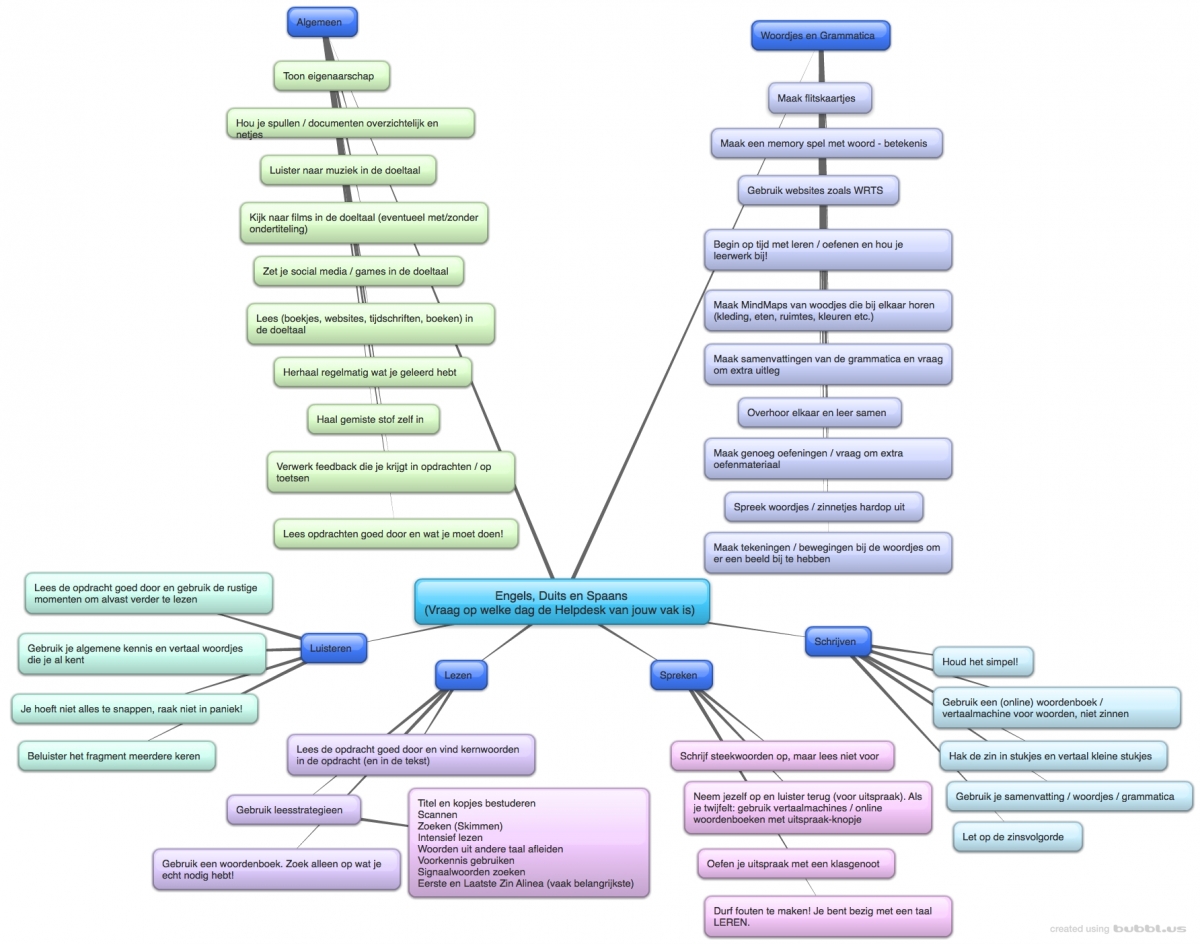
Een taal leren kan overweldigend lijken, maar gelukkig is het in kleinere stappen op te breken.

Kijk naar de afbeelding hieronder voor verschillende tips, manieren en werkvormen om de verschillende vaardigheden beter te beheersen.

Wij raden in ieder geval het volgende aan:

- leer 3x per week woorden in stukken. Deze woorden kun je vinden in onder 'Basics' en in je eigen woordenlijst.

- herhaal ook woorden die je vaker tegenkomt en gebruikt.

- lees opdrachten en Wikiwijs-pagina's altijd goed door.

- hoe meer Engels je in je leven tegenkomt, hoe beter. Kies voor Engelse audio/film, gebruik Engelse ondertiteling, lees een Engelse versie van een bekend boek. Engels Engels Engels, overal!

- vraag om feedback. Jouw expert kan meteen (herhalings)fouten eruit halen zodat je iets niet verkeerd aanleert.

- gebruik kennis van je klasgenoten.

Zelf zinnen maken

In het Engels is de woordvolgorde anders dan in het Nederlands. Het kan dus voorkomen dat je alle losse onderdelen en woorden om een zin mee te maken wel weet of hebt opgezocht, maar niet weet hoe je deze onderdelen met elkaar moet combineren. Hieronder wordt uitgelegd wat de basis zinsstructuur in het Engels is. Gebruik deze pagina steeds opnieuw als je zinnen moet leren formeren of om je Masterpiece te maken. Gebruik vervolgens de grammatica en woorden die je in de Basics lessen leert om steeds meer zinnen te maken en te experimenteren!


Om een simpele zin te maken heb je bouwblokken nodig. Ook in het Nederlands leren we zinnen ontleden om deze bouwblokken te herkennen. Tijdens de lessen leer je Engelse woorden die je hierbij kan gebruiken. Hieronder eerst een overzicht van de bouwblokken die we hebben en in het Engels op deze volgorde gebruiken:

- Onderwerp: wie of wat voert de actie uit/over wie of wat gaat het. In het Engels wordt het onderwerp in bevestigende en ontkennende zinnen altijd als eerst genoemd. Bij vragen komt het onderwerp altijd als tweede.

- Persoonsvorm/Werkwoorden/Gezegde: deze drukken de actie uit die plaatsvindt. Deze worden uitgevoerd door het onderwerp of hebben te maken met het onderwerp. In het Engels komen alle werkwoorden direct achter elkaar en noem je eerst de hulpwerkwoorden en dan het hoofdwerkwoord. Het hoofdwerkwoord is het belangrijkste werkwoord in de zin en het woord dat de actie het meest duidelijk uitdrukt, bijv. write (hoofdww). Het hulpwerkwoord kan verschillende vormen hebben, bijv. can/could/will/would/shall/should/may/might/must. Deze kunnen allemaal voor het hoofdwerkwoord komen en passen de betekenis van wat je zegt aan.

- Lijdend voorwerp: hangt samen met het onderwerp en de persoonsvorm/werkwoorden/gezegde. Het onderwerp van de zin kan de actie van het werkwoord uitvoeren met het lijdend voorwerp of het lijdend voorwerp is hetgeen waar de actie om draait. Dit heb je vaak nodig om een zin compleet te maken, bijv. I (onderwerp) need (ww) help (lijdend voorwerp). Je kan er ook achter komen wat het lijdend voorwerp is als je een vraag stelt met het werkwoord en het onderwerp. Bijv. What do I need? -> help.

- Meewerkend voorwerp: aan wie of wat, of voor wie of wat is het allemaal bedoelt. Hier komt in het Engels vaak 'to' of 'for' voor te staan. Bijv. I (onderwerp) need (ww) water (lijdend voorwerp) for my plant (meewerkend voorwerp).

- Plaats: waar speelt het zich allemaal af. Let hierbij goed op of je het juiste voorzetsel gebruikt hebt! Bijv. at my school = bij mij op school, on my school = bovenop het schoolgebouw.

- Tijd: wanneer speelt het zich allemaal af. Als je extra wil benadrukken wanneer het zich afspeelt, kun je de tijd ook helemaal vooraan in de zin noemen. Bijv. Next week, I'm going to walk home. This week, I'm going to bike.

Voorbeeld van een simpele zin:

Onderwerp – alle werkwoorden achter elkaar (belangrijkste achteraan) – wat - voor wie/wat – plaats – tijd

I              am painting      a picture             for my mom       in the garden     right now.


Om een uitgebreide zin te maken, kun je meer bouwblokken toevoegen en de bestaande bouwblokken vervangen met moeilijkere varianten. Hiermee kun je ook meer van je taalvaardigheid en taalbeheersing laten zien. Dit kan o.a. door synoniemen gebruiken om meer van je vocabulaire te laten zien.

Bouwblokken die je toe kan voegen om je zinnen complexer te maken hebben ieder een eigen functie en regels. Deze regels leer je gedurende leerjaar 1 en 2, maar zijn soms al eerder nodig. Hier zijn er een aantal die je kunt gebruiken.

Hieronder een overzicht van de bouwblokken die we hebben en in het Engels een uitgebreide zin maken:

- Zelfstandige naamwoorden: woorden waar je in het Engels de lidwoorden 'a' of 'an' voor kan zetten.

- Bijvoeglijk naamwoorden: zeggen iets over een zelfstandig naamwoord. Deze komen altijd direct voor het woord waar ze iets over zeggen en worden door een komma gesplitst als het er meerdere zijn, bijv. 'the great, big, beautiful book'.

- Bijwoorden zijn er in verschillende soorten en kunnen op verschillende plekken in de zin komen. De vuistregels hierbij zijn:

- Bijwoorden van frequentie: zeggen iets over hoe vaak iets gebeurt, bijv. always, usually, sometimes, often, never. Deze komen altijd áchter am/is/are/was/were en vóór alle andere werkwoorden.

- Bijwoorden van manier: zeggen iets over de manier waarop iets gebeurt, bijv. slowly, fast, hard.

- Bijwoorden van kwaliteit/intensiteit: zeggen iets over de kwaliteit of hoe erg waarmee iets gebeurt, bijv. well, badly, very, really.

Voorbeeld van een uitgebreide zin:

Onderwerp – alle werkwoorden achter elkaar (belangrijkste achteraan) en bijwoord op de juiste plek – wat beschreven met bijvoeglijk naamwoorden en synoniem - voor wie/wat met synoniem – plaats met bijvoeglijk naamwoord – tijd synoniem

I              am actually painting      a huge, realistic portrait             for my mother       in the beautiful garden     at the moment.


Afbeeldingsresultaat voor learning english sentences

Grammar

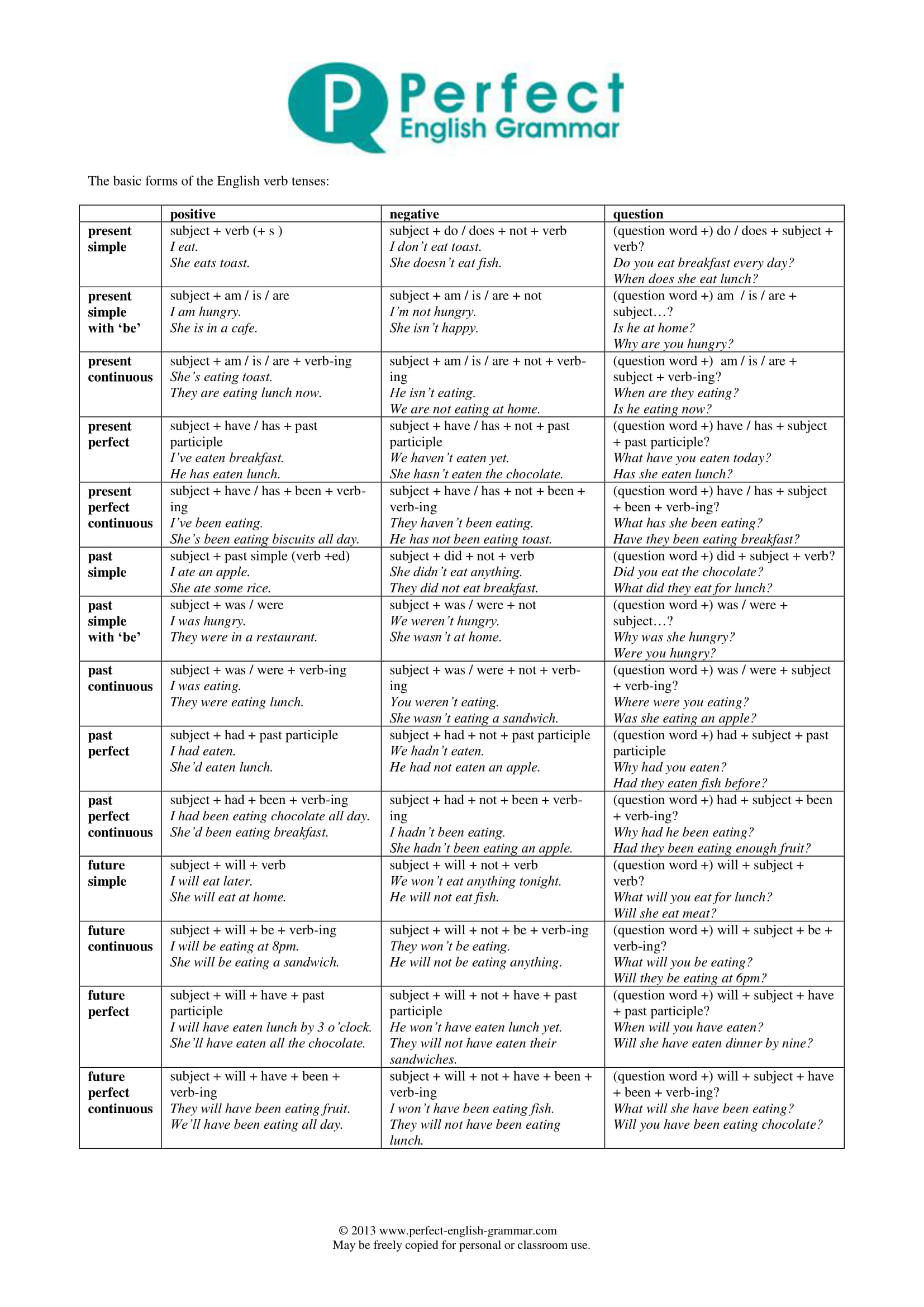
In year 4+ you don't learn any new grammatical structures during class. There will be some repetition, but if you feel like you need more practise, you've come to the right place. You can find a pdf that explains the most used tenses here and a quick infographic here.


We expect you to be able to use the tenses below correctly. You can click each of them for explanation and exercises. Afbeeldingsresultaat voor grammar meme"

- Present Simple
- Present Continuous
- Past Simple
- Past Continuous
- Present Perfect
- Past Perfect
- Passive
- Modal verbs
- Adjectives and Adverbs
- Future 


If you want to elevate your English, you might also want to practise these tenses:

- Present Perfect Continuous
- Conditionals
- Reported Speech
- Passive (yes, again)
- Gerund and infinitive

Tenses - Cheat sheet

https://www.perfect-english-grammar.com/support-files/all_tenses_form_cheatsheet.pdf


Vocabulary

Of course grammar alone doesn't improve your English if your vocab is not broad enough. On this page you'll find different ways to improve your vocab. 


General ideas
You can, of course, practise and broaden your vocabulary by using Duolingo and Memrise. You can choose your level and work your way up at your own pace.  Besides this, watching English programms / film / series and reading English books / blogs / articles will improve your vocabulary as well.


English vocabulary in use - Intermediate

In this (online) book, you'll find loads of exercises meant to improve your English. You can start at the beginning of the book, or choose a topic to broaden your vocabulary. Besides the exercises to improve your vocab, this book also explains in what way you can work to improve your vocab.Afbeeldingsresultaat voor words"


English vocabulary in use - Advanced

If you feel that the previous book with exercises was a bit too simple, or if you've worked your way through it, or if you want to challenge yourself with learning advanced vocab, please download the file below. This book contains more exercises to learn even more vocab.

  • Het arrangement DNS English Year 4 HAVO/VWO is gemaakt met Wikiwijs van Kennisnet. Wikiwijs is hét onderwijsplatform waar je leermiddelen zoekt, maakt en deelt.

    Auteur
    Sectie Engels
    Laatst gewijzigd
    22-04-2021 09:02:42
    Licentie

    Dit lesmateriaal is gepubliceerd onder de Creative Commons Naamsvermelding 3.0 Nederlands licentie. Dit houdt in dat je onder de voorwaarde van naamsvermelding vrij bent om:

    • het werk te delen - te kopiëren, te verspreiden en door te geven via elk medium of bestandsformaat
    • het werk te bewerken - te remixen, te veranderen en afgeleide werken te maken
    • voor alle doeleinden, inclusief commerciële doeleinden.

    Meer informatie over de CC Naamsvermelding 3.0 Nederland licentie.

    Aanvullende informatie over dit lesmateriaal

    Van dit lesmateriaal is de volgende aanvullende informatie beschikbaar:

    Eindgebruiker
    leerling/student
    Moeilijkheidsgraad
    gemiddeld

    Bronnen

    Bron Type
    B1 - Goal
    https://maken.wikiwijs.nl/168436/B1___Learning_Objectives
    Link
    job interview questions
    https://vm.tiktok.com/ZMexAYhw9/
    Video

    Gebruikte Wikiwijs Arrangementen

    Sectie Engels. (z.d.).

    DNS - PREPAREDNESS 101

    https://maken.wikiwijs.nl/56572/DNS___PREPAREDNESS_101

    Sectie Engels. (z.d.).

    DNS English Year 4 MAVO

    https://maken.wikiwijs.nl/65132/DNS_English_Year_4_MAVO

    Sectie Engels. (z.d.).

    Thema 2 Ontdek je Omgeving
    https://maken.wikiwijs.nl/62614/Thema_2_Ontdek_je_Omgeving

  • Downloaden

    Het volledige arrangement is in de onderstaande formaten te downloaden.

    Metadata

    LTI

    Leeromgevingen die gebruik maken van LTI kunnen Wikiwijs arrangementen en toetsen afspelen en resultaten terugkoppelen. Hiervoor moet de leeromgeving wel bij Wikiwijs aangemeld zijn. Wil je gebruik maken van de LTI koppeling? Meld je aan via info@wikiwijs.nl met het verzoek om een LTI koppeling aan te gaan.

    Maak je al gebruik van LTI? Gebruik dan de onderstaande Launch URL’s.

    Arrangement

    IMSCC package

    Wil je de Launch URL’s niet los kopiëren, maar in één keer downloaden? Download dan de IMSCC package.

    Voor developers

    Wikiwijs lesmateriaal kan worden gebruikt in een externe leeromgeving. Er kunnen koppelingen worden gemaakt en het lesmateriaal kan op verschillende manieren worden geëxporteerd. Meer informatie hierover kun je vinden op onze Developers Wiki.