
Art v456

Art v456

Art

Introduction

Art
In this theme you will focus on art.

What are you going to do?

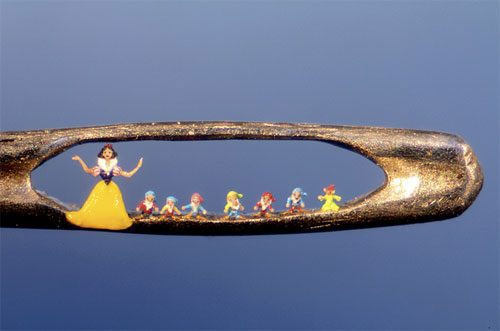
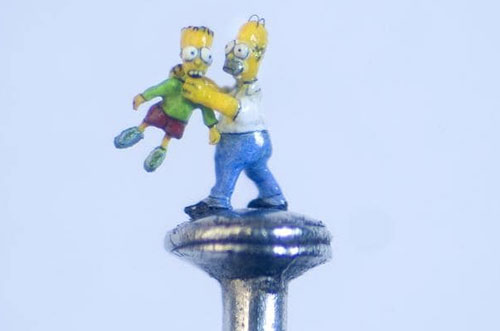
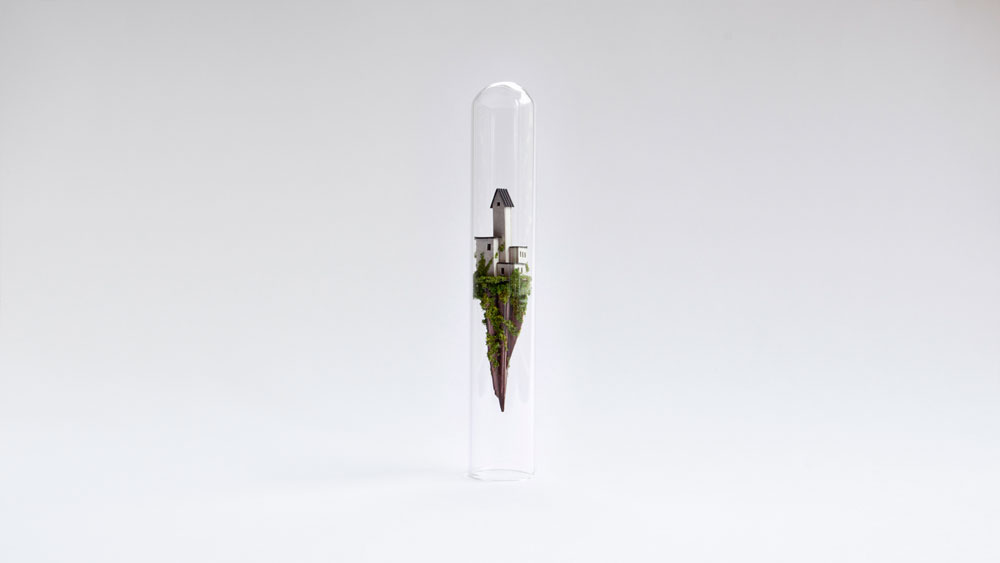
We are going to find out about some famous artists and some famous museums. Then we look at street artists and minute art.
Finally, we will look at a teenage artist and look at the phenomena of the social media and the promotion of art.

How about you?
Are you interested in art? Do you like paintings?
Have you ever visited an art museum?

Art can be found in places all around us; a dance, a painting, sculpture, poetry, in nature... A tricky concept to define because everyone's entitled to their own preferences and feelings when it comes to art.

Have fun!

Need to know

What do you need to know?
At the end of this theme, you should be able to talk about Art with ease.
But you don't have to be able to do all this perfectly right away! If you take the following lessons you'll find out what you need to know!

Give it a try!
Read the questions.

  • Form groups of three or four.
  • In your group, select as many questions as there are members of your group.
  • Discuss these questions.
  • Select one question you all think is interesting.
  • Present, as a group, the results of your discussion to your class mates.
  • Answer, as good as you can, questions of your class mates.

When listening to other presentations, listen carefully and think of questions or things you did not understand.

Choose from the following questions:

  • Do you like modern art? Why / why not?
  • Do you like paintings? Why / why not?
  • Do you think of cartoons and comics as art?
  • Do you consider photography an art form? Why / why not?
  • Do you agree with this statement? Graffiti is a form of art; a form of expressing one's mind.
  • What art form do you like best?
  • What famous painters do you know? What are they famous for?
  • Who are some famous artists in your country?

Can do

In this theme you will focus on the following 'can do' statements.

Listening (B1-B2):

  • I can follow the main points of a song and can fill in the gaps in a song text.
  • I can understand and catch the main points in a short interview between teens or with an artist about art.
  • I can understand a video about a (visit to) the National Motor museum and answer questions.

Reading (B2)

  • I can rapidly grasp the content and the significance of an article of Banksy.
  • I can read and understand an article about art in which the writers express specific attitudes and points of view.
  • I can understand in detail texts about a museum and I can place missed sentences in the text.
  • I can understand in detail a text about an artist and answer questions about the text.
  • I can read an article about Teen art work and grasp the most important points.

Speaking (B1-B2)

  • I can take an active part in a face to face conversation on art and museums.
  • I can give or seek personal views and opinions in an informal discussion about Banksy. I can maintain the conversation and discussion.
  • I can give a presentation for my class about my own art exhibition. I can speak clearly at an understandable pace.

Writing (B1-B2)

  • I can write down the answers to questions about art and I can express personal views and opinions.
  • I can write a review of the work of an Instagram artist. I can express my personal opinion.
  • I can write a formal email to a museum to ask permission to sketch at the museum (V&A).
  • I can describe in an entry my favourite museum.
  • I can write a discursive essay about Graffiti. I can express my personal point of view and can give reasons in support my point of view; vandalism or pure art?
  • In a formal email I can convey information about a piece of artwork I would like to order and I can ask for more specific information.

To do

The theme Art contains an introduction, five lessons and a finishing touch.
In the schedule below, you can see the titles of the sections and an estimate of the time required for each part.

Lesson

Title

Activities

Time (hours)*

Introduction

Introduction

Need to know

Can do

To do


0,5 hour

Lesson 1

The world's finest museums

Listen to a video about famous artists. Listen and speak about famous paintings. Read the top ten museums.
Grammar: must/have to

3-4 hours

Lesson 2

Sketching in a museum

Watch signs in museums and read about the Victoria and Albert Museum. Write a formal email to V&A.
Grammar: future going to and will

3-4 hours

Lesson 3

Street Art

Read the story and an article about Banksy.
Speak about questions you would ask Banksy. Write a discursive essay.
Grammar: possessive adjectives

2-3 hours

Lesson 4

Minute Art

Watch famous pictures and read an article about very small pieces of art. Write a letter to order a piece of artwork.

2-3 hours

Lesson 5

Teen artist

Speak with a classmate about two art images. Together read an article about Art of pasta noodles.
Write a review of the work of an Instagram artist.

2-3 hours

Finishing touch

Projects


Oefenprogramma


Evaluation

You are going your own exhibition.
You are going to listen to a song.

You are going to practise with the 'Oefenprogramma Engels'

You answer evaluation questions, what did you learn?

3-4 hours


Total


18 hours


*hour = lesuur. Eén lesuur komt ongeveer overeen met 2 SLU.

Lessons

Finest museums

Finest museums

Introduction

The subject of this lesson is 'The world's finest museums'.

In this lesson you are going to find out about some famous artists and some famous museums.

We start with a fun video in which you will hear the names of lots of artists (mainly painters) in a song. How many do you recognize?

We look at six works of arts and listen to two teens talking about them.
Then we look at a Top 10 list of museums. Do you agree with the top 10 list?
So let’s start with the artists!

This lesson contains 7 steps and an evaluation. Work them through step by step.
 

Step

Activity


Introduction

Find out what you already know.

Step 1

Writing and watching

One minute to write down famous artists. Watch a video.

Step 2

Listening

Match painter and painting. Listen to audio conversation between two teens. Mention the paintings in order.

Step 3

Speaking

Speak about your favourite painting with a classmate.

Step 4

Reading

Read a text about top ten museums. Two exercises about museums.

Step 5

Speaking

Read questions and speak about museums.

Step 6

Grammar

Grammar: must/have to.
Complete rules, do exercise and study Grammar Desk.

Step 7

Task

Write an 'entry' for your top museum.


Evaluation

Reflecting on what you have learned.


Difficult words? Search these on Cambridge Dictionaries


Step 1 - Writing-Watching

Writing and Watching
Who are your favourite artists? How many famous artists can you think?
You have 1 minute to write down all the famous artists (e.g. painters/sculptors) you can think of. Use a stopwatch to time yourself!

Now watch this video.

  • Which of your artists are mentioned?
  • Are there any artists that you have never heard of?

Here is the tapescript of the video.

  • Did you mention all the artists by listening?
  • Are there some artists you spot now by reading?

Transcript

We’re famous artists, yes famous artists: Paul Gaugin, Edward Hopper and Van Gogh (Oh.)
Pablo Picasso. (I thought so.) (I know ya! How are ya?)
We're definitely people you should know ... Sandro Botticelli, Michelangelo, Wolleh.

The names just keep on coming and we haven't got all day! We’re famous artists... Renoir! Famous artists. Au revoir!
Monet, Da Vinci, Pieter Bruegel (Don’t pinch me!). Some people think we’re geniuses. Some people think we’re weird. (But, weird, what do you mean? Weird is a relative term).
Toulouse-Lautrec, Vermeer, Basquial,
(And please don’t touch my beard!)
Andy Warhol, Jacob Lawrence, Jackson Pollock too.
I’m afraid we have to go now, so we’ll just say Toodaloo!
And if you think we’re slightly messy it may be slightly true!
But that my fine young viewer, will be up to you.


Step 2 - Listening

Listening
Look at these paintings.

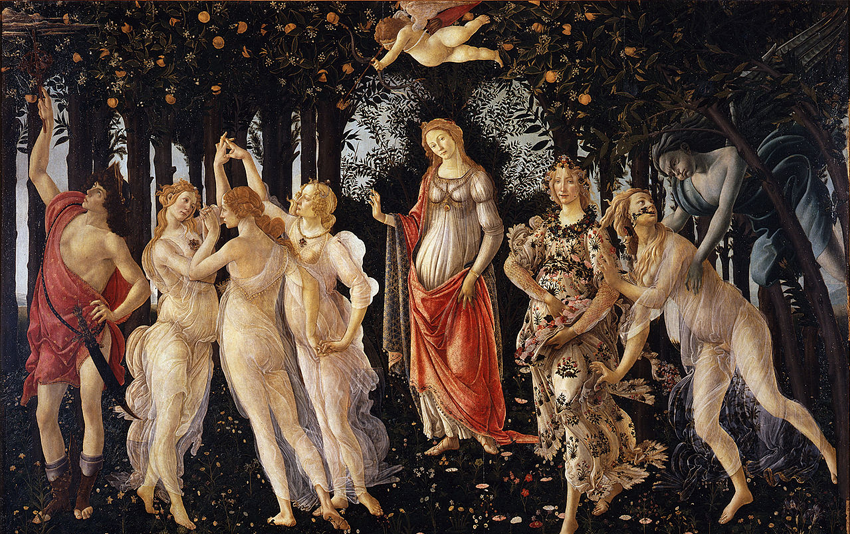
Painting 1: Primavera

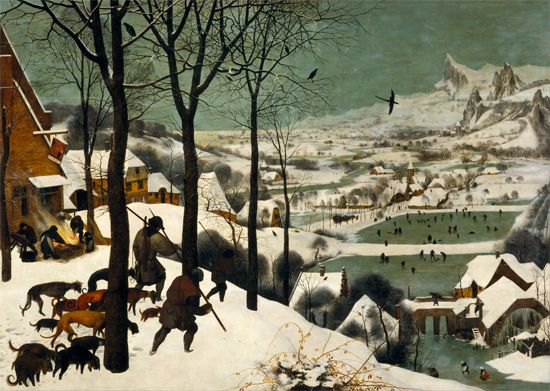
Painting 2: Hunters in the snow

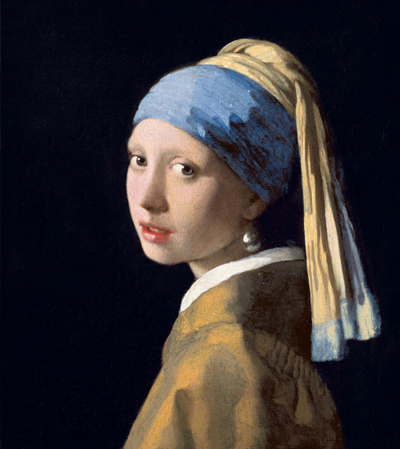
Painting 3: Girl with the pearl earring

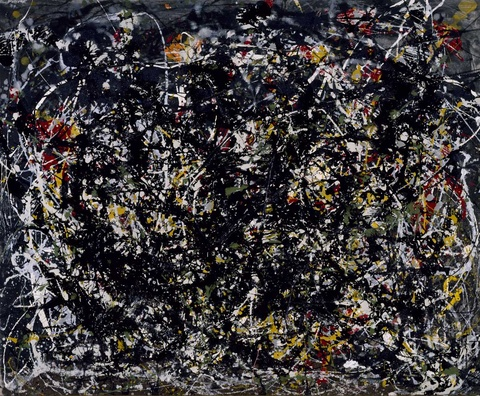
Painting 4: Number 6
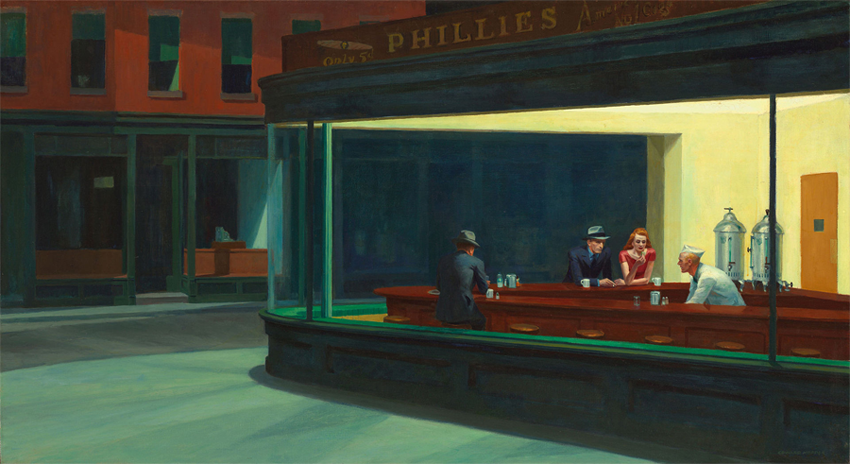
Painting 5: Nighthawks
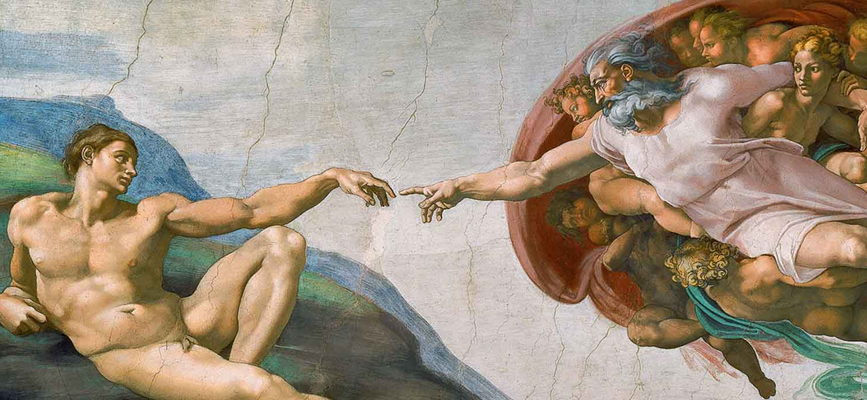
Painting 6: Creation of Adam


Use the internet to find out who the painters are.
Do the first exercise.

Look at the paintings again. Listen to two teens talking.

Do the exercises.

Step 3 - Speaking

Speaking
In Step 1 you listened to an interview and a video about artists and paintings.

  • What is important in a painting for you?
  • Do you have a favourite ‘famous’ painting? Write down for yourself:
    • title
    • painter
    • in which museum the painting hangs
    • what do you like about the painting.

You are going to speak with a classmate about your favourite painting.
Tell your classmate which painting you have chosen and why.
Has he/she heard before about the existence of the painting?

Then you ask your classmate all about his/her favourite painting.
Do you like the painting chosen by your classmate? Why or why not?

Step 4 - Reading

Reading: Top Ten Museums
Now you are going to read about the Top Ten Museums according to the National Geographic Book 'The best 10 of Everything'. There are many ‘lists’ of Top 10s. Let’s see which museums are in the Top 10.

Quickly read through the texts. Which museums do you know? Which museums have you visited?

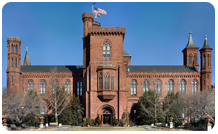
1. Smithsonian Institution, Washington, D.C.
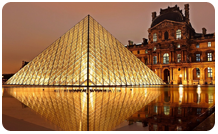
The Smithsonian is the world’s largest research and museum complex, with 19 museums and galleries, the National Zoological Park, and various research stations. More than 137 million objects detailing America’s story are housed here, so you’d better prepare for a long week of walking. There’s so much to see that, if you spent one minute day and night looking at each object on exhibit, in ten years you’d see only ten percent of the whole. Therefore, it’s wise to head out with a plan. Focus on only one or two exhibits at two or three different museums.

Main attractions:

  • 'Dorothy’s ruby red slippers', 'The dresses of the First Ladies', and the original Star-Spangled Banner at the National Museum of American History;
  • the Gem Hall (including the Hope Diamond) at the National Museum of Natural History;
  • the Wright brothers’ 1903 Flyer, the Spirit of St. Louis; and the Apollo 11 command module at the National Air and Space Museum.


2. Le Louvre, Paris, France
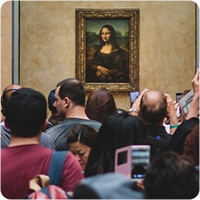
The Louvre was a medieval fortress and the palace of the kings of France before becoming a museum two centuries ago. The addition of I.M. Pei’s pyramid shocked many when it was unveiled in 1989 as the new main entrance, yet it somehow works, integrating the palace’s disparate elements. The museum’s collections, which range from antiquity to the first half of the 19th century, are among the most important in the world. A good place to start is the Sully Wing, at the foundations of Philippe-Auguste’s medieval keep—it’s in the heart of the Louvre, kids love it, and it leads straight to the Egyptian rooms.

Main attractions:

  • 'Venus de Milo',
  • 'Winged Victory of Samothrace', and
  • Leonardo da Vinci’s 'Mona Lisa'.


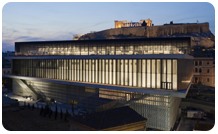
3. The Acropolis Museum, Athens, Greece
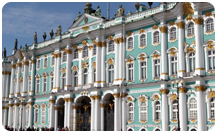
The stunning ground floor gallery houses finds from the slopes of the Acropolis. Its amazing transparent glass floor provides a walk over history, with a view of the archaeological excavation, while sloping upward to the Acropolis with sanctuaries of the Athenians from each historic period nearby. Smaller settlements have been excavated, yielding glimpses of Athenian life. For the first time, the exhibits in the Archaic Gallery allow visitors to take in all sides of the objects, which are displayed in open spaces characterized by changing natural light.

Main attractions:

  • The frieze of the Parthenon is mounted on a structure with exactly the same dimensions as the cella of the Parthenon, giving comprehensive viewing of every detail.


4. State Hermitage, St. Petersburg, Russia
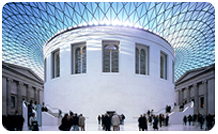
Russia may be isolated from the artistic centers of Paris, Rome, and London, but the Hermitage has managed to acquire a spectacular collection of world art—more than three million items—spanning the years from the Stone Age to the early 20th century. The museum occupies six buildings along the Neva River, the leading structure being the confection-like Winter Palace. This gloriously baroque, blue-and-white structure was finished in 1764 and over the next several centuries was the main residence of the czars. Catherine the Great founded the museum that same year when she purchased 255 paintings from Berlin. The museum’s focal point is Western European art—120 rooms in four buildings ranging from the Middle Ages to the present day.
Rembrandt, Rubens, Tiepolo, Titian, da Vinci, Picasso, Gauguin, Cézanne, van Gogh, and Goya are all represented here. For in-depth tours, contact Glories of the Hermitage.

Main attractions:

  • The Treasure Gallery’s Gold Rooms showcase golden masterpieces from Eurasia, the Black Sea Littoral in antiquity, and the Orient.
  • The museum also houses pieces from Nicholas II’s private collection, including paintings, drawings, and medals created to commemorate his coronation.


5. The British Museum, London, England
Britain’s largest museum looks after the national collection of archaeology and ethnography—more than eight million objects ranging from prehistoric bones to chunks of Athens’ Parthenon, from whole Assyrian palace rooms to exquisite gold jewels.

Main attractions:

  • The Egyptian gallery boasts the world’s second finest collection of Egyptian antiquities outside Egypt, including the Rosetta Stone, carved in 196 B.C.


6. The Prado, Madrid, Spain
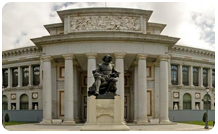
The Spanish royal family is responsible for the Prado’s bounty of classical masterpieces. Over centuries, kings and queens collected and commissioned art with passion and good taste. In addition to stars of Spanish painting such as Velázquez, Goya, Ribera, and Zurbarán, the Prado has big collections of Italian (including Titian and Raphael) and Flemish artists. Fernando VII opened the collection to the public in 1819, in the same neoclassic building it’s housed in today, designed by Juan de Villanueva.

Main attractions:

  • 'The Three Graces' by Rubens.


7. The Metropolitan Museum of Art, New York City, New York
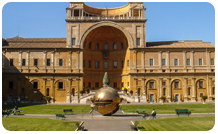
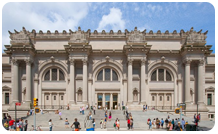
The Metropolitan Museum of Art is the largest museum in the Western Hemisphere. Its collection of more than two million items is not only broad—covering the entire world, from antiquity to the present—but deep, with holdings so large in a number of areas that some might be considered museums unto themselves. Its European paintings are stunning: works by Botticelli, Rembrandt, Vermeer, Degas, Rodin, and other luminaries. The Egyptian Collection showcases the tomb of Perneb (circa 2440 B.C.) and the exquisite Temple of Dendur (circa 23-10 B.C.). The American Wing contains American arts and crafts, including a room from a Frank Lloyd Wright Prairie House. And the list goes on and on.

Main attractions:

  • 'Adam and Eve', the well-known engraving by Albrecht Dürer, is only one of the many impressive pieces
    you will discover at the Met.


8. The Vatican Museums, Vatican City, Italy
Twenty-two separate collections comprise the Musei Vaticani, each one more spectacular than the next. The most famous are probably the Museo Pio-Clementino, with its splendid classical sculpture; the Raphael Rooms, entire rooms painted by Raphael; the Pinacoteca (picture gallery), which contains the cream of the Vatican’s collection of medieval and Renaissance paintings; and, of course, Michelangelo’s Sistine Chapel. But there is also the ancient Egyptian exhibits of the Museo Gregoriano Egizio, as well as the Etruscan offerings of the Museo Gregoriano Etrusco. And that’s just a start.

Main attractions:

  • The renowned Sistine Chapel and the Raphael Rooms are not to be missed.


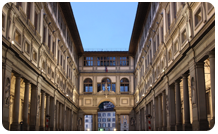
9. The Uffizi Gallery, Florence, Italy
'Great' is an overworked adjective in Italy, where so many of the country’s monuments and works of art command the highest praise. In the case of the Galleria degli Uffizi, it barely does justice to a gallery that holds the world’s finest collection of Renaissance paintings. The museum has a corridor which houses its self-portrait section. All the famous names of Italian art are here—not only the Renaissance masters, but also painters from the early medieval, baroque, and Mannerist heydays. In its Uffizi section the Vasari Corridor is used to exhibit the museum's famous collection of self-portraits.

Main attractions:

  • 'The Birth of Venus' by Botticelli is one.


10. Rijksmuseum, Amsterdam, the Netherlands
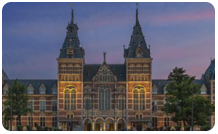
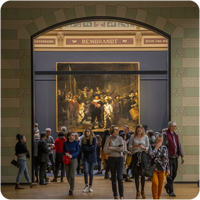
About 900,000 objects fill the Rijksmuseum, the largest collection of art and history in the Netherlands. It is most famous for its paintings by 17th-century Dutch masters, including Ruysdael, Frans Hals, Johannes Vermeer, and Rembrandt van Rijn. Established in 1800 to exhibit the collections of the Dutch stadtholders, the Rijksmuseum also displays art from the Middle Ages.

Main attractions:

  • 'De Nachtwacht' ('The Night Watch') by Rembrandt.


Read the texts again.

Do the exercise.

In which museum do you find these artistic collections or objects?

Step 5 - Speaking

Speaking: Think!
Read these questions. Think about what you will say, and then talk to your partner. Do you share the same opinion?
Don’t forget to give reasons to justify your thoughts!

  1. How often do you go to a museum?
  2. How important are museums for preserving art?
  3. What jobs are there in museums? Make a list.
    How interesting do you think it would be to work there? Give your reasons.
  4. Some people say that art and archaeological finds should be returned to their original countries. What do you think?
  5. Some people think that all museum entry should be free.
    Why, and what is your opinion?

Step 6 - Grammar

Grammar
Let’s look at must/have to.
Look at these sentences:

We have a new art teacher. We have to do our homework.
The exhibition is fantastic. You must see it!


Look at the rules:

1 We use have to when we are talking about something that is necessary/very important to do.

2 We use must when we are obliged (we have no choice) to do something.

3 You can use must or have to when you think something is necessary especially if you are saying what you think.

4 Use must when it is a fact, or when you are not giving your opinion.

Do the exercise.

You can check out the theory of must/have to in the Grammar Desk.

Modal verbs

Step 7 - Task

Task
If you had to choose your favourite museum, which would you choose?

Write an 'entry' for your top museum. An entry is an item written in e.g. in a diary or reference book.

- Your 'entry' starts with the introduction of your museum.
- Don’t forget to add the 'main attraction'.
- Explain why people (in your opinion) must visit your museum.
  Encourage people to visit your museum!

Write your entry in about 150 words.

Evaluation

Fill in the schedule and answer the questions below.

Activity easy difficult known​ new
Step 1 - Writing and watching        
Step 2 - Listening        
Step 3 - Speaking        
Step 4 - Reading        
Step 5 - Speaking        
Step 6 - Grammar        
Step 7 - Task        


What have you learnt in this period?
Answer the following questions:

  • What was the easiest part of this lesson?
  • What was the most difficult part?
  • What was most interesting part in this lesson?
  • What do you have to ask your teacher?

Sketching in a museum

Sketching

Introduction

The subject of this lesson is 'Sketching in a museum'.​
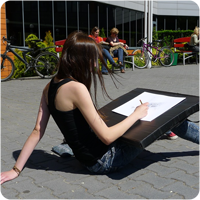
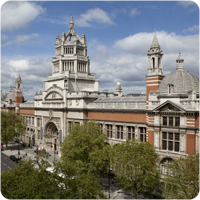
You are going to read about a museum in London, the Victoria and Albert Museum. It is often referred to as the V&A.

The V&A is an important museum for art students in the UK. It claims to be ‘the world’s leading museum of art and design.’ So why are they in the news?
Read on!

This lesson contains 3 steps and an evaluation.
Work them through step by step.


Step

Activity


Introduction

Find out what you already know.

Step 1

Watching

Which signs can you see in a museum?

Step 2

Reading

Read about a museum. Choose the first sentence of each paragraph.

Step 3

Grammar

Future: will vs going to. Exercises and Grammar desks to study.

Step 4

Task

Rewrite the informal email of Sacha in 100 words. Tips to write a formal email.


Evaluation

Reflecting on what you have learned.


Difficult words? Search these on Cambridge Dictionaries

Step 1 - Watching

Watching - signs
Sketching is a rough type of drawing. It is a form of visual art.
How important do you think sketching is for students?

  1. Very important if you choose an art study – if you can’t draw, you can’t do art.
  2. Important – it helps discover the best ideas.
    Maybe it helps to demonstrate an idea better than in words.
  3. Important - it can help us learn to write and think creatively and develops hand-eye coordination.
  4. No idea! I don't think it's very important.

Sketches
A sketch may serve a number of purposes.
Most visual artists use the sketch as a method of recording or working out ideas.
Sketches drawn can also help authorities find or identify wanted people (composite sketches).
Street artists in popular tourist areas sketch portraits within minutes.


In step 2 you’re going to read an article about the Victoria and Albert Museum (V&A).
What activities/objects are generally not allowed in a museum? Watch the signs.
Maybe these signs were also first sketched?

Do the exercise.

Step 2 - Reading

Reading
You’re going to read an article about the V&A. Some sentences are missing.
Read the sentences. The sentences must be placed in the article.

  1. But photography’s not the only no-no in this lineup of lingerie.
  2. Stealthily photographing someone’s knickers might normally get you arrested.
  3. The V&A has been quick to point out that sketching is still welcomed in the rest of the museum.
  4. But it transpires that the rule, has nothing to do with protecting intellectual property.
  5. There is even a section on the museum’s website underlining the virtues of sketching.
  6. The long, snaking queues outside the museum from 6am every morning do make it clear why the V&A wants to speed up the flow.

Now read the article.

1. [.....] But now everyone’s at it in the V&A. A ban on photography in the museum’s new exhibition, Undressed: A Brief History of Underwear, means the gallery is full of people furtively trying to snap pictures of pants when the guards aren’t looking. Sneaky museum Instagramming never felt so naughty.

2. [.....] If you thought you could get away with a quick sketch of that Victorian whalebone corset or the butt-lifting boxers, think again: the museum has introduced a ban on drawing too. When I tweeted a picture on Thursday of the officious sign that stands at the entrance to the gallery, declaring “No photography or sketching”, it was met with collective grasps of incredulity. “Is this a late April Fools?” asked one. “How has any artist learned from the past other than through study and facsimile?” Another responded: “No memorising anything you see. Approved memories can be purchased in the gift shop.”

3. [.....] A drawing, however realistically executed with the finest charcoal pencil, does not constitute a breach of copyright. Instead, according to a V&A spokesperson, it is to do with preventing congestion and the strict loan agreements the museum signs for each new exhibition. Allowing students to stand in front of exhibits for hours on end, as they lovingly craft an image of that 1950s Playtex rubber girdle in their sketchbooks, just doesn’t allow the conveyor belt of visitors to flow fast enough. So what next? A ban on wheelchairs and prams because they take up too much space too?

4. [.....] But a rule banning sketching goes entirely against everything the institution has ever stood for. The studious reproduction of museum exhibits has long been a fundamental part of art education – a means of honing drawing skills and offering deeper ways of looking. A visit to the sprawling Victorian repository isn’t complete without clattering into a skinny-jeaned art student poring over their sketchbook. It is what the V&A has always been about.

5. [.....] “Drawing in a sketchbook,” wrote the architect, Le Corbisier , “teaches first to look, and then to observe and finally perhaps to discover … and it is then that inspiration might come. “It is particularly untimely for the museum to have introduced the diktat when it is about to unveil an exhibition devoted to the act of copying at the Venice Architecture Biennale. A World of Fragile Parts promises to explore the role of copies as a tool for preservation and to “question the relationship between the copy and the original in a society that privileges authenticity”. Tricky to stage in gallery that forbids copying.

6.[.....] The  rule only applies to temporary exhibitions, but it still jars with the avowedly accessible ambitions for its new East End outpost.


Do the exercise.


Step 3 - Grammar

Grammar
Let’s look at the future will vs going to.

Read the theory in the Grammar Desks.

Future: going to

Future: will

Do all the exercises.

Step 4 - Task

Task
Your friend Sasha is an art student. She wants to sketch at the V&A.
She’s written a first draft of an email and has asked you for help.
Look at Sasha’s email asking for permission. List all the things that are wrong.

To: v.partridge@vanda.co.uk
From: sasha.price@myself.nl
Subject: Hello!

Hiya Mr Partridge!
I love your museum and I really like the exhibition ‘Colours’ that is on at the moment.
I saw your no sketching sign and I was really disappointed.
I’m studying art at school and I was wondering if you could give me permission to sketch one of the paintings.
It’d be really good for my final year project.
If you could reply soon, that’d be good.

Cheers!
Sasha Price.


To be able to rewrite this email here are some helpful tips:
Tips: How to write a formal email

  1. Begin Dear Sir/Madam, or with the name of the person e.g. Dear Victor Partridge.
  2. Choose a suitable subject for the email. (not Hello!)
  3. Use phrases like I was wondering/would it be possible/it would be really helpful if
  4. Be clear about what you are asking permission for and why.
  5. If you want a reply, use ‘I look forward to hearing from you’.
  6. Sign off with Best wishes/Kind regards/Yours faithfully/Yours sincerely
  7. If you know the name of the person e.g. Dear Mr Partridge – use Yours sincerely/Best wishes/Kind regards.
    If you don’t know the name e.g. Dear Sir/Madam – use Yours faithfully.

Copy and paste the text of Sasha's email.
Rewrite the email and use no more than 100 words.

Answer

Evaluation

Fill in the schedule and answer the questions below.

Activity easy difficult known​ new
Step 1 - Watching        
Step 2 - Reading        
Step 3 - Grammar        
Step 4 - Task        


What have you learnt in this double period?
Answer the following questions:

  • What was the easiest part of this lesson?
  • What did you already know?
  • What was the most interesting part?
  • What do you have to ask your teacher?


Street art

Street art

Introduction

The subject of this lesson is 'Street Art'.
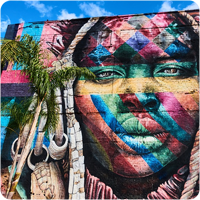
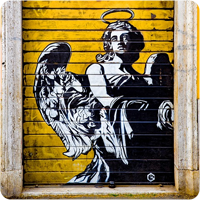
You’re going to read about a street artist. Street art is usually created in public places, and it usually hasn’t been requested. It is similar to graffiti but there are some ideological differences. However, both are usually created in public locations outside of the context of traditional art venues.

This lesson contains 6 steps and an evaluation. Work them through step by step.


Step

Activity


Introduction

Find out what you already know.

Step 1

Reading

Read an article about Bansky. Answer the questions.

Step 2

Words

Match words with definitions. Complete sentences.

Step 3

Grammar

About possessive adjectives and pronouns. Tick true sentences, fill in missing adjectives and/or pronouns. Check theory in Grammar Desk.

Step 4

Speaking

Think of five questions (in case you will meet Bansky). Answer to questions and give reasons.

Step 5

Reading

Definition of geographic profiling, read about it. An exercise and text about 'Geographic profiling'. Answer questions.

Step 6

Task

Write in 200 words about a disastrous holiday.


Evaluation

Write a discursive essay. Read the steps to work out your plan.


Difficult words? Search these on Cambridge Dictionaries


Step 1 - Reading

The story behind Banksy
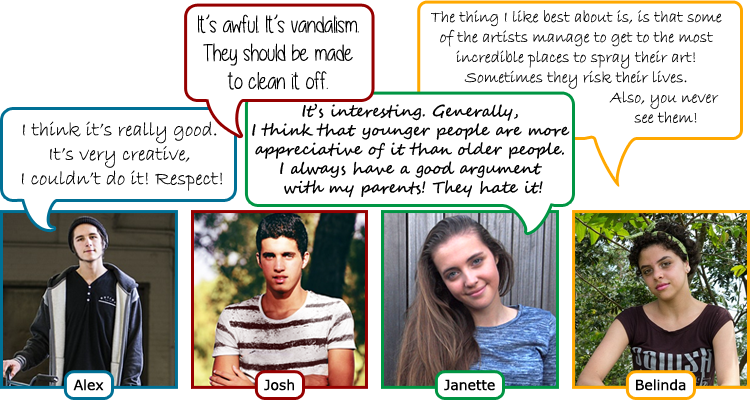
Read these opinions about street art/graffiti.
Which viewpoint(s) do you agree with? Give two reasons to support your opinion.

​Answer the questions about Alex, Belinda, Josh and Alex.

Reading: The story behind Banksy
Read 'The story behind Banksy' quickly.
What is Banksy’s real name?

Now read the text again and answer the questions.

Banksy melds street-fighting passion and pacifist ardor in his image of a protester whose Molotov cocktail morphs into a bouquet. (Pixelbully / Alamy)
On his way to becoming an international icon, the subversive and secretive street artist turned the art world upside-down

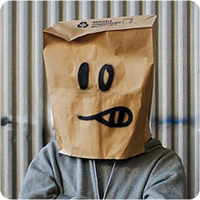
When Time Magazine selected the British artist Banksy—graffiti master, painter, activist, filmmaker and all-purpose provocateur—for its list of the world’s 100 most influential people in 2010, he found himself in the company of Barack Obama, Steve Jobs and Lady Gaga. He supplied a picture of himself with a paper bag (recyclable, naturally) over his head. Most of his fans don’t really want to know who he is. Pest Control, the tongue-in-cheek-titled organization set up by the artist to authenticate the real Banksy artwork, also protects him from prying outsiders. Hiding behind a paper bag, or, more commonly, e-mail, Banksy relentlessly controls his own narrative. His last face-to-face interview took place in 2003.

The Barton Hill district of Bristol in the 1980s was a scary part of town. So when Banksy, who came from a much smarter part of town, decided to go make his first expedition there, he was nervous. “My dad was badly beaten up there as a kid,” he told fellow graffiti artist and author Felix Braun. He was trying out names at the time, sometimes signing himself Robin Banx, although this soon evolved into Banksy. The shortened nickname may have demonstrated less of the gangsters’ “robbing banks” cachet, but it was more memorable—and easier to write on a wall.

Banksy’s first London exhibition, so to speak, took place in Rivington Street in 2001, when he and fellow street artists convened in a tunnel near a pub. “We hung up some decorators’ signs nicked from a building site, "he later wrote, “and painted the walls white wearing overalls. We got the artwork up in 25 minutes and held an opening party later that week with beers and some hip-hop pumping out of the back of a Transit van. About 500 people turned up to an opening which had cost almost nothing to set up.”

During the next 17 months, always in disguise, Banksy brought his own brand of prankster performance art to major museums, including the Louvre. There, he succeeded in installing an image of the Mona Lisa plastered with a smiley-face sticker. In New York City, he secretly attached a small portrait of a woman (which he had found and modified to show the subject wearing a gas mask) to a wall in the Metropolitan Museum of Art. The museum took it in its stride: “I think it’s fair to say,” spokeswoman Elyse Topalian told the New York Times, “it would take more than a piece of Scotch tape to get a work of art into the Met.” While the value of his pieces soars, there is a certain sadness around some of Banksy’s creative output. A number of his works exist only in memory, or photographs. When I recently wandered in London, searching for 52 previously documented examples of Banksy’s street art, 40 works had disappeared altogether, whitewashed over or destroyed.

Source: By Will Ellsworth-Jones, Smithsonian Magazine , February 2013


Do the exercise.

Step 2 - Words

Words

Look at the text again.

Banksy melds street-fighting passion and pacifist ardor in his image of a protester whose Molotov cocktail morphs into a bouquet. (Pixelbully / Alamy)

On his way to becoming an international icon, the subversive and secretive street artist turned the art world upside-down

When Time Magazine selected the British artist Banksy—graffiti master, painter, activist, filmmaker and all-purpose provocateur—for its list of the world’s 100 most influential people in 2010, he found himself in the company of Barack Obama, Steve Jobs and Lady Gaga. He supplied a picture of himself with a paper bag (recyclable, naturally) over his head. Most of his fans don’t really want to know who he is. Pest Control, the tongue-in-cheek-titled organization set up by the artist to authenticate the real Banksy artwork, also protects him from prying outsiders. Hiding behind a paper bag, or, more commonly, e-mail, Banksy relentlessly controls his own narrative. His last face-to-face interview took place in 2003.

The Barton Hill district of Bristol in the 1980s was a scary part of town. So when Banksy, who came from a much smarter part of town, decided to go make his first expedition there, he was nervous. “My dad was badly beaten up there as a kid,” he told fellow graffiti artist and author Felix Braun. He was trying out names at the time, sometimes signing himself Robin Banx, although this soon evolved into Banksy. The shortened nickname may have demonstrated less of the gangsters’ “robbing banks” cachet, but it was more memorable—and easier to write on a wall.

Banksy’s first London exhibition, so to speak, took place in Rivington Street in 2001, when he and fellow street artists convened in a tunnel near a pub. “We hung up some decorators’ signs nicked from a building site, "he later wrote, “and painted the walls white wearing overalls. We got the artwork up in 25 minutes and held an opening party later that week with beers and some hip-hop pumping out of the back of a Transit van. About 500 people turned up to an opening which had cost almost nothing to set up.”

During the next 17 months, always in disguise, Banksy brought his own brand of prankster performance art to major museums, including the Louvre. There, he succeeded in installing an image of the Mona Lisa plastered with a smiley-face sticker. In New York City, he secretly attached a small portrait of a woman (which he had found and modified to show the subject wearing a gas mask) to a wall in the Metropolitan Museum of Art. The museum took it in its stride: “I think it’s fair to say,” spokeswoman Elyse Topalian told the New York Times, “it would take more than a piece of Scotch tape to get a work of art into the Met.” While the value of his pieces soars, there is a certain sadness around some of Banksy’s creative output. A number of his works exist only in memory, or photographs. When I recently wandered in London, searching for 52 previously documented examples of Banksy’s street art, 40 works had disappeared altogether, whitewashed over or destroyed.

Source: By Will Ellsworth-Jones, Smithsonian Magazine , February 2013


Do the exercises.

Step 3 - Grammar

Grammar
Let’s look at ... possessive adjectives.

Check the theory in the Grammar Desk.

Possessive adjectives


Do the exercises.

Read the sentences: I have got a hat. It’s my hat. The hat is mine.
Jack hasn’t got their landline number.
Whose is this pen? It’s hers.

Write down the sentences that are TRUE.

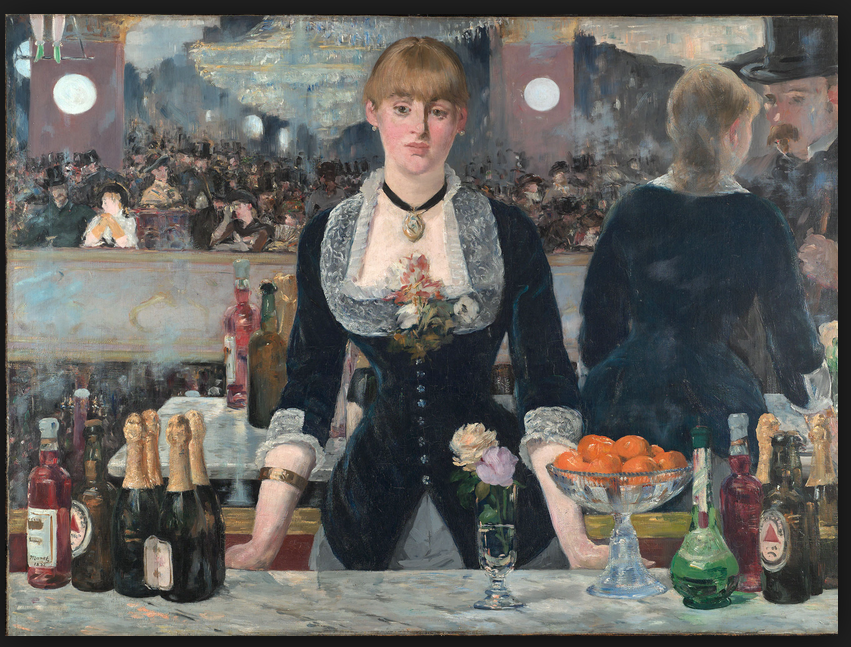
A bar at the Folies-Bergere by Manet
  1. In English adjectives don’t have plurals. So there is only one form.
  2. You cannot put a possessive pronoun with a noun or noun phrase
    e.g.: Have you seen theirs phones?
  3. There is no possessive pronoun for it.
  4. It’s and its are different.
  5. Its = possessive adjective
  6. It’s = contraction meaning It is or it has

In exercise 2 you fill in the missing possessive adjective or pronoun. These sentences are about this painting of Manet.

Step 4 - Speaking

Speaking
Imagine you could meet Banksy, what questions would you ask him?
Think of five questions. Write down your questions for an interview with Banksy.

Discuss with your classmate.
What does he/she think Banksy would answer to your questions?
Now take a look at the questions of your classmate. What do you think Banksy would answer to his/her questions?


Then discuss the following questions with a classmate:

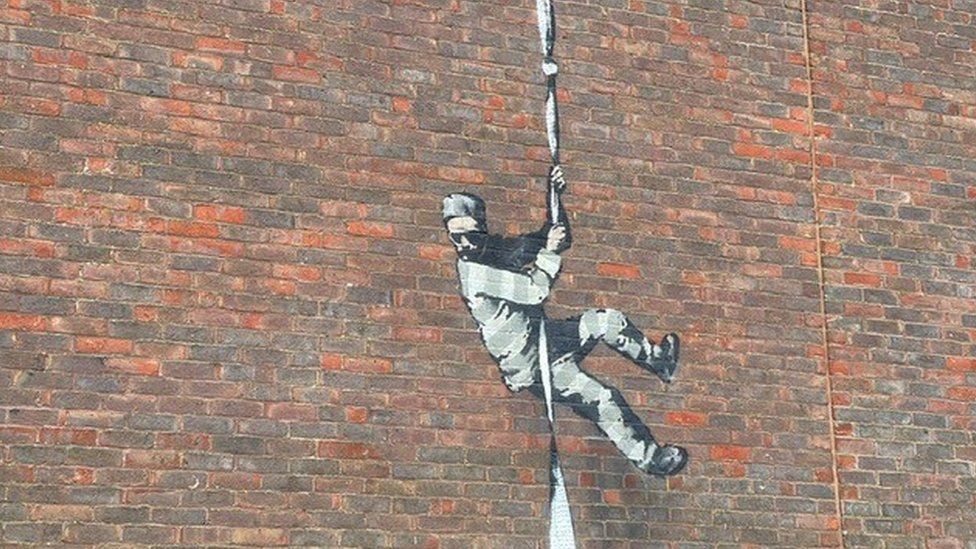
  • What do you think: Is this 'Banksy' artwork? Why or why not?
Possible Banksy artwork on wall of Reading Prison

An expert said it did "appear to be a new Banksy"    www.bbc.com   

Artwork on Reading Prison

The picture shows a prisoner - possibly resembling famous inmate Oscar Wilde - escaping on a rope made of bedsheets tied to a typewriter. Campaigners have been fighting to see the former jail turned into an arts hub rather than sold off for housing.

The "guerrilla artist" has not yet claimed the work but an expert said it did "appear to be a new Banksy".


  • Why do you think that Banksy doesn’t want his/her identity revealed? Give reasons.
  • Can you think of a situation in which you would want to be anonymous?
  • What are the advantages and disadvantages of anonymity?
    Give your reasons.

Step 5 - Reading

Reading
Some people wanted to discover the mystery behind Banksy’s identity and so they tried to find out who he (or she) is. Now we’re going to read about how they think they have discovered who he is.

Read possible definitions of geographic profiling.

Geographic profiling is:

a. a way of finding out where a person is at any time in the present time.

b. a tracking system to locate people especially criminals and their families.

c. a way of finding out the residence by connecting places that a person has visited.


Read this definition quickly. Were you right?

First read about geographic profiling.

Geographic profiling
Geographic profiling is an investigative methodology that uses the locations of a connected series of crimes to determine the most probable area that an offender lives in. Although it is generally applied in serial murder, rape, arson, robbery, and bombing cases, geographic profiling also can be used in single crimes that involve multiple scenes or other significant geographic characteristics.

Developed from research conducted at Simon Fraser University's School of Criminology and rooted in the path-breaking work of Brantingham and Brantingham (1981), the methodology is based on a model that describes the hunting behaviour of the offender. The criminal geographic targeting (CGT) program uses overlapping distance-decay functions centred on each crime location to produce jeopardy surfaces—three-dimensional probability surfaces that indicate the area where the offender probably lives. The distance-decay concept conveys the idea that people, including criminals, generally take more short trips and fewer long trips in the course of their daily lives, which may include criminal activities. Thus overlapping distance-decay functions are sets of curves expressing this phenomenon and suggesting, for example, that it is more likely that offenders live close to the sites of their crimes than far away. Probability surfaces can be displayed on both two- and three-dimensional colour isopleth maps, which then provide a focus for investigative efforts.

Geographic profiling can be used as the basis for several investigative strategies. Some of the more common ones include:

  • Suspect and tip prioritization.
  • Address-based searches of police record systems.
  • Patrol saturation and surveillance.
  • Canvasses and searches.
  • Mass DNA screening prioritization.
  • Department of motor vehicles searches.
  • ZIP Code prioritization.
  • Information request mail outs.


Do the exercise.

Now read the text 'Banksy unmasked?'.

Banksy unmasked? Scientists use maths and criminology to map artist's identity
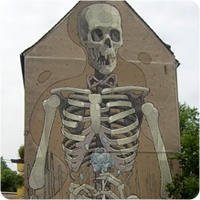
British academics have used combinations of maths, criminology and geographic profiling to back up a theory over the identity of mysterious street artist Banksy. Scientists at Queen Mary University of London
said the pattern of how Banksy’s artworks were distributed suggested he was artist Robin Gunningham.
Gunningham was first named as Banksy by the Daily Mail newspaper in 2008. Banksy’s politically-themed street art has made him a celebrity in Britain, despite his true identity never having been confirmed. His most high-profile recent project was Dismaland, a “bemusement park”, located in southwest England. Geographic profiling is a technique used in fields from criminology to the study of patterns of infectious disease. The research, published in the Journal of Spatial Science, analysed a series of locations of Banksy’s artworks in London and Bristol and mapped them against “anchor points” such as the homes of people suspected of being Banksy to draw conclusions about possible identity.

“Our analysis highlights areas associated with one prominent candidate (e.g. his home), supporting his identification as Banksy,” the paper said. “More broadly, these results support previous suggestions that analysis of minor terrorism-related acts (eg graffiti) could be used to help locate terrorist bases before more serious incidents occur, and provides a fascinating example of the application of the model to a complex, real-world problem.” One of the research team, Steve Le Comber, told the BBC: “I’d be surprised if it’s not (Gunningham), even without our analysis, but it’s interesting that the analysis offers additional support for it.” The BBC also reported that Banksy’s legal team had contacted staff at the university with concerns about how the research was to be promoted.

Source: https://www.theguardian.com/

 
Do the exercise.

Step 6 - Task

Task
You are going to write a discursive essay.
Discursive essays are like a debate, where you give different arguments about the same topic. It presents a balanced and objective examination of a subject.
The topic may be controversial, but the discursive essay attempts to present a much more balanced discussion of the issue.

The topic of this discursive essay is: Graffiti – vandalism or pure art?

  1. Note down reasons that people think graffiti is an act of vandalism.
  2. Note down reasons that people think graffiti is pure art.
  3. What do you think?

Your plan:

  • Para 1: Introduce the topic and outline what you are going to say.
    Your first paragraph should identify the issues that you are going to discuss and be interesting!
  • Para 2: why people might think it is vandalism.
    Word your reasons carefully. Make sure that your points are logical.
  • Para 3: why people might think it is art.
    Open with 'Contrary to this...' 'On the other hand...'
    List the opposing side’s reasons but do not change your opinion.
    Use phrases like: 'some people claim ...There are those who say...'
  • Para 4 conclusion and your own opinion.
    Make sure that your opinion is clear. Begin with phrases like: 'To sum up / In my opinion / To conclude’.

To write a quality essay, it's good to know on which points it will be assessed by your teacher. See the rubric on the next pages.
Finally hand in your essay to your teacher.

Discursive Essay rubric
Guidelines for scoring a discursive essay. These should be at B1 level as per CEFR.

  Fair (2 pts) Good (3 pts) Excellent (4 pts)
Planning
Plan
Some points but not all are clearly relevant. Clearly relevant supporting points. Good planning supporting points and a logical method of organization: considers pros/cons
Introduction
Gets the readers attention and clearly sets out what is going to say.
Introduction is adequate. Introduction prepares reader for the essay. Introduction is creative, gets interest and prepares reader for the essay.
Logical order
Does the order of the supporting details make sense?
The writer attempts to develop the essay in a logical order, but some of the essay may be presented in an order readers may find confusing. Most of the essay is presented in a logical order, and readers should have little trouble following the supporting details. The essay is developed in a logical order appropriate to the writer's purpose and reader's needs.
Conclusion
Does the conclusion restate the topic in a new way to tie the details together?
There is an attempt at a conclusion, but it doesn't restate the topic clearly or tie the details together in a fresh way. (simple repetition of the main points) The conclusion sums up the topic by restating it in a fresh way; it ties the details together in a non-repetitive fashion. The conclusion sums up the topic by restating the ideas in a fresh way; it ties the details together well.
Grammar and Vocabulary
Does the essay indicate that the writer has control of the spelling, grammar and vocabulary?
The essay contains errors of grammar, vocabulary or spelling to such an extent to impede understanding. The writer is able to express him/herself well although a few errors are present. There are very few errors and the writer has good control of the features of grammar and vocabulary at this level.


Evaluation

Fill in the schedule and answer the questions below.

Activity


Needs improvement

Satisfactory, good

Excellent

Step 1 - Reading

I can read the text about Banksy and answer the questions.


Step 2 - Words

I can understand and use the words.


Step 3 - Grammar

I can understand and use the grammar.


Step 4 - Speaking

I can think of questions I would ask Banksy and discuss about Banksy with a classmate.


Step 5 - Reading

I can read the texts about geographic profiling and Banksy 'unmasked' and answer the questions.


Step 6 - Task

I can write a discursive essay.


What have you learnt in this period?
Answer the following questions:

  • What did you already know?
  • What was new to you in this lesson?
  • What was the most interesting part?
  • What do you have to ask your teacher?

Minute art

Minute art

Introduction

The subject of this lesson is 'Minute art'.
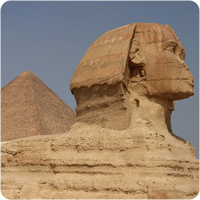
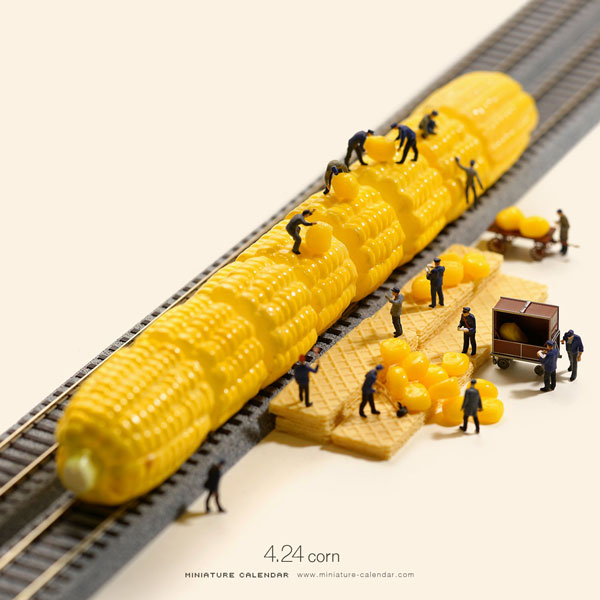
Do you know the expression 'through the eye of a needle'?
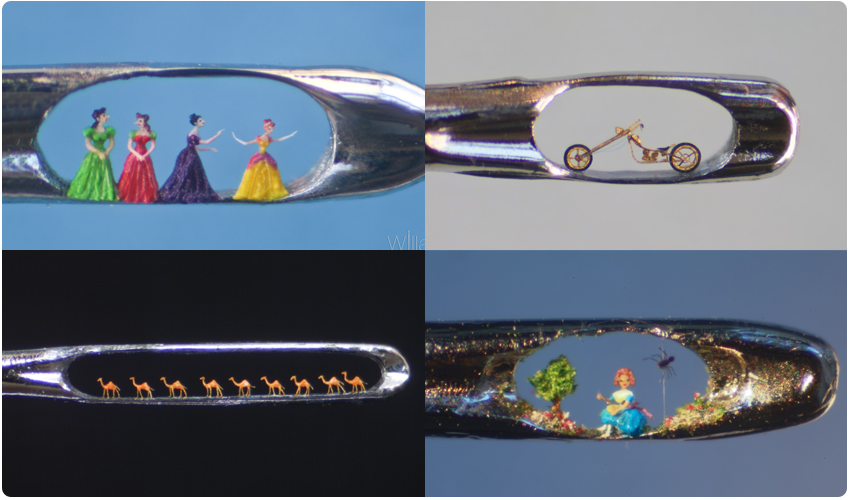
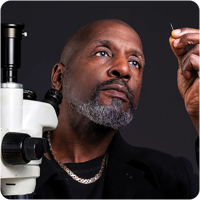
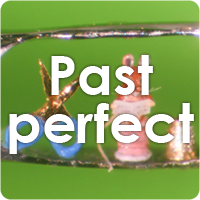
Well, you’re going to read about an artist whose work is so small and so tiny, that it all fits in the eye of a needle.
It’s minute – that means really small.
Read on!


This lesson contains 4 steps and an evaluation.
Work them through step by step.


Step

Activity


Introduction

Find out what you already know.

Step 1

Watching

Recognize famous pictures.

Step 2

Reading

Pictures, questions and text of an artist creating very small pieces of art.

Step 3

Listening

Questions and a video of an interview with this artist. Fill in missing words in the transcript.

Step 4

Task

You like to have a piece of small artwork composed by Willard. Write him a letter and explain your intentions.


Evaluation

Reflecting on what you have learned.


Difficult words? Search these on Cambridge Dictionaries


Step 1 - Watching

Watching
Look at the pictures. What and where are they? 
 

What do they all have in common? What are they called together?
They called together: The seven old wonders of the ancient world.
The only one remaining is the Great Pyramid of Giza.

The eight wonder?

Following in the tradition of this classical 'seven old wonders list', modern people and organizations have made their own lists of wonderful things ancient and modern.

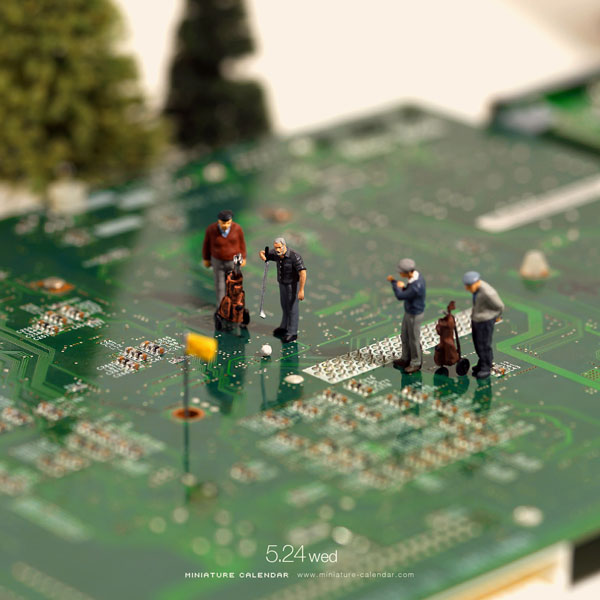
Below an example of a list of Minute art artists.
Can the work of one of them be described as the eight wonder of the world?

1. Tatsuya Tanaka

Tatsuya Tanaka 1 Tatsuya Tanaka 2

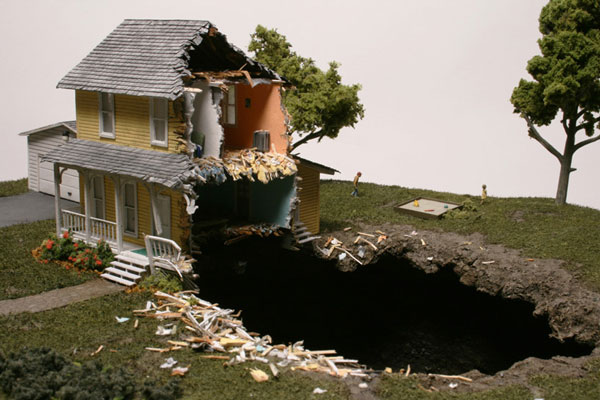
2. Thomas Doyle
Thomas-Doyle

3. Willard Wigan

Willard Wigan 1 Willard Wigan 2

4. Lim Pui Wan
Lim Pui Wan

5. Rosa De Jong
Rosa de Jong

Bron: www.designmantic.com (25-artists-creating-miniuature-art)

Step 2 - Reading

Reading
You are going to read about an artist whose work has been described as the ‘eighth wonder of the world’.
Here is are some impressions of his work.
Do you agree: can this work be describes as 'the eight wonder of the world'?
Why do you think they are so incredible?

Now read the article.

Interview: Willard Wigan
Thursday 2nd April 2015
To Wolverhampton artist, Willard Wigan, size really does matter.

His mother always told him the smaller his work got, the bigger his name would be. And now Willard Wigan’s work is widely recognised as an eighth wonder of the world. In pictures they appear to defy physics, but viewing them up close can leave you speechless.
And you have to look really close – under a microscope in fact – to appreciate Willard’s intricately detailed micro sculptures. But where did it all begin for this world-famous artist? “I remember I had an argument with my mum when I was five, so I went out to the shed in my garden to get away,” he said. “Then my dog Max came along and starting digging a hole. I saw all these ants emerge and I thought, they need a home now. So I decided to build them one. “I used my dad’s razor blade to cut tiny pieces of wood and I made houses and furniture for the ants,” the 57-year-old recalled.

This event sparked Willard’s love affair for making objects of all shapes and small sizes. Willard’s mother was a key figure in encouraging his artwork early on. Willard said: “My mother always told me, the smaller my work got, the bigger my name would be. Every time I created a piece of work, she would always say that’s too big, which encouraged me to keep making things even smaller.” His smallest piece of artwork has been recognised as a Guinness World Record. It is just one-and-a-half microns across, ‘about the size of a blood cell’, which is of a motorbike, made from gold fragments, inside a human hair. So for Willard, good things come in small packages. But just how does the self-taught artist make his work so small?

“I make my work between heartbeats. I have to use micro tools to create my sculptures, such as tiny shards of diamonds. “I even have to break down the paint molecules that I use. I’ll paint with a fly’s hair or an eyelash. When I work I stay away from caffeine and anything else that will affect my heart rate. I prefer to work at night when there is minimal noise and vibration disruption from the outside traffic,” he said. Willard enters a meditative state under the microscope, which he has perfected over many years. He slows his heartbeat down and works between every pulse, enabling him to control his body movements and hand gestures. On average, each micro sculpture will take him eight weeks to create. But Willard admits he never enjoys the making process, only seeing people’s reactions to his work afterwards. A lot of his micro-sculptures commonly sit in the eye of a needle or a pin head. Many famous world figures have the Wolverhampton artist’s micro sculptures in their collections. In 2012, Willard was privately commissioned to create a piece for Queen Elizabeth’s Diamond Jubilee. Willard sculpted a crown that sat on top of a pin’s head. “When the Queen is impressed with your work, you know you’re doing something right,” he adds. “She was so overwhelmed and excited with the piece, she even sent me three letters” he added. The Queen had previously recognised Willard’s work five years earlier, by presenting him with an MBE in 2007 for his services to art. Despite his rise to fame Willard, says he was misunderstood by his teachers due to his mild autism. He said part of the inspiration for creating such tiny sculptures was that if people were unable to view his work, then they wouldn’t be able to criticise it. However, now a thriving, world-renowned artist, Willard hopes he can be an inspiration for other people.

“I like to think I could be a testament to people that you can make it, no matter who you are or where you are from. You can achieve anything you want to if you put your mind to it. If you believe in yourself, and you are original and creative, you will succeed. Never be satisfied with what you have done and always try to improve,” he said.
Source: http://nativemonster.com/


Do the exercise.

Step 3 - Listening

willard wigan

Listening
Now you are going to watch an interview with Willard Wigan.

Do the exercise.

Step 4 - Grammar

Grammar
Let's look at the past perfect.

Do the exercise.
Write a sentence with the past perfect. Use the notes to help you.

You can check out the theory of the past perfect tense in the Grammar Desk.

KB: Past perfect

Step 5 - Task

Task
You are going to order a piece of artwork by Willard Wigan.

  1. Think of the occasion that you want to celebrate.
  2. Who is the artwork for?
  3. Decide if you want the work to be on a pinhead or in the eye of a needle.
  4. What ideas for the art work do you have?
  5. Ask information: what will be the total costs and the delivery time. 

Write your email/letter to Willard Wigan. Mention point 1-5 in your email/letter.
Begin like this:

Dear Mr Wigan,

I would like to order a sculpture.
My name is ... and I would like to give the sculpture to ...


Here are some tips to write a correct formal letter: Tips: How to write a formal email

Evaluation

Fill in the schedule and answer the questions below.

Activity easy difficult known​ new
Step 1 - Watching        
Step 2 - Reading        
Step 3 - Listening        
Step 4 - Task        


What have you learnt in this period?
Answer the following questions:

  • What was the easiest part of this lesson?
  • What did you already know?
  • What was the most interesting part?
  • What do you have to ask your teacher?

Teen artists

Teen artists

Introduction

The subject of this lesson is 'Teen artists'.
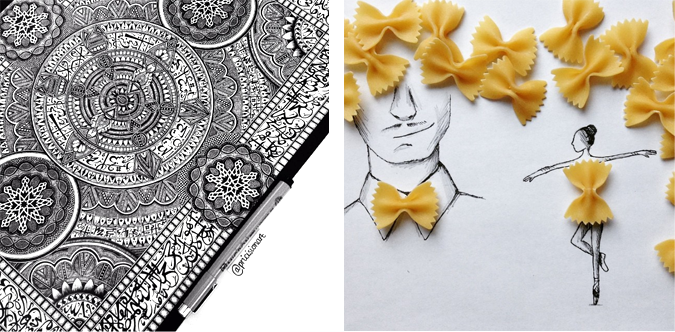
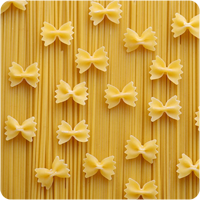
The medieval and renaissance painters they needed the patronage of someone rich and famous. This person (a royal or a noble) would pay them to produce commissioned artworks. So making a living from being an artist was not easy.

However, now in the 21st century, things are different. The cost of materials is much more affordable and it probably won’t be a king or queen who buys your work! In fact, if you have social media, you can easily show people your work.

In this next section we look at a teenage artist and look at the phenomena of the social media and the promotion of art.

This lesson contains 3 steps and an evaluation. Work them through step by step.

Step

Activity


Introduction

Find out what you already know.

Step 1

Writing

Answer the questions to two images.

Step 2

Reading

Read text A and do exercise A. OR: Read text B and do exercise B. Compare answers with a classmate.

Step 3

Task

'Discover' an artist on Instagram and write in 200 words a review.


Evaluation

Reflecting on what you have learned.


Difficult words? Search these on Cambridge Dictionaries


Step 1 - Writing

Writing
First look at these two images.


Read the questions and note down your answers.

  1. Which do you like best? Why?
  2. What medium (materials) did the artist use?
  3. How long did it take the artist?
  4. Have you seen art like this before?
  5. Which museum do you think would exhibit them: local/national/international?
  6. Are there any other places where you can see art like this?

Share your answers with your classmate.

Step 2 - Reading

Reading

Work together with your classmate.

  • One of you reads text A and does exercise A.
  • The other one reads text B and does exercise B.

Text A

Where You See A Fork Or A Pasta Noodle, This Teen Sees His Next Work Of Art

22/01/2015 8:40 AM AEDT | Updated January 23, 2015 03:59
By Amanda Scherker Associate Editor, Viral Content, The Huffington Post

Most people probably wouldn't see much creative potential in a comb, a gum wrapper or a pasta noodle. But Kristián Mensa sees his next work of art.
The 17-year-old's Instagram account, @mr. kriss, caught the eye of Elite Daily -- and it's not hard to see why. For starters, take a look at his iPhone, transformed into a pool. Born in the Czech Republic, Kristián now goes to school in Colorado. In an email to The Huffington Post, the teen said that he started drawing when he was seven, and he's had a unique perspective from the get-go: "I've always liked to make my own rules and I didn't like being told what I should or shouldn't draw."
Every day, he sits down with a blank sheet of paper and lets his imagination run wild. Next thing you know, he's turned a fork into a convincing prison cell. Kristián couples hand drawings with iPhone photography. He's most inspired by "little and often 'not interesting' things" and enjoys "giving those things new meaning." For example, take his whimsical use of bow-tie pasta noodles. Kristián's happiest when his drawings "make his friends smile." This dinosaur teapot probably does the trick.
Kristián's advice to aspiring artists is simple: "Turn off your phone on your way from work or school and look up!"
Source: http://www.huffingtonpost.com.au/


Exercise A: Fill in the table, belonging to text.

Name .....
Age .....
Nationality .....
Lives in .....
Started drawing aged .....
Inspired by .....
Advice to your artists .....
Ambition doesn't say


Text B

This Teen’s Incredibly Intricate Drawings Take Doodling To The Next Level
Kaylin Pound
in Envision
Mar 14, 2016 2:16pm

We’ve all seen spiral notebooks decked out in mindless drawings. But when it comes to doodling, 18-year-old Prianka Bassi takes drawing to a whole new level. Bassi creates all sorts of intricate artwork meticulously sketched with unbelievable amounts of detail. No really, these things are so complex, it must take her forever to complete them. She started drawing at the age of 8 or 9 but has been doing pen drawings in detail since she was 16. “My first post was of a small pattern I did when I was bored in class and so many people liked it and wanted to see more, so from then I posted more and more.” said Bassi.
Thanks to her incredible talent, Bassi acquired quite a fan base on social media, with thousands of followers on Twitter and Instagram.
Apparently, Bassi’s art teacher played a major role in helping her blossom into the budding artist she is now and even inspired her to follow her dreams and pursue a career in the arts.
Bassi continued, “She was the one who motivated me to continue with art regardless of the Indian stereotypes [that] only doctors or engineers are respected.”

Source: http://elitedaily.com/


Exercise B: Fill in the table, belonging to text.

Name .....
Age .....
Nationality .....
Lives in doesn't say
Started drawing aged .....
Inspired by .....
Advice to your artists doesn't say
Ambition .....


Then share the information with your classmate. And check the answers.

Answers

Step 3 - Task

Task
The two artists of text A and text B (Step 2) have both become Instagram famous. That means that because they have photographed their work and many people have liked it (each has a lot of followers) they have caught the eye of journalists.

Now, you are going to ‘discover’ an Instagram artist and write a review of his/her work.

  1. Find an artist whose work you like.
  2. Think what it is that you like about the art.
  3. Imagine that you are able to interview the artist. Write the questions that you would ask the artist.
  4. Your classmate will answer them (make sure that they look at your artist’s Instagram page!)
  5. Now write your answer to this question.

Your English teacher has asked you to write a review of an Instagram artist.
Write your review saying what you like about the artist and why.
Also write where you think the artist will be in 10 years’ time.

Write no more than 200 words.


Evaluation

Fill in this schedule and answer the questions below.
(Copy to Word or write down in your notebook)

Activity


Needs
Improvement

Satisfactory,
good

Excellent


Step 1 - Writing   

I can note down my point of view on questions about art.


Step 2 - Reading

I can read the text about art with a classmate and answer the questions.


Step 3 - Task

I can write a review of an Instagram artist


What have you learnt in this period?
Answer the following questions:

  • What was the most difficult part of this lesson?
    What was the most interesting part?
  • What did you already know?
  • What was new to you in this lesson?
  • What do you have to ask your teacher?

Finishing touch

Project A: Exhibition Review

Final project - your own exhibition
You are going to hold your own exhibition.

  1. First you need to decide on a maximum of five pieces of art to include in your exhibition. Every exhibition has a theme – so decide on the theme. It could be ‘nature’ or ‘new artists’ or ‘street art in my town’. You’ll have your own ideas.
  2. Then look for some art that could fit the theme. Look at the grand masters, but also search on Instagram, or local artists.
  3. Once you have chosen the theme and the five works, you now need to put them together and say why.
  4. Take a photo of the works and put them on a ppt.
  5. Prepare your talk for your class.
  6. Practice your presentation with your partner. Then give your talk to your class.
    Your talk should include a maximum of 5 slides, and should last no longer than three minutes.


Good

Sufficient

Insufficient

Organisation

Information is presented in a logical, attractive sequence.

Information is mostly presented in a logical, attractive sequence.

Information is not presented in a logical, attractive sequence.

Content

Interesting, clear information.

Information is mostly interesting. Some was already known.

There was not much that was of interest in this presentation.

Speaker style

Speaks clearly and at an understandable pace. Maintains eye contact with audience. Well-rehearsed.

Mostly speaks clearly and a good pace. Mostly keeps eye contact. Has rehearsed a bit.

Mostly unintelligible. Does not maintain eye contact. Has not rehearsed.

Language

The vocabulary use is very good and the sentence structure is good.

The vocabulary use is fairly good and the sentence structure is good.

The vocabulary use is not very good, neither is the sentence structure.

Project B: Viva la Vida

Song: Viva la Vida
Musicians are artists too, and they can be inspired by painters.
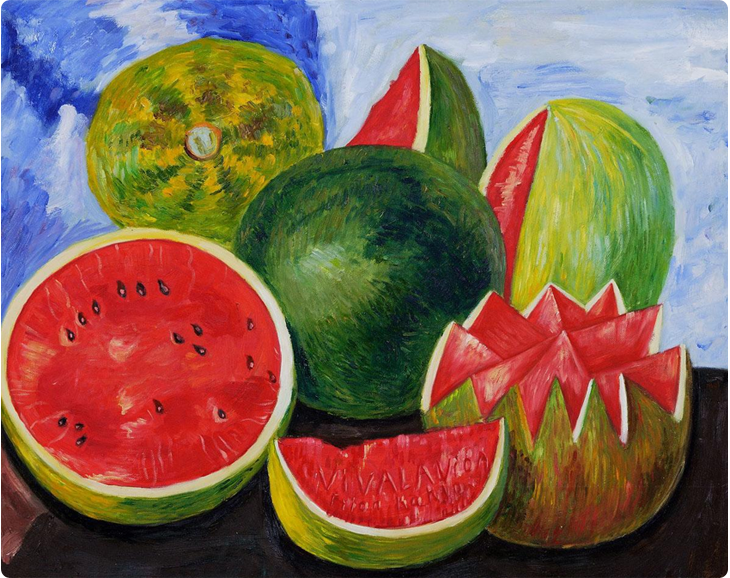
Mexican artist Frida Kahlo painted this picture.
It’s called "Sandías con leyenda: Viva la vida" (Watermelons with legend: the life lives).

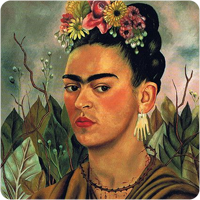
Frida Kahlo


Chris Martin of Coldplay christened his song and the album after this. He explained: 'She went through a lot...' and then she started a big painting in her house that said 'Viva la Vida'. I just loved the boldness of it. The movie 'Frida', starring Salma Hayek is about her life.

Listen to the song. Fill in the gaps.
Drag the answers on the right to the gaps in the song text.

Oefenprogramma Engels

Voice from Jamaica and the National Motor Museum

If your school participates in VO-content, you can practice with the English practice program 'Oefenprogramma Engels'.

Here you find a part of this program.
This section fits in well with this theme.
Sign in with your 'School Entree account'!

Read

Voice from Jamaica


and listen

The Classic British Car

On www.oefenprogrammaengels.nl you can of course also practice with other reading, listening or viewing assignments!

Examentraining

On this page you will find Examenkracht exam questions of previous years.
The questions will correspond as much as possible to the exercise you have just finished.

While answering, use as much of what you have learned earlier. If you cannot answer the question right now, try again later. When you have answered a question, you can check and indicate the score yourself.

If you want your results to be saved, you will have to log in on ExamenKracht.

VWO 2021-TV2

VWO 2021-TV2 Vragen 30-33
VWO 2021-TV2 Vragen 34-37

VWO 2016-TV1

VWO 2016-TV1 Vraag 3
VWO 2016-TV1 Vraag 5


More practice?
Go to Examenkracht where you will find the newest exams.

What did you learn?

Can do statements

Take a look at the Can do statements also mentioned in the introduction - 'Can do'.
Are you able to do what you have to do?
Did you understand and meet these learning goals? Fill in the schedule below.
(Copy the schedule to Word or write down in your notebook.)

Can do statements

Needs improvement

Satisfactory, good

Excellent

Listening (B1-B2):


I can follow the main points of a song and can fill in the gaps in a song text.


I can understand and catch the main points in a short interview between teens or with an artist about art.


I can understand a video about a (visit to) the National Motor museum and answer questions.


Reading (B2)


I can rapidly grasp the content and the significance of an article of Banksy.


I can read and understand an article about art in which the writers express specific attitudes and points of view.


I can understand in detail texts about a museum and I can place missed sentences in the text.


I can understand in detail a text about an artist and answer questions about the text.


I can read an article about Teen art work and grasp the most important points.


Speaking (B1-B2)


I can take an active part in a face to face conversation on art and museums.


I can give or seek personal views and opinions in an informal discussion about Banksy. I can maintain the conversation and discussion.


I can give a presentation for my class about my own art exhibition. I can speak clearly at an understandable pace.


Writing (B1-B2)


I can write down the answers to questions about art and I can express personal views and opinions.


I can write a review of the work of an Instagram artist. I can express my personal opinion.


I can write a formal email to a museum to ask permission to sketch at the museum (V&A).


I can describe in an entry my favourite museum.


I can write a discursive essay about Graffiti. I can express my personal point of view and can give reasons in support my point of view; vandalism or pure art?


In a formal email I can convey information about a piece of artwork I would like to order and I can ask for more specific information.

     
  • Het arrangement Art v456 is gemaakt met Wikiwijs van Kennisnet. Wikiwijs is hét onderwijsplatform waar je leermiddelen zoekt, maakt en deelt.

    Auteur
    VO-content
    Laatst gewijzigd
    2025-11-28 11:56:41
    Licentie

    Dit lesmateriaal is gepubliceerd onder de Creative Commons Naamsvermelding-GelijkDelen 4.0 Internationale licentie. Dit houdt in dat je onder de voorwaarde van naamsvermelding en publicatie onder dezelfde licentie vrij bent om:

    • het werk te delen - te kopiëren, te verspreiden en door te geven via elk medium of bestandsformaat
    • het werk te bewerken - te remixen, te veranderen en afgeleide werken te maken
    • voor alle doeleinden, inclusief commerciële doeleinden.

    Meer informatie over de CC Naamsvermelding-GelijkDelen 4.0 Internationale licentie.

    Het thema 'Art' is ontwikkeld door auteurs en medewerkers van StudioVO.

    Fair Use
    In de Stercollecties van StudioVO wordt gebruik gemaakt van beeld- en filmmateriaal dat beschikbaar is op internet. Bij het gebruik zijn we uitgegaan van fair use.
    Meer informatie: Fair use

    Mocht u vragen/opmerkingen hebben, neem dan contact op via de
    helpdesk VO-content.

    Aanvullende informatie over dit lesmateriaal

    Van dit lesmateriaal is de volgende aanvullende informatie beschikbaar:

    Toelichting
    Dit thema valt onder de arrangeerbare leerlijn van de Stercollectie voor Engels voor vwo, leerjaar 4, 5 en 6. Dit is thema Art. Dit thema omvat de volgende onderwerpen: - The world's finest museums - Sketching in a museum - Street Art - Minute Art - Teen artist De grammaticaopdrachten behandelen must/have to, future going to and will en possessive adjectives.
    Leerniveau
    VWO 6; VWO 4; VWO 5;
    Leerinhoud en doelen
    Engels;
    Eindgebruiker
    leerling/student
    Moeilijkheidsgraad
    gemiddeld
    Studiebelasting
    18 uur 0 minuten
    Trefwoorden
    arrangeerbaar, art, engels, minute art, sketching in a museum, stercollectie, street art, teen artist, the world's finest museums, v456

    Gebruikte Wikiwijs Arrangementen

    VO-content Engels. (2025).

    Art h45

    https://maken.wikiwijs.nl/98846/Art_h45

    VO-content Engels. (2021).

    Minute Art v456

    https://maken.wikiwijs.nl/172780/Minute_Art_v456

    VO-content Engels. (2021).

    Sketching in a museum v456

    https://maken.wikiwijs.nl/172777/Sketching_in_a_museum_v456

    VO-content Engels. (2021).

    Street Art v456

    https://maken.wikiwijs.nl/172781/Street_Art_v456

    VO-content Engels. (2021).

    Teen artists v456

    https://maken.wikiwijs.nl/172778/Teen_artists_v456

    VO-content Engels. (2021).

    The world's finest museums v456

    https://maken.wikiwijs.nl/172779/The_world_s_finest_museums_v456

  • Downloaden

    Het volledige arrangement is in de onderstaande formaten te downloaden.

    Metadata

    LTI

    Leeromgevingen die gebruik maken van LTI kunnen Wikiwijs arrangementen en toetsen afspelen en resultaten terugkoppelen. Hiervoor moet de leeromgeving wel bij Wikiwijs aangemeld zijn. Wil je gebruik maken van de LTI koppeling? Meld je aan via info@wikiwijs.nl met het verzoek om een LTI koppeling aan te gaan.

    Maak je al gebruik van LTI? Gebruik dan de onderstaande Launch URL’s.

    Arrangement

    IMSCC package

    Wil je de Launch URL’s niet los kopiëren, maar in één keer downloaden? Download dan de IMSCC package.

    Voor developers

    Wikiwijs lesmateriaal kan worden gebruikt in een externe leeromgeving. Er kunnen koppelingen worden gemaakt en het lesmateriaal kan op verschillende manieren worden geëxporteerd. Meer informatie hierover kun je vinden op onze Developers Wiki.