
Money v456

Money v456

Money

Intro

Money
In this theme you will focus on money.

What are you going to do?

You are going to read and speak about charity. You will read about credit cards. You will read about and discuss gambling.
You will also read a text about how money can buy happiness.
In the final project you will learn about advertising and some advertising tricks to encourage you to buy things. You will then make a commercial and see how successfully you use these techniques to get your classmates to ‘buy’ your product!

What about you?
When you think about your future, do you think about money?
Do you enjoy reading about rags to riches tales?
Do you read stories about rich people?
Do you know how to look after your own money and to spend wisely?
Do you do things to help people who don’t have much money?
Some people say that you can buy happiness. What do you think?

These are some of the issues that we are going to explore in this theme.

Have fun!

Need to know

What do you need to know?
At the end of this theme, you should be able to talk about this subject with ease.
But you don't have to be able to do all this perfectly right away! If you take the following lessons you'll find out what you need to know!

Give it a try!
Read the questions.

  • Select two questions you think are interesting.
  • Discuss with a classmate.
  • Discuss your two questions with your classmate.
  • Answer, as good as you can, your classmate's questions.
Choose from the following questions.
  • Are you good at saving money? Explain why / why not?
  • Do you ever give money to charity? Why / why not? How often?
  • Do you ever buy second-hand things (used things)? Why / why not?
  • How much do you usually spend each month on food?
  • If someone gave you a million dollars, what would you do with it?
  • What is the most expensive thing you've ever bought? How much did it cost?
  • Should children get an allowance (pocket money) from their parents? How much?
  • If you had to save money, what could you do without? I would stop spending money on.......
  • If you needed to earn some extra money, how would you do that?
  • When you buy something, what things are most important to you? Price? Quality? Fashion trends? Status? Image?


Can do

In this theme you will focus on the following 'can do' statements.

Listening (B1-B2):

  • I can follow the main points in a podcast about Money.
  • I can listen to songs about Money and fill in the gaps in the song texts.
  • I can listen to songs and understand what they are singing.
  • I can catch the main points in a short video about chasing money.

Reading (B2)

  • I can rapidly grasp the content and the significance of a report about charity money.
  • I can read and understand  an article in which the writers express specific advices and points of view about creditcards.
  • I can understand in detail texts within my field of interest (outside my own field if I can check with a dictionary).
  • I can read an article about money can buy happiness, summarize the main points. I can deal with the content and discuss the findings and your own experiences with a classmate.

Speaking (B1-B2)

  • I can start, maintain and close simple face to face conversation on charity.
  • I can maintain a conversation and discussion about gambling.
    I can interact with a degree of fluency and spontaneity.
  • I can give or seek personal views and opinions in a debate with classmates.
  • I can give detailed accounts of experiences and describing feelings about receiving presents.
    I can present clear, detailed descriptions
  • I can explain and give reasons for my choices about experience presents.


Writing (B1-B2)

  • I can write a simple text about charity.
  • I can write an informal email to a friend giving him tips how to save money.
  • I can write an advertisements or commercial about a product.
  • I can write my own short term budget.
  • I can write a farewell speech for a friend.


To do

The theme Money contains an introduction, four lessons and a finishing touch.
In the schedule below, you can see the titles of the sections and an estimate of the time required for each part.

Lesson

Title

Activities

Time (hours)*

Introduction


0,5 hour

Lesson 1

Charity begins at home

Read and speak about charity.

Write about which charity you will donate money.

Grammar: Relative clauses

3-4 hours

Lesson 2

Life on the never-never

Read about creditcards and getting a loan.

Write an email about saving money.

Grammar: Passive

3-4 hours

Lesson 3

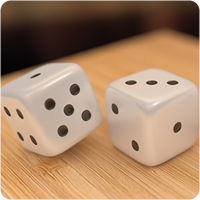
Throw the dice

Read and speak about gambling.

Hold a class debate about gambling.

Grammar: Enough/too

2-3 hours

Lesson 4

Money = happiness

Read about how money can buy happiness.

Discuss about presents.

Grammar: 2nd conditional

2-3 hours

Finishing touch

Projects


Oefenprogramma


Examentraining


Evaluation

You are going to find out more about advertising and how quickly you and your classmates spend money because of an ad you’ve seen.


You are going to practise with the 'Oefenprogramma Engels'


You are going to prepare for exams: practise taking past versions.


You will answer evaluation questions, what did you learn?

3 hours


Total


18 hours


*hour = lesuur. Eén lesuur komt ongeveer overeen met 2 SLU.

Lessons

Charity begins at home

Charity begins at home

Introduction

The subject of this lesson is 'Charity begins at home'.

You’re going to look at charities.

  • Do you know what happens to your euros when you give to charity?​
  • Do you give to charity?
  • Why do you think that some charities receive more money than others?

Let’s find out.

This lesson contains 6 steps and an evaluation. Work them through step by step.

Step

Activity


Introduction

Find out what you already know.

Step 1

Reading

Read about 3 teenagers and answer questions.

Step 2

Speaking

Answer and discuss questions about charity with a classmate.

Step 3

Reading

Read the first part of a text about charity. Answer questions with true or false.

Step 4

Reading

Read the second part of a text about charity. Answer questions.
Find out in small groups information about charity funds.

Step 5

Grammar

Relative clauses. Study Grammar Desk. Complete the rules and do exercises about who/which/that/where or whose and sentences halves. Exercise about non-defining and defining. Exercise: add commas in sentences.

Step 6

Task

Unjumble words exercise.


Evaluation

Write in 150 words to which charity you will donate money.


Difficult words? Search these on Cambridge Dictionaries


Step 1 - Reading

Reading (and speaking)
Read about these 3 teenagers: Shaun, Alex and Tim.

SHAUN:
I was walking along the street in my town the other week and I heard this guy
playing some music.
It was really good.

As I got closer, I could see he had a sign next to his guitar case.
I think it said ‘All money goes to cancer research’.
I thought that was pretty cool and so I dropped a €10 note in the case.
He played really well!


ALEX:
I’m not sure when I last gave money to a charity.
I think there was a box in a shop once, it was in the shape of a dog – that’s right!

It was for Guide Dogs. That’s a really good charity.
It’s for people who are blind but they can get a dog that will see for them.

I don’t remember how much I gave – but not much. Maybe €1.
But I want to do more for charity.


TIM:
I actually do quite a lot for charity. I really like doing charity runs.

I did one in my home town last week and then I’m going to do one next week in another town.
It’s a great way to raise money and to do something.

I think it’s easy for people to just give money, but if you actually do something then it means more.
I usually raise money for older people. It’s because my grandma is in a home and she couldn’t afford it.

I think it makes sense to raise money for a charity that is helping someone in your family or friend circle.


Do the exercise.

Step 2 - Speaking

Speaking
Read these questions about charity.
Choose a classmate and answer the questions together.

  1. Name five charities and what they do.
  2. When was the last time you gave money to a charity?
  3. How much did you give? (approx.)
  4. Have you ever raised money for a charity by doing something?
    If not, what could you do? If yes, what did you do?


Look at these rubrics. How did it go?
How do you assess your speaking skills? What about your classmate?


Good

Sufficient

Insufficient

Speaker style

Speaks clearly and at an understandable pace.

Mostly speaks clearly and a good pace.

Mostly unintelligible.

Language

The vocabulary use is very good and the sentence structure is good.

The vocabulary use is fairly good and the sentence structure is good.

The vocabulary use is not very good, neither is the sentence structure.

Step 3a - Reading part 1

Introduction
You’re going to read a report about charity money.

First read the text quickly. Which of the following topics is mentioned?

Vocabulary

You are going to read a challenging text.
To help you, first learn this vocabulary list in StudioWozzol:
(Click in StudioWozzol on the red arrow for the options (e.g. read the words aloud, copy the whole list, learn by writing...)

Vocabulary Money - Charity


Now you’re going to read the text and do the exercise: decide if the statements are true or false.
Read the text.

One in five of Britain’s biggest charities spend less than 50 per cent of total income on good works, new report claims.

By Christopher Hope


Some of the UK’s biggest and best known charities are spending less than half of their total income every year on good works, a new research has found. The report from the True and Fair Foundation found that one in five of the country’s biggest charities spend less than 50 per cent of their total income on charitable activities. Some of the charities are some of Britain’s best known voluntary organisations such as Cancer Research UK, the Guide Dogs for the Blind and the British Heart Foundation.

Rob Wilson, the charities minister, said charities had to “reassure people and make very clear that the money donated to them will be spent on frontline charitable activities”. 'It's important for charities to be as transparent and accountable as possible - so people can make an informed decision about where their money goes.' He told The Telegraph that they had a duty to “eke out every last penny for good causes”. He said: "Giving to charity is one of the greatest expressions of generosity a person can make and it must not be taken for granted.

The foundation analysed the latest official annual report and accounts of the 5,543 charities. Its report - "A Hornets' Nest" published today - found that 1,020 charities were spending less than 50 per cent of their total income on charitable activities. Spending on “charitable activities” is defined in accounting rules as “all costs incurred by a charity in undertaking activities that further its charitable aims for the benefit of its beneficiaries”. The British Heart Foundation spent an average of just 46 per cent of its income on charitable activities over the past three years. Sue Ryder, which runs a network of second hand shops, spent 46 per cent of its annual income on charitable works over the three years. The Royal Horticultural Society spent 60 per cent of its income on charitable activities over the same period. Many of the charities also receive millions of pounds of public money on top of the cash they raise from individual donors.

Source: Telegraph.co.uk


Do the exercise.

Step 3b - Writing

Writing
In the previous step (step 3a) you have read the first part of a report about charity money with the title:
"One in five of Britain’s biggest charities spend less than 50 per cent of total income on good works, new report claims".


Some people think that people who work for charities receive very high salaries.
People frequently cite high salaries as one of the main reasons for not giving to charities.

What do you think?
Why do you think that people think this?
Write no more than 150 words giving your reasons.


Step 4 - Reading part 2

You’re going to read the second part of a report about charity money.
Read part 2 and choose the correct answers to the questions.

by Christopher Hope

Many of the charities disputed the figures. Cancer Research said it had spent 80 per cent of its income on charity if the cost of running its shops was excluded. A spokesman for Sue Ryder said the research was “misleading in light of the size of our retail chain and the costs at Sue Ryder compare favourably to many other organisations”. She added: “These calculations do not take into consideration the additional benefits that our shops bring to the local community.” Martin Miles, Chief Financial Officer at the British Heart Foundation, said the report did not allow “for the very different financial profile of running the UK’s largest network of charity shops”, adding that 78 per cent of its income was spent on life saving research and improving the lives of heart patients. He said: “We are committed to spending every penny that is donated in a way that will offer the greatest benefit to heart patients and over the last 50 years people’s donations have funded research that has helped to halve death rates for cardiovascular disease in the UK.”
Sir Stephen Bubb, chief executive of the Association of Chief Executives of Voluntary Organisations, said: "This is a flawed and simplistic analysis which arbitrarily defines ‘charitable activity’ to exclude campaigning.
"Yet campaigning is the lifeblood of the great British charitable tradition. We work to alleviate the symptoms of disease and poverty and to tackle the causes of such. Donors give money for both.”
A Charity Commission spokesman said: “Donors need to see how charities spend their money.
That’s why charity accounts are public documents. "This report has not, however, considered basic information in the charities’ accounts, which has led to this flawed analysis. "The Commission has looked at the accounts of the charities named and we would recommend anyone interested in charity finances does the same.”

Source: Telegraph.co.uk


Do the exercises.

In small groups, find out about one of the following charities.
Choose one. Share your information with the class.


Find out the following information about the 'your' charity:

  1. What do they do?
  2. Where are their main offices?
  3. When is their next big charity event?
  4. Do they comment on The Hornet’s Nest report? What do they say?
    (Briefly summarize).
  5. Share three interesting facts about the charity with your class.

Step 5a - Grammar

Let's look at relative clauses.

Relative clauses


Read the sentences.

  1. We use who when we are talking about people.
  2. We use which or that when we are talking about places or people.
  3. We use whose when we are giving more information about people or places.
  4. We use where when we are talking about places.


Now do the exercises.

Step 5b - Grammar 2

Commas!

Let's look at relative clauses page 3 about non-defining and defining clauses.

Relative clauses

In the next sentences tick in commas in the right column if necessary.
Copy this schedule and write down your answers.

Sentences

Add commas if necessary

The actor is now playing a man whose wife died in childbirth.


My eldest daughter whose boyfriend works for a clothing company is on holiday in Japan at the moment.


The shirt which is a beautiful colour only cost me €15.


They’re the new students who are joining our class next week.


The book which was written by M. Santos was first published in 1821.


She gave me my essay which had been corrected.


My grandmother who is 91 walks her dog every day.


You can borrow the pen that has my name on it.


Step 6 - Task

Task: Writing

“Giving to charity is one of the greatest expressions of charity a person can make and it must not be taken for granted.”


Imagine that you have just received €500. You decide to donate it to a charity.

Which charity would you choose, and why?
Write about 200 words stating your reasons.

Evaluation

Fill in the schedule and answer the questions below.


Activity

Needs improvement

​Satisfactory, good

Excellent

Step 1 - Reading

I can read opinions of teenagers about charity.


Step 2 - Speaking

I can speak with a class mate about charity.


Step 3a - Reading

I can read a report about charity and answer questions.


Step 3b-Writing

I can write down my opinion about what part of the income of charities goes on good works.


Step 4 - Reading

I can read texts about charity and search for relevant information. I can share this information about a charity foundation with the class.


Step 5 - Grammar

I can understand and use the grammar 'relative clauses'.


Step 6 - Task

I can write 200 words to state which charity I would choose to donate to.


What have you learned in this lesson?
Answer the following questions:

  • What was the easiest part of this lesson?
  • What was the most interesting part?
  • What was the most difficult part?
  • What was new to you in this lesson?
  • What do you have to ask your teacher?

Life on the never-never

Life on the never-never

Introduction

The subject of this lesson is 'Life on the never-never'.

Buying something on the never-never is a British expression.  
It means that you buy something with a loan, because you don't have the money to pay for it. 'Borrowing money'.

Obviously a loan has to be paid back with interest.
Thus you will pay more than if you had bought the item with your own savings.  


This lesson contains 6 steps and an evaluation.
Work them through step by step.

Step

Activity


Introduction

Find out what you already know.

Step 1

Words

Match the words with their definition.

Step 2

Reading

Read an article about credit cards. Tick the topics.
Fill in the correct paragraph title and answer questions with a classmate.

Step 3

Grammar

Study Grammar Desk about Passive. Complete the rule. Do the exercises.

Step 4

Words - Idioms

Check meaning of idioms. Fill in correct answer to the questions.

Step 5

Song

Listen to a song about Money. Fill in the gaps in the lyrics.

Step 6

Task

Email an Australian friend how to save money.


Evaluation

Reflecting on what you have learned.


Difficult words? Search these on Cambridge Dictionaries


Step 1 - Words

Words
Do the exercise.

Step 2 - Reading

Reading
You’re going to read an article that gives some advice about credit cards.
Then you do exercise 1, 2 and 3.

First, look at these topics. Which do you think will be mentioned?

  • Talking to the bank manager
  • Paying bills on time
  • How to avoid paying more money
  • How to increase your credit
  • Avoiding buying things you cannot afford
  • Live only on cash

Now read the article quickly and fill in the topics in exercise 1.

Survival Tips for your first credit card by Maryam Khan

A. [...............]
Each of your credit card transactions is tracked. A statement is a breakdown of your transactions for the month. It is important to note that your statement period does not necessarily begin at the start of each month. If you are unsure of when it starts and ends, talk to your credit card company. At the end of the period, you will be given a summary of your spending in the form of a paper or online statement along with your balance owing and payment due date. Read your statement carefully! Look at what you have been using your credit card for and determine whether those purchases were, in fact, necessary. When debt is a cloud overhead you should be putting on a pair of rain boots, not a new pair of heels.

B. [...............]
It may be appealing to pay that minimum payment of $10 rather than the $100 you put on your card last month, but failing to pay the full balance on your credit card will only set you back further. For example, if you were to only make the $10 minimum payment then it would take you 10 months to pay off $100 at which point you will have likely added on another few hundred dollars in purchases. Most credit cards also have a monthly interest rate. Paying your credit card balance on time and in full will help you avoid any additional interest charges. Keep in mind, however, it is always better to pay back something than nothing.

C. [...............]
Companies love tacking on additional fees to customer accounts and banks are no different. It may seem convenient to withdraw money from the ATM with your credit card, but unlike your debit card the charges for cash advances on your credit card can be substantial. Once additional charges are accounted for that single withdrawal will have left a bigger hole in your wallet than you had intended.

D. [...............]
Now, you may be thinking: “If I had money why would I need a credit card?” But just as you should not be spending money on things you do not need, you most definitely should not be spending money that you do not have. Exceeding your credit card limit will not only put you in the red but will result in additional fees. Treat your credit card as you would your debit card, which is hopefully by spending only the amount that you have available in your account. If you have $200 in your account, and you need to spend $50 on gas, then use your credit card to pay for gas, and immediately transfer $50 from your account. This way you are effectively using your credit card, improving your credit, and staying within your limit.

E. [...............]
Until your credit card situation is under control keep to a cash-only diet. Set yourself a budget per month for all your expenses and the purchases you expect to make. It will be easier to save than spend when you have to hand over physical cash instead of swiping your card.

Prior to solving any problem you have to understand it. By gaining a better understanding of your financial situation and the role your credit card plays you can find a balance between spending and saving. Follow the above tips and you will gradually build your credit while avoiding the pitfalls of credit card debt that so many of your classmates will experience this school year.


Do the exercises.

Do exercise 2. Choose the correct paragraph titles.

Exercise 3

Answer the following questions with your classmate.

  1. Do you agree with every point that the author makes? Why /why not?
  2. Do you have a ‘good understanding’ of your financial situation?
  3. Do you have an after school job? If so, what do you do with the money you earn?
    If not, do your parents give you pocket money, or do they buy you what you want? Explain what your situation is, and any reasons for it.
  4. Do you plan to get a credit card in the future? Do you think it’s a good idea? In what situations would you use it? In what situations would you not use it? Say why.

Step 3a - Grammar

Grammar
Now we are going to work out the passive. Look at these sentences.

  1. The bank tracks each of your credit card transactions.
  2. Each of your credit card transactions is tracked.

In sentence 1 we know who the subject is.
In sentence 2 the most important thing is the action who did it.

Study the Grammar Desk about the passive.

Passive voice


Do the following exercises about the passive.

Step 3b - Grammar

Grammar: Future
Let’s look at the future: will versus going to.

In the next exercise read the sentence and complete with the correct form of the verb in brackets.

We use the future tense for different meanings.
Now match the meanings of the sentences of the previous exercise.

For more explanation see Grammar Desk about future tenses.

Step 4 - Words Idioms

Word Idioms
There are lots of idioms in English.
Here are some that are connected to money.

You can use a dictionary to check the meaning of the idiom:

Cambridge Dictionaries


Do the exercise.

Watch the video about money.

Do the exercise.

Step 5 - Song

Song
Listen to the song 'Money, money, money' from ABBA.

Do the exercise.

Do you agree with the singers? Would life be better in a ‘rich man’s world’?
Give your reasons.

Step 6 - Task

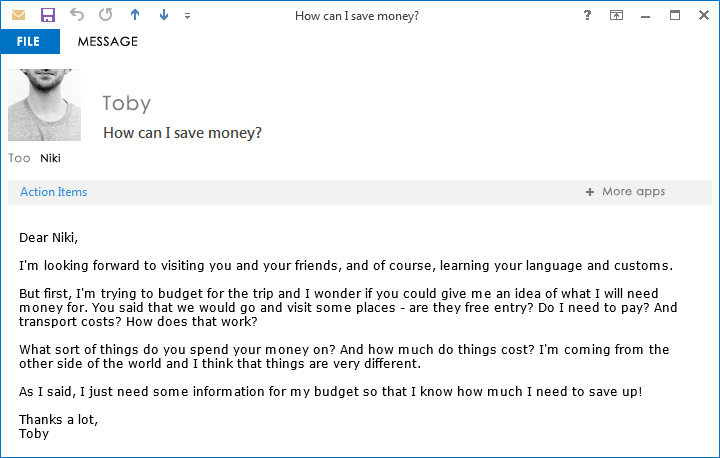
Task - Write an informal email

Your Australian friend, Toby, is going to visit your school.
You receive this email from him.

Write a reply to Toby in 180-220 words.
Answering his questions and giving tips how he can save money.
And then, probably he can stay a little bit longer!


Evaluation

Fill in the schedule and answer the questions below.


Activity

Needs improvement

​Satisfactory, good

Excellent

Step 1 - Words

I can understand and use the words.


Step 2 - Reading

I can read an article that gives advice about credit cards.


Step 3 - Grammar

I can understand and use the grammar: Passive voice


Step 4-Words

I can understand and use the words.


Step 5 - Song

I can listen to a song and fill in the gaps in the song text.


Step 6 - Task

I can write an informal email to a friend.


What have you learned in this lesson?
Answer the following questions:

  • What was the easiest part of this lesson?
  • What was the most interesting part?
  • What was the most difficult part?
  • What was new to you in this lesson?
  • What do you have to ask your teacher?

Throw the dice

Throw the dice

Introduction

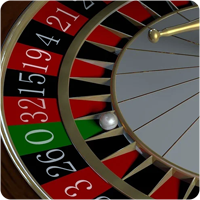
The subject of this lesson is 'Gambling'.

In this section we’re going to look at teen gambling.
Gambling is taking part in an activity that involves the risk of losing money or a valuable object (like your Iphone/a video game etc.) But it can also involve winning money. Gambling is a game of chance, although there are some games that require skills. Gambling can be with slot machines, lotteries, bingo, card games, pool, darts, horse racing etc.
Most card games Aren't only about chance. A card game requires the skill of knowing what to do if you have been dealt a poor hand. However, having the skill is not a guarantee that you will win.

Gambling seems harmless, but is it? It certainly isn't! For some people, it can become a serious addiction, just like drugs, tobacco or alcohol.

This lesson contains 4 steps and an evaluation. Work them through step by step.

Step

Activity


Introduction

Find out what you already know.

Step 1

Speaking

Read questions about gambling.
Discuss answers with a classmate.

Step 2

Grammar

About enough/too. Underline sentences and choose in exercise between enough and too.

Step 3

Watching

Watch a video and fill in the gaps.

Step 4

Grammar

Too / Enough

Step 5

Task

Hold a class debate (in groups of 3 pupils).
Think of ideas, organize your ideas and structure your speech.


Evaluation

Reflecting on what you have learned.


Difficult words? Search these on Cambridge Dictionaries

Step 1 - Speaking

Read the questions about gambling.
Think about your answers (make notes).
Then compare your answers with a classmate and discuss about the differences (about 10 minutes).

  1. How many different forms of gambling can you think of?
  2. Do you like gambling?
  3. Why do you think so many people like gambling?
  4. Besides the financial problems, what other problems could gamblers have?What question would you like to ask to a gambling addict?
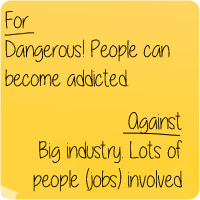
  5. Do you think gambling should be banned? Why? Why not?​

Important for a good discussion

Content

Provide relevant ideas about gambling. Show understanding of the subject. Make useful comments.

Fluency

Speak loudly, clearly and use correct grammar. Speak confidently (but don't care about a hesitation).

Listen

Pay attention to the other speaker (your classmate). Listen carefully and respectfully (sitting up, making eye contact).


Step 2 - Reading

Read the article quickly (scanning). What is the main purpose of the article? Choose.

Vocabulary

Now you are going to read the text in detail.
To help you, first learn this StudioWozzol vocabulary list:
(Click in StudioWozzol on the red arrow for the options (e.g. read the words aloud, copy the whole list, learn by writing...)

Vocabulary Money - Throw the dice


Read the article and answer the questions.

Teen Gambling: Nothing (Left) To Lose
By the time he was 16, Josh found that gambling had become much more than a game. He had lost way more money than he could afford, and was often skipping school to gamble online. His friends stopped calling and his already tense relationships with his family got even worse. Similarly, David, 17, used to go to the casino to make life seem more exciting. “I went when I didn’t feel like going to class, when I didn’t want to be at home,” he explains. “I went when I had a lot of work to do because for the time I was sitting at the table I forgot about my work.” He began stealing money from his dad’s company, and began smoking more and more pot to “help take the edge off of my problems”. Like Josh, David began to find himself drawn more to the card tables than his friends. “I don’t like going there with people anymore. I just want to be alone and be able to do my thing.”

While most teens experiment with gambling at some point (i.e., lottery tickets, sports betting, poker games or internet gambling), between 4 and 10% will develop gambling problems. Some of these teens will become seriously addicted, losing too much money, pushing away their friends and family, and failing at school. This puts them at greater risk for serious drug and alcohol problems, as well as suicide. “Most teens who gamble lose nothing more than money,” explains Dr. Rina Gupta, psychologist and co-director of the Youth Gambling Centre at McGill University. “However, some lose control of their lives before they ever even realize it. This tends to happen when they see gambling as a way of escaping bad feelings or responsibilities. It can easily go downhill from there, causing serious problems in most aspects of their lives.” Teens worried about their own gambling, or concerned about a friend who gambles, now have a new place to seek advice and help. An anonymous and confidential online chat service every night from 8 p.m. to midnight (EST) offers teens a chance to speak with a counsellor who can answer questions, offer some direction, and direct them to the help they need to get their lives back.

www.stopthechase.ca is a project organized by the Ontario government’s, where teens can either call, email or live chat to specially trained counsellors about their concerns, and gain useful information. No names are necessary, so users can chat freely. There doesn’t have to be any commitment to return, and they are sure to fall upon a friendly ear to listen and offer some help. “This is a way to support teens struggling with gambling issues,” says Dr. Gupta. “We know teens feel comfortable in front of their computers and love to chat. The site allows for both one-on-one chats with a counsellor and group chats with other teens with similar questions and concerns.” The service offers access to counsellors with years of experience in the gambling field. They answer questions honestly, and without judgment, and can refer anyone who asks for more help to a referral service in their area. This is precisely the kind of intervention that would have benefited Josh. By the time he was 18, he had hit rock bottom. “My future didn’t look very good,” he admits. “I was severely depressed, anxious and overweight, I wanted to disappear.” When he made the decision to seek help, everything changed. “I feel like I am relearning how to live,” he explains, relieved that the lies and unhappiness are now part of his past. “In the past two years I have seen and experienced first-hand an incredible amount of heartache. I hope to never witness such avoidable pain again.” Now Josh hopes his story can be a source of hope for other kids who find themselves in a similar situation with problem gambling. “I understand how bad life can seem. I’ve been there, believe me,” he says. “You are not alone. Get the help you need, be true to yourself and start your own journey.” Fortunately, Josh reached out for help. It hasn’t been easy for him to get back on track, but he did it.

If you can relate to any of the teens described here, or if you know someone who is gambling a little too much, check out www.stopthechase.ca. You have nothing to lose!

Source: Teen gambling nothing left lose


Step 3 - Watching

Watch the video Stop the chase.

Do the exercise while you watch.

Step 4 - Grammar

Let's look at: too / enough.

  • Some of these teens will become seriously addicted, losing too much money, pushing away their friends and family, and failing at school.
  • I'm not old enough.

Too ➨ more than what is needed
Enough ➨ sufficient


Read these sentences.

  • Mike isn’t old enough to swim alone.
  • I can’t run fast enough to get that bus.
  • Jo hasn’t got enough money to eat out.
  • It’s too hot today!
  • You’re walking too slowly – hurry up!
  • I’ve got too much homework.


Use:

  • enough: after adverbs/ adjective and before nouns.
  • too: before adverbs/adjectives and before nouns in phrases too much / too many

Now do the exercise.

Step 5 - Task

You are going to hold a class debate. The motion is:
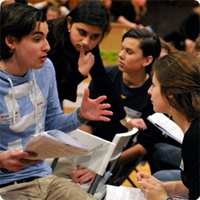

All forms of gambling should be banned!

Your teacher will tell you if you are going to support or be against the motion.
You will be working in groups of three pupils.

1. Ideas
Think of some ideas individually.
Write down some key words for your argument.
Now share your ideas in your group.

2. Organise your ideas

In your groups, put your ideas in a logical order.

  • Try to identify about six to seven arguments.
  • Put similar ones together to make a bigger argument.
  • Then give each main argument a heading.
  • ​You need at least three main arguments (three people in your group – three speakers).

3. Structure your speech

Introduction

You introduce the topic, and you outline what you are going to say.

Speaker 1

First state the title that you've given to your argument, then describe what you exactly mean, and give evidence for your argument. 

Speaker 2

First state the title that you've given to your argument, then describe what you exactly mean, and give evidence for your argument. 

Speaker 3

First state the title that you've given to your argument, then describe what you exactly mean, and give evidence for your argument. 

Speaker 1

Repeat the three argument headings and ask people to vote for you.


Take a look at the 'Gereedschapskist activerende werkvormen Debateren; tips how to hold a good debate:

Debat voeren

Bij een debat hebben twee of meer mensen een verschillende mening over een onderwerp. Deze standpunten worden helder in beeld gebracht door argumenten voor het eigen standpunt te geven, of door de argumenten van de ander met tegenargumenten te bestrijden.


Evaluation

Fill in the schedule and answer the questions below.


Activity

Needs improvement

​Satisfactory, good

Excellent

Step 1 - Speaking

I can speak about famous buildings.


Step 2 - Reading

I can read a text about Teen Gambling in detail and answer questions.


Step 3 - Watching

I can watch and understand the video about 'The Chase'.


Step 4 - Grammar

I can use and understand the grammar: too/enough.


Step 5 - Task

I can hold a class debate.


What have you learned in this lesson?
Answer the following questions:

  • What was the easiest part of this lesson?
  • What was the most interesting part?
  • What was the most difficult part?
  • What was new to you in this lesson?
  • What do you have to ask your teacher?

Money = happiness

Money = happiness

Introduction

The title of this lesson is 'Money = happiness'.

Do you think that you would be happy if you had a lot of money?
And when I say 'a lot', I mean, a lot! Imagine you could buy anything you wanted, do anything you wanted, go anywhere you wanted to go.

You wouldn’t think ‘Oh, wait, I can’t afford it!’ You would be able to afford anything!!
But would all that cash make your life easier? Read on!

This lesson contains 5 steps and an evaluation.
Work them through step by step.

Step

Activity


Introduction

Find out what you already know.

Step 1

Speaking

Questions about giving and receiving presents.
Compare and discuss with classmates.

Step 2

Reading

A text about how money can buy happiness.
Match the study to the findings. Answer the questions.
Answer more questions together with a classmate and discuss.

Step 3

Grammar

About the 2nd conditional. Complete the rule.
Complete sentences in exercise.

Step 4

Song

Listen to 'Money' from Pink Floyd. Name aspects of wealth.
Put the song lines in order. Give your reasons to the statement.

Step 5

Task

Look at the schedule of 'experience' presents.
Discuss advantages and disadvantages.
Choose in pairs the best present. Make a farewell speech.


Evaluation

Reflecting on what you have learned.


Step 1 - Speaking

You are going to talk about a present in the context of money = happiness. Work together with a classmate.

  • Think of five questions in the context of money = happiness.
  • Write down your questions.
  • Then ask your questions.

When you have answered all the questions, change roles.

Compare and discuss
Then discuss the differences and similarities in your questions and asnwers with your classmate (about 10 minutes).

  • What are the differences?
  • What do you agree on? (about 5 minutes).

Compare your questions to the examples:

  • Have you ever received a present that was an ‘experience’. Describe it.
    Did you enjoy it? Why/why not?
  • Do you prefer to give presents or to receive them? Why?

Step 2 - Reading

You are going to read a text about How money can buy happiness.
To help you, first learn this StudioWozzol vocabulary list:
(Click in StudioWozzol on the red arrow for the options (e.g. read the words aloud, copy the whole list, learn by writing...)

Vocabulary Money - Money is happiness

Read the article How money can buy happiness quickly.
Match the dates to the findings.

by Graham Witcomb

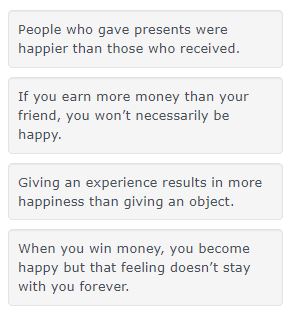
Money can buy happiness, to a point. As a child, you were probably told that money doesn't buy happiness. It turns out that this wise advice is wrong, sort of. Many studies have found that wealth is significantly correlated with subjective well-being, but only up to a point.

In 2010, a Princeton study by Daniel Kahneman and Angus Deaton found that earning more than $US75,000 per year won't significantly increase your day-to-day happiness. But don't worry. The fact that your financial achievements no longer fill you with undiluted pleasure may mean something else – that you're spending it wrong.

Most of us make the seemingly logical assumption that as material things last longer than one-time experiences, they should also make us happier for longer. A weekend getaway, we reason, is only good for a few days. A new TV, however, will give us years of enjoyment.

It turns out we have it backwards. We quickly adapt to ever-present material goods so their ability to make us happy diminishes over time. That new TV quickly becomes a "new normal".

A 1978 study found that even lottery winners get used to their new wealth and eventually revert back to their pre-win level of happiness. So, scratch that scratchie? Not just yet.

A 2016 study by Thomas Gilovich found that spending money on experiences, rather than goods, provides a much greater and longer lasting sense of wellbeing. The reason, Gilovich concluded, is that: "(1) Experiential purchases enhance social relations more readily than material goods; (2) Experiential purchases form a bigger part of a person's identity; and (3) Experiential purchases are evaluated more on their own terms and evoke fewer social comparisons than material purchases. "Gilovich is suggesting that buying "stuff" to keep up with the Joneses won't make you happy but buying experiences might. And it turns out that one of the most satisfying experiences is spending the money not on oneself but someone else.

In 2013, researchers at Harvard University approached people on campus and gave them either $5 or $20 and told them to spend it by the end of the day. Half the participants were asked to spend it on themselves; the other half were told to spend it on someone else. When asked what would make them happiest, most participants predicted that spending more money ($20 versus $5) and spending it on themselves would do more for them than giving it away.

However, when the researchers checked up on their subjects that evening, those who had spent the money on someone else or donated it to the homeless reported feeling significantly better. But there's a final twist: no difference in mood was found between those who spent $5 or $20 – which reinforces the idea that it isn't how much money you have to spend, but how you spend it, that has the biggest effect on your happiness.

Source: www.smh.com


Do the exercises.

    Findings: Money can buy happiness

Discuss with a classmate

Read these questions and discuss them.

  1. Which of the findings surprised you? Why?
  2. Have you ever received an ‘experience’ present? What was it? Did you enjoy it?
    Do you agree with the findings about ‘experience’ presents?
  3. Have you ever given an experience present? What was it and who was it for?
    Did they enjoy it? (why?)
  4. If you could choose an experience present for your parents from the following list, which would you choose?
    Give your reasons, and explain why you would not choose the other two.
    1. a hot air balloon ride
    2. a dinner for two in a very expensive restaurant
    3. a day of adventure activities.

Compare and discuss your answers with other classmates.


Step 3 - Grammar

Let’s look at the 2nd conditional.

Read the sentence.

If I had a lot of money, I would be happy.

This means that the person is imagining that they had money.


This is the second conditional and we use it when we are talking about imaginary or unlikely situations.

We use the simple past and then the verb with would.

Do the exercise.

Step 4 - Song

Listen to the song 'Money' from Pink Floyd.

The video shows many aspects of wealth.

  • Which aspects of wealth do you think you will see?
    Write down at least four aspects.


Watch the video and check your answers.

Do the exercise.


Writing

Read the questions. Write down the answers in your notebook in about 100 words.

  • What does this line mean? "Share it fairly but don't take a piece of my pie?"
  • Do you agree that money is the root of all evil? "Money it's a crime,.....Is the root of all evil today". Explain your answer
  • Do you think money can buy happiness? Give your opinion with arguments.

Step 5 - Task

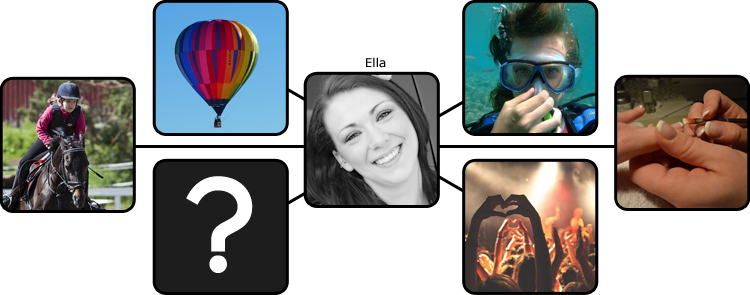
A friend of yours, Ella, is leaving your school because her parents are moving to a different town.
You want to give her an ‘experience’ present. Look at the following presents.

Discuss the advantages and disadvantages of each.
Then in pairs choose the best present.

  1. Look at the activities.
  2. Note down the advantages and disadvantages of each.
  3. Then talk to your classmate. Talk together about the advantages and disadvantages.
  4. Then try to agree on one activity together.
    Besides the pictures of page 1 you can also think of other ideas,
    like a photoshoot, a wellness treatment or your own ideas.
  5. Then together prepare a farewell speech for Ella.
    In the speech you describe the 'experience' present, you have chosen for her.
  6. Write the speech down. Ask your teacher how to hand in the speech.

Evaluation

Fill in the schedule and answer the questions below.


Activity

Needs improvement

​Satisfactory, good

Excellent

Step 1 - Speaking

I can speak about presents in the context of money=happiness.


Step 2 - Reading

I can read a text about how money can buy happiness and discuss with classmates.


Step 3 - Grammar

I can use and understand the grammar: 2nd conditional


Step 4 -  Song

I can listen to a song about Money and answer questions.


Step 5 - Task

I can discuss advantages and disadvantages of a present and write a farewell speech for a friend.


What have you learned in this period?
Answer the following questions:

  • What was the easiest part of this lesson?
  • How well do you understood the lesson? What was the most difficult part?
  • Which lesson was the most interesting? Why?
  • What do you wish you could have done differently?
  • What do you still need help with? What do you have to ask your teacher?

Finishing touch

Project A: a short story


Advertisements and commercials trigger people to buy products. You are going to find out more about advertising and how easily you and your classmates are convinced that you want to buy an article after you've seen an ad (advertisement) or watched a commericial.

Assignment 1: marketing techniques

Find out about some of these different marketing techniques.
Collect some examples of TV/online advertisements that illustrate some of these techniques:

  • Social appeal (feel included)
  • Fear appeal (fear of consumers)
  • Hero endorsement (using celebrities to advertise)
  • Bargain appeals (at this price for a limited time only)
  • Statistics appeal (use numbers, proofs, to show how good product works)
  • Complementing customers (punch lines which complement consumers who buy their products)

Bring the videos to class. Watch them with your group.


Assignment 2: make a commercial

Now try and make a commercial in your group. Here are some ideas of products.

  • mobile phone
  • pair of shoes
  • a book
  • a computer / game console
  • your own idea...

As you prepare your commercial, answer these questions in your group:
(write the answers down in your notebook or text document)

  • Who is it for? For example: A cool teenager, a soccer fan,  a stylish girl.
  • What are three reasons people should buy or use your product? For example: Cheap, easy, better than...
  • What will be your slogan?
  • Choose a technique from the ones mentioned in assignment 1. Which technique?
  • Scripting: Decide what story you’d like to tell in the commercial. Write down what happens in the beginning, middle and end.
    Write the script for your commercial.
  • Roles: Divide roles. Who is going to act, who is going to film. There is a role for everyone.

Assignment 3: Film your commercial

Once you have got your story and scripts ready, it is on to filming!
Each group presents its commercial to the class.
When each group has presented, which is the most original or the most convincing commercial.

See below how your presentation will be judged.


Good

Sufficient

Insufficient

Organisation

Information is presented in a logical sequence.

Information is mostly presented in a logical sequence.

Information is not presented in a logical sequence.

Slides (if used)

Effective use of slides that clearly illustrate the points being made.

Good use of slides that mostly illustrated the points being made.

Poor use of slides (too many/too few?) that did not contribute to the presentation.

Content

Interesting, clear information.

Information is mostly interesting. Some was already known.

There was not much that was of interest in this presentation.

Speaker style

Speaks clearly and at an understandable pace. Maintains eye contact with audience. Well-rehearsed.

Mostly speaks clearly and a good pace. Mostly keeps eye contact. Has rehearsed a bit.

Mostly unintelligible. Does not maintain eye contact. Has not rehearsed.

Language

The vocabulary use is very good and the sentence structure is good.

The vocabulary use is fairly good and the sentence structure is good.

The vocabulary use is not very good, neither is the sentence structure.

Project B: listening and writing

Listening

What do you spend your money on? Do you save money?
Are you ‘good with money’?
Listen to the podcast. Which of the topics are mentioned?

  • budget
  • short term goals
  • investing
  • expenses
  • saving accounts
  • income
  • lists
  • credit cards
  • dates


Do the assignment 'Podcast Money'.

Writing

Write out a short term budget. Check your income and expenses.
Do you need to make some alterations?
Set this out as an excel sheet like the example below.
Open this Google doc.

Make a copy of the worksheet in your own environment.
(Bestand - Maak kopie) or download the worksheet (Bestand - opslaan als)

Example

Income

Expenses

Date

Source

Amount

Date

What?

Amount

08/07/2020

Allowance

€10

10/07/2020

cinema

€10


b’day present

€50

15/07/2020

clothes

€15

15/07/2020

Allowance

€10


22/07/2020

Allowance

€10


Total income

€80


Total expenses

€25

Oefenprogramma Engels

Billionaires

If your school participates in VO-content, you can practice with the English practice program 'Oefenprogramma Engels'.

Here you find a part of this program.
This section fits in well with this theme.
Sign in with your 'School Entree account'!

Billionaires

90 billionths


On www.oefenprogrammaengels.nl you can of course also practice with other reading, listening or viewing assignments!

Examentraining

On this page you will find Examenkracht exam questions of previous years.
The questions will correspond as much as possible to the exercise you have just finished.

While answering, use as much of what you have learned earlier. If you cannot answer the question right now, try again later. When you have answered a question, you can check and indicate the score yourself.

If you want your results to be saved, you will have to log in on ExamenKracht.

VWO 2019-TV1

VWO 2019-TV1 Vragen 36 en 37
VWO 2019-TV1 Vraag 38

VWO 2019-TV2

VWO 2019-TV2 Vragen 37 en 38

VWO 2018-TV1

VWO 2018-TV1 Vraag 30
VWO 2018-TV1 Vraag 31
VWO 2018-TV1 Vraag 33
VWO 2018-TV1 Vraag 34

VWO 2018-TV2

VWO 2018-TV2 Vraag 33


More practice?
Go to Examenkracht where you will find the newest exams.

What did you learn?

Can do statements

Take a look at the Can do statements in the introduction - 'Can do'.
Are you able to do what you have to do?

Finishing touch Project

  • Did you do the project? How did it go?
  • What do you think of working in a group?
  • Did every group member do the same amount of work?

Analyse your mistakes

What did you learn of the mistakes you made in this theme?
You can learn a lot of your mistakes!

Do you recognize one or a few of the mistakes in this schedule?
Copy the schedule in Word.
Fill in other mistakes you made in the free bottom rows.
Fill in the missing tips in the second column. Of course, you can add your own tips for the other mistakes.

Kind of mistake

Tips

I did not learn enough.

You have to plan your learning activities better.
Don't leave it until the last minute. Set up a timetable.

I did not understand.
I did learn the Grammar theory but did not know how to use it.


I made sloppy mistakes.
I know how to do it, but I do it incorrectly because I lose concentration.


I have to check the Vocabulary. I use the wrong words or I did not recognize the words.

You can study the Vocabulary of the themes in www.studiowozzol.nl.

Here you can practise words in a context.
This will help you to memorize words.
You also can create your own task in Studiowozzol.

.....  
.....  
  • Het arrangement Money v456 is gemaakt met Wikiwijs van Kennisnet. Wikiwijs is hét onderwijsplatform waar je leermiddelen zoekt, maakt en deelt.

    Auteur
    VO-content
    Laatst gewijzigd
    28-11-2025 12:12:17
    Licentie

    Dit lesmateriaal is gepubliceerd onder de Creative Commons Naamsvermelding-GelijkDelen 4.0 Internationale licentie. Dit houdt in dat je onder de voorwaarde van naamsvermelding en publicatie onder dezelfde licentie vrij bent om:

    • het werk te delen - te kopiëren, te verspreiden en door te geven via elk medium of bestandsformaat
    • het werk te bewerken - te remixen, te veranderen en afgeleide werken te maken
    • voor alle doeleinden, inclusief commerciële doeleinden.

    Meer informatie over de CC Naamsvermelding-GelijkDelen 4.0 Internationale licentie.

    Het thema 'Money' is ontwikkeld door auteurs en medewerkers van StudioVO.

    Fair Use
    In de Stercollecties van StudioVO wordt gebruik gemaakt van beeld- en filmmateriaal dat beschikbaar is op internet. Bij het gebruik zijn we uitgegaan van fair use.
    Meer informatie: Fair use

    Mocht u vragen/opmerkingen hebben, neem dan contact op via de
    helpdesk VO-content.

    Aanvullende informatie over dit lesmateriaal

    Van dit lesmateriaal is de volgende aanvullende informatie beschikbaar:

    Toelichting
    Dit thema valt onder de arrangeerbare leerlijn van de Stercollecties voor Engels voor vwo, leerjaar 4, 5 en 6. Dit is thema Money. Dit thema omvat de volgende onderwerpen: - Charity begins at home - Life on the never-never - Throw the dice - Money = happiness De grammaticaopdrachten gaan over Relative clauses, Passive, Enough/too en 2nd conditional.
    Leerniveau
    VWO 6; VWO 4; VWO 5;
    Leerinhoud en doelen
    Engels;
    Eindgebruiker
    leerling/student
    Moeilijkheidsgraad
    gemiddeld
    Studiebelasting
    18 uur 0 minuten
    Trefwoorden
    arrangeerbaar, charity begins at home, engels, life on the never-never, money, money = happiness, stercollectie, throw the dice, v456

    Gebruikte Wikiwijs Arrangementen

    VO-content Engels. (2021).

    Charity begins at home v456

    https://maken.wikiwijs.nl/172760/Charity_begins_at_home_v456

    VO-content Engels. (2021).

    Life on the never-never v456

    https://maken.wikiwijs.nl/172761/Life_on_the_never_never_v456

    VO-content Engels. (2021).

    Money = happiness v456

    https://maken.wikiwijs.nl/172762/Money___happiness_v456

    VO-content Engels. (2021).

    Money h45

    https://maken.wikiwijs.nl/98834/Money_h45

    VO-content Engels. (2021).

    Throw the dice ​​v456

    https://maken.wikiwijs.nl/172763/Throw_the_dice___v456

  • Downloaden

    Het volledige arrangement is in de onderstaande formaten te downloaden.

    Metadata

    LTI

    Leeromgevingen die gebruik maken van LTI kunnen Wikiwijs arrangementen en toetsen afspelen en resultaten terugkoppelen. Hiervoor moet de leeromgeving wel bij Wikiwijs aangemeld zijn. Wil je gebruik maken van de LTI koppeling? Meld je aan via info@wikiwijs.nl met het verzoek om een LTI koppeling aan te gaan.

    Maak je al gebruik van LTI? Gebruik dan de onderstaande Launch URL’s.

    Arrangement

    IMSCC package

    Wil je de Launch URL’s niet los kopiëren, maar in één keer downloaden? Download dan de IMSCC package.

    Voor developers

    Wikiwijs lesmateriaal kan worden gebruikt in een externe leeromgeving. Er kunnen koppelingen worden gemaakt en het lesmateriaal kan op verschillende manieren worden geëxporteerd. Meer informatie hierover kun je vinden op onze Developers Wiki.