
HVX - Engels - 4V

HVX - Engels - 4V

English language and literature - 4 VWO

Introduction


Welcome to VWO 4 English: Language and Literature

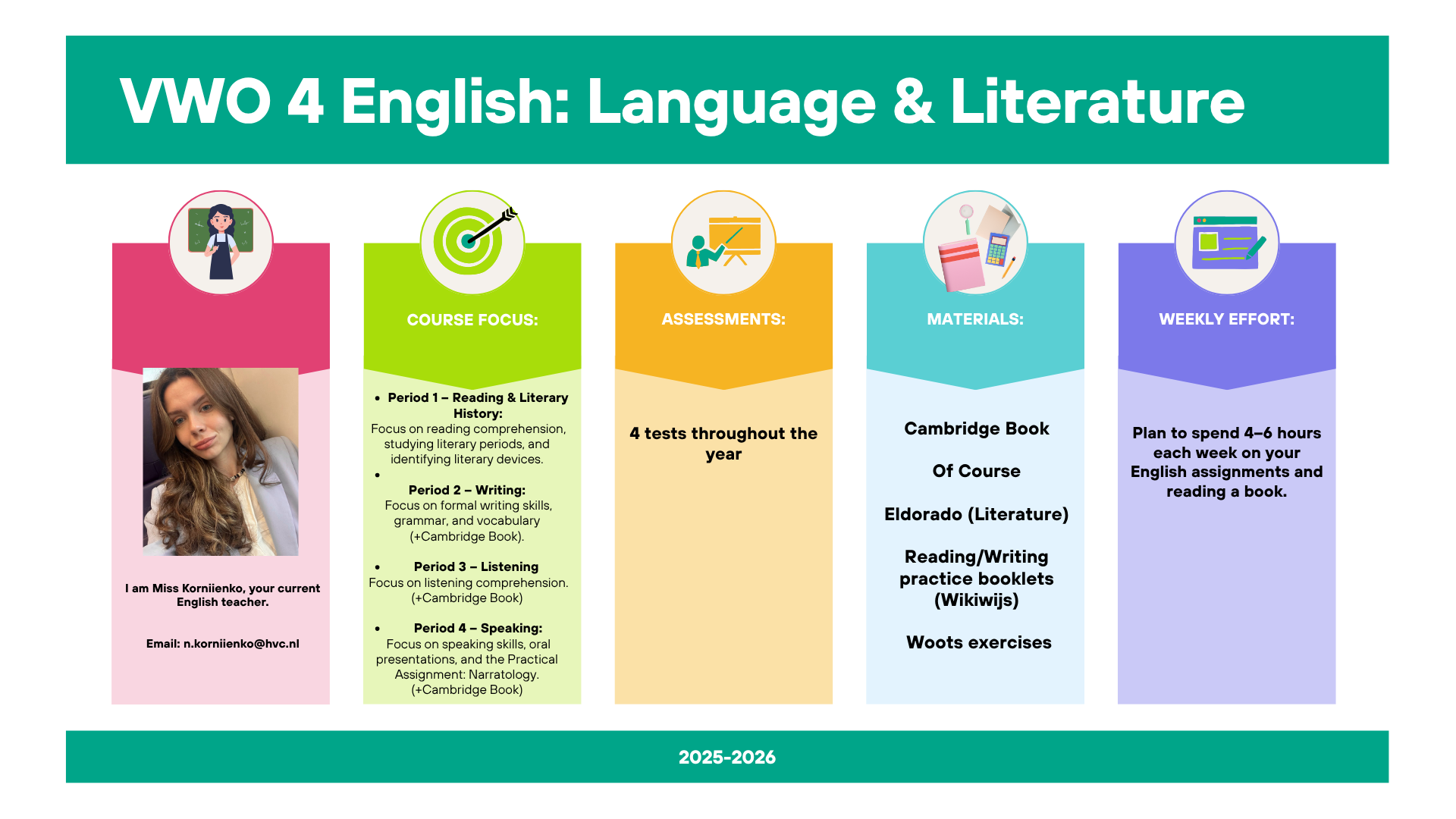
This year, we will explore both English language skills and literature through a structured, four-period program. Each period focuses on a different set of skills, helping you develop a well-rounded understanding of English:

  • Period 1 – Literary History and Reading Skills:
    You will work on reading comprehension, study texts such as Beowulf and The Canterbury Tales, and learn about the key periods in English literature. You will also practice identifying literary devices and understanding their use in texts.

  • Period 2 – Writing:
    This period focuses on formal writing skills, including letter writing and exercises from the Cambridge book. You will also study grammar and vocabulary to improve your writing accuracy.

  • Period 3 – Listening and Viewing:
    You will develop your listening and viewing skills, using resources like Woots exercises and Cambridge materials. You will learn to understand spoken English in different contexts and answer questions based on what you hear or watch.

  • Period 4 – Speaking:
    This period emphasizes speaking skills. You will complete a Practical Assignment: Narratology, practice oral presentations, and continue to work on grammar and vocabulary from the Cambridge book.

Throughout the year, you will also have reading assignments from the Reading Practice Booklet and other texts, as well as opportunities to apply literary knowledge in exercises and assessments.


Annual Planner (2025–2026)

Period Topic / Skills Activities / Materials Assessment / Test Weighting
Period 1 Reading + Literary History

- El Dorado Literary History: key concepts - Beowulf & The Canterbury Tales: reading and study questions

- Wasp Reporter: 4 texts

- Reading Course Materials Wikiwijs

Written test in exam week:

- Reading comprehension passages

- Literary history knowledge+literary devices

1x
Period 2 Writing + Cambridge

- Partyboekje: Writing exercises

-Cambridge Book: Chapter 1

Written test in exam week:

- Formal letter writing

Cambridge: Grammar and vocabulary from Chapter 1

1x
Period 3 Listening & Viewing + Cambridge

- Woots: listening and viewing exercises

- Cambridge Book: Chapter 2

Written test in exam week:

- Listening and viewing section with questions

Cambridge: Grammar and vocabulary from Chapter 2

1x
Period 4 Speaking + Cambridge

- Narratology Project

- Cambridge Book: Chapter 3

Speaking:

-Practical Assignment: Narratology

Cambridge: Grammar and vocabulary from Chapter 3

1x Speaking 1x Cambridge


99.900+ English Language Stockillustraties, royalty-free vector  illustraties en clipart - iStock | Learning english, Blackboard

General Course Materials

Literature Reading List (3 books)

We will read a total of three books this year.

Instructions:
For each book you read, you must complete one follow-up assignment as well as address the general criteria from the reading assignment assessment form.


! One book will be done together in Period 3 or 4.

! You are expected to complete the remaining two books independently.


ENGLISH LITERATURE AS LEVEL (1 YEAR) / KGV | King George V College,  Liverpool

Reading Assignments

Reading List with Recommendations

Category Title Author Genre / Notes Recommended For / Tips
Classics 1984 George Orwell Dystopian novel

Students interested in politics, society, and dystopian worlds


  To Kill a Mockingbird Harper Lee Social issues / Coming-of-age

Those who enjoy character-driven stories and moral dilemmas


  The Great Gatsby F. Scott Fitzgerald American classic / Jazz Age

Students interested in 1920s America, wealth, and social commentary


  Pride and Prejudice Jane Austen Romance / Social commentary

Readers who enjoy romance, humor, and societal observations


  A Tale of Two Cities Charles Dickens Historical fiction

Students who like historical settings and dramatic plots


  Slaughterhouse-Five Kurt Vonnegut Satire / Science fiction

Those who enjoy dark humor, war stories, and experimental narratives


  Animal Farm George Orwell Political allegory / Satire

Students interested in allegories, politics, and historical context


Modern & Contemporary The Catcher in the Rye J.D. Salinger Coming-of-age

Students who relate to teenage struggles and self-discovery


  The Handmaid's Tale Margaret Atwood Dystopian novel

Those interested in feminism, dystopias, and social issues


  The Curious Incident of the Dog in the Night-Time Mark Haddon Mystery / Contemporary

Students who enjoy unique perspectives and problem-solving stories


  The Hate U Give Angie Thomas Social issues / Contemporary

Readers interested in activism, racism, and modern social issues


  The Hobbit J.R.R. Tolkien Fantasy

Students who enjoy adventure, fantasy worlds, and classic quests


  Brave New World Aldous Huxley Dystopian novel

Those interested in futuristic societies, science, and ethics


Other Genres The Hitchhiker's Guide to the Galaxy Douglas Adams Science fiction / Comedy

Students who enjoy humor, absurdity, and imaginative worlds


  Wuthering Heights Emily Brontë Gothic novel

Readers who like dark romance, complex characters, and drama


  Jane Eyre Charlotte Brontë Gothic novel / Romance

Students who enjoy strong protagonists and emotional depth


Period 1- Literature and Reading Comprehension

Period 1 (Weekly Planner)

In this period, we focus on reading.


Week 5 (21-26 sept) Week 6 (29 sept - 3 okt) Week 7 (6-10 okt) Week 8 (13-17 okt) HERFSTVAKANTIE (20-24 okt) Week 9 (27-31 okt) Week 10 (2 dagen) (3-4 nov)  

TOETSWEEK (5-11 nov)

LET OP:

DE TOETS IS IN DECEMBER!

Wasp Reporter : Humanoid Robots. Maken oefeningen 57 en 58. Bij oefening 57 kun je gewoon je wasp reporter open laten en het stuk lezen en de antwoorden opzoeken. Maak uit het leesboekje alle vragen bij tekst 1 Summer Camp: Unplugged or Unfair?. De vragen staan ONDER tekst 2. Wasp reporter: Faulty Thinking. Maken oefeningen die op wikiwijs staan onder het kopje : Vragen Faulty Thinking. Lezen uit El Dorado Basisboek: H2. Ga op wikiwijs naar het kopje literatuurgeschidenisboeken en open het bestand "Wat je moet weten literatuurgeschiedenis. Maak een definitielijst + voorbeeld van alles wat bij "5 behandelde begrippen"staat.   Maak uit het leesboekje alle vragen bij tekst 2 Think millennials have it tough? For 'Generation K', life is even harsher Ïn de les leren voor de toetsweek. Leer al je begrippen van El Dorado en alles inzake Beowulf en the Canterbury Tales.   Toets over Literatuugeshiedenis (zie bestand op wikiwijs) en teksten lezen en vragen beantwoorden.


Period 1 (Learning Targets)

Learning Targets – Literature

  • I can identify and apply a range of literary devices (such as metaphor, simile, hyperbole, personification, etc.).

  • I can describe the main characteristics of the Old English Period and the Early Middle Ages.

  • I can summarise the plots of Beowulf and The Canterbury Tales.

Learning Targets – Reading Comprehension

  • I can identify the main idea and supporting details in a text.

  • I can make inferences and draw conclusions from a text.

  • I can understand and explain literary devices used in a text (e.g., metaphor, simile, personification).

  • I can summarise a text in my own words.

  • I can answer comprehension questions accurately, using evidence from the text.

  • I can compare and contrast information from different texts.

Test 1

The test during the Period 1 exam week consists of:

  • Reading passages and answering questions about them (Begrijpend lezen).

  • General knowledge of literary history from the Eldorado books (Literatuurgeschiedenis).


1) All concepts you need to know:


Prehistory (before 50 B.C.):

  • Celts → came to Europe from Southeast Asia

  • Germans (Germanic tribes) → lived in Germany, the Netherlands, and Belgium
    Note: English is also a Germanic language

Ancient History (50 B.C. – 500 A.D.):

  • Romans → expansionist; they wanted to conquer more land
    England was part of the Roman Empire during this period

  • Greeks → focused more on developing their culture

Early Middle Ages (500 – 1100 A.D.):

  • The Roman Empire in Western Europe collapsed

  • Northern European tribes (Saxons, Batavians) fought the Romans in Western Europe and drove them away

  • Vikings (from Scandinavia) wanted to conquer territory in Western Europe; they still had their own religion/beliefs

  • ~800 A.D.: Beginning of the Catholic Church’s influence

    • The church elites spoke Latin; ordinary citizens did not.

    • This created a power imbalance: citizens followed the church’s instructions blindly.

Old English Period (c. 450–1066)

  • Key features of Old English literature

    • alliteration

    • kennings

    • strong rhythm and caesura (pauses in lines)

    • heroic and warrior culture

    • oral storytelling tradition

  • Themes in Old English texts

    • fate (“wyrd”)

    • loyalty and bravery

    • good vs. evil

Middle English Period (c. 1066–1500)

  • Historical background

    • The Norman Conquest of 1066

    • Influence of French and Latin on English

    • Rise of Middle English as a “bridge” between Old and Modern English

  • Features of Middle English literature

    • more accessible language

    • increased focus on religion, society, everyday life

    • growth of written texts and literacy

Chapter 2 (El dorado-basisboek):

  • You must create your own list with each concept, including a definition and an example.

  • For the test, you must be able to give the definition, and if a text is provided, you must identify which concept applies.


2) What you need to know from the El Dorado book – ENGLISH:

Beowulf (pp. 13–14):

  • Know the period it comes from

  • Know the name of the monster in the story

The Canterbury Tales:

  • Know approximately when it was written

  • Know the author

  • Watch the videos about three of the tales

  • Be able to summarize what happens in these stories


Key Literary Terms

Alliteration

Alliteration is the repetition of the same sound at the start of a series of words in succession whose purpose is to provide an audible pulse that gives a piece of writing a lulling, lyrical, and/or emotive effect.

This paragraph is an example of alliteration..

Repetition

Repetition refers to the use of the same word or phrase multiple times and is a fundamental poetic technique.

Metaphor

Metaphor is a common poetic device where an object in, or the subject of, a poem is described as being the same as another otherwise unrelated object.

A beautiful example can be seen in the first stanza of The Highwayman by Alfred Noyes, in the line:

‘The moon was a ghostly galleon tossed upon cloudy seas…’

Simile

Simile is a common poetic device. The subject of the poem is described by comparing it to another object or subject, using 'as' or 'like'. For example, the subject may be 'creeping as quietly as a mouse' or be 'sly, like a fox.'

Hyperbole

Hyperbole, a figure of speech that is an intentional exaggeration for emphasis or comic effect. Hyperbole is common in love poetry, in which it is used to convey the lover's intense admiration for his beloved.

Personification

Personification is a poetic device where animals, plants or even inanimate objects, are given human qualities – resulting in a poem full of imagery and description.

For example: ‘the daffodils are dancing in glee.’

Imagery

If you’ve practiced or studied creative writing, chances are you’ve encountered the expression “paint a picture with words.” In poetry and literature, this is known as imagery: the use of figurative language to evoke a sensory experience in the reader. When a poet uses descriptive language well, they play to the reader’s senses, providing them with sights, tastes, smells, sounds, internal and external feelings, and even internal emotion. The sensory details in imagery bring works to life.

Euphemism

A euphemism is a form of figurative language. These idiomatic, indirect expressions replace harsh, impolite, taboo, or unpleasant terms with more delicate phrases. They can be used humorously or to downplay or mask a situation, causing some to find the device deceitful or counterproductive.

For example:

  • When firing someone, an employer might say, “We’re going to have to let you go.” That unemployed person might then say they are “between jobs” rather than admit they were fired.
  • When sick or unwell, a person might tell their friend, “I’m feeling under the weather.”
  • To share the news of a woman’s pregnancy, her mother could say, “She has a bun in the oven.” This is an instance of a humorous euphemism, rather than an attempt to replace an awkward or harsh phrase.
  • To delicately broach the topic of someone’s death, it may be said that the deceased “passed away.”

Literature Course Materials

Literary Terms to Practice

Literary Terms to Practice

  1. Simile – comparison using “like” or “as.”

  2. Metaphor – direct comparison without “like” or “as.”

  3. Personification – giving human qualities to non-human things.

  4. Alliteration – repeating the same initial consonant sound.

  5. Hyperbole – extreme exaggeration.

  6. Irony – the opposite of what is expected or said.

  7. Imagery – language that appeals to the senses (sight, sound, smell, taste, touch).

  8. Repetition – repeating words or phrases for emphasis.

Task A: Identify the literary device

Write which term is used.

  1. Her smile was as bright as the sun.

  2. The wind whispered through the trees.

  3. He ran a million miles to get to school on time.

  4. Brave bears battle boldly.

  5. Time is a thief.

  6. “Great, another exam,” she said while rolling her eyes.

  7. The warm smell of cinnamon filled the kitchen.

  8. Never give up. Never stop trying.

Task B: Create your own examples

Write one original sentence for each literary term.

Task C: Match the definitions

Match the description with the correct term.

a. A comparison using “like” or “as.”
b. A comparison without “like” or “as.”
c. Strong exaggeration.
d. Giving human qualities to something non-human.
e. A contrast between what is expected and what happens.
f. Repeating the same beginning sounds.
g. Language that appeals to the senses.
h. Repeating words or phrases for effect.

Reading Course Materials

In this section, you will focus on developing your reading comprehension and literary understanding. You will work with a variety of texts, including classic and contemporary literature, newspaper articles, and exercises from your Reading Practice Booklet.

Reading Practice:

Text 1


Life at the extreme


CHRISTOPHER STEVENS reviews last night's TV

1) There are three basic units of measurement in tellyland. People who watch TV cannot be expected to know about metres, so height is gauged in double-decker buses ─ the Eiffel Tower, for instance, is 74 Routemasters tall. All countries have to be compared to Wales. There's no point in saying that 16 million people live in Holland, unless you also point out that the Netherlands is less than twice the size of Wales, with a population five times bigger. Volume is calculated in Olympic swimming pools. If 10 million cubic metres of rubbish is sent to landfill every day, a TV reporter must always explain that it's enough to fill 4,000 Olympic pools, though doing so would actually be a serious criminal offence.

2) We now have a fourth yardstick for TV. All speed is measured in Bolts ─ the pace of 100m world champion Usain Bolt at full throttle. And so Davina McCall informed us, in Life At The Extreme (ITV), that the Namib beetle could belt along at speeds, 'for their size, almost ten times faster than Usain Bolt'. The lanky Jamaican superman can hit 25mph flat out. But this didn't mean the beetles were zipping along at 250mph, like Speedy Gonzales after three cups of black coffee. The key phrase was 'for their size'. Namib beetles are no bigger than undernourished wasps, and they scuttle across the sands at human walking pace. Usain would have no trouble keeping up. This was about as informative as Davina got.

3) She was having a lovely time in southern Africa, squealing with excitement when she saw a giraffe and cooing over an orphaned aardvark. But she hadn't bothered to do too much homework before setting off. When she held a gecko, all she could tell us was 'his little feet are so sweet'. Thank you, Davina Attenborough. On a nighttime expedition through the dunes, hunting with ultraviolet torches for venomous scorpions, she seemed less than keen. 'I have never been a huge fan of scorpions,' she admitted. 'There's something quite eerie about them, the tail and the fact that they could kill me.' She ought to have brought a chair along, so she could stand on it and scream. It got worse when she tried camping out at night, building a wall of thorn branches round her tent to keep the lions at bay. 'Look,' she wailed, dropping her machete, 'I've broken a nail.'

4) The idea of the series is that Davina will roam the world, living in its most inhospitable places, to learn how people and animals adapt to its extremes. 31_______________ , she looks as though she'd struggle to cope at an all-inclusive Mediterranean resort if the canapés ran out. To discover if it was true that cheetahs were the fastest animals on earth, for example, she visited a wildlife sanctuary and challenged a tame one called Kiki to a race. First, though, she wanted reassurance that the big cat wouldn't see her as prey and maul her. 'Dunno,' said the keeper. 'No one's ever been stupid enough to run in the cheetah camp.'

adapted from dailymail.co.uk, 2016

noot 1 verwijzing naar David Attenborough, een beroemde Britse bioloog en maker van zeer gewaardeerde natuurdocumentaires


27. How does the writer view the “basic units of measurement in tellyland” (paragraph 1) judging from the tone of this paragraph?

A as colourful

B as educational

C as inaccurate

D as simplistic


28. What is the point made by Christopher Stevens about Davina McCall’s use of “Bolts” in paragraph 2?

According to Stevens she uses it

A to help viewers better appreciate the ecological impact of insects.

B to make an unremarkable insect appear more spectacular.

C to make clear why she is fascinated by a particular insect.

D to stress how much research into insects her show involves.


Om een artikel te verlevendigen kan een schrijver gebruikmaken van

verschillende stijlfiguren, zoals:

a eufemisme

b paradox

c terzijde

d vergelijking

29. Geef van de citaten uit de tekst aan van welke van de bovenstaande

stijlfiguren ze een voorbeeld zijn.

Noteer de letter van de stijlfiguur achter het nummer op het antwoordblad.

Let op: je mag elke stijlfiguur slechts één keer gebruiken, dus er blijven twee stijlfiguren over.

“though doing so would actually be a serious criminal offence” (alinea 1)

“like Speedy Gonzales after three cups of black coffee” (alinea 2)

___________________________________________________________________


30. What becomes clear about Christopher Stevens from paragraph 3?

A He dislikes serious programmes that are presented by women.

B He is annoyed by the superficiality of Davina McCall and her show.

C He is unhappy because David Attenborough supports Davina McCall.


31. Which of the following fits the gap in paragraph 4?

A After all

B In general

C Trouble is

D What’s more


Text 2

What's the Big Idea?


Based on an article by Rob Cromwell


1 If you were asked to name a business that encourages creativity in its staff, the likes of Apple, Google or Pixar might be near the top. But what is it that makes them hotbeds of revolutionary ideas and novel inventions? Is it the indoor beach shacks and hidden rooms (complete with fully-stocked bars) that Pixar staffers can enjoy? Or perhaps the Lego room and twostorey slide that Google employees use?


2 "Businesses like to put themselves in boxes, it simplifies things, but if the box is too rigid – or it's the wrong box ─ the company suffers. It won't be 11____ enough to deal with changing conditions," says Luc de Brabandere, co-author of Thinking in New Boxes. "This is where creative thinking comes in, as organisations look at constructing 'new' boxes for themselves. There is no universal recipe for success."


3 History is awash with firms who have jumped on the creative bandwagon with both verve and a bundle of cash, but without a suitable business plan in support. And simply paying lip service to creativity can be terminal. Kodak invested heavily in creativity, and the people they employed delivered expertly: its R&D department invented a digital camera in 1975. However, the management insisted film remained the future and Kodak lost out to electronics companies more willing to adapt. The company filed for bankruptcy in 2012.


4 David Burkus, author of The Myths of Creativity says: "We're in a knowledge-based economy, so it's beneficial to be perceived as creative. People are naturally biased against innovations. The key to overcoming this is delaying judgment ─ it's what consumers do, and it means that good ideas can overcome that bias in the end." Burkus adds: "You can learn something from every test that doesn't work. The best companies are those that reward both success and failure, because both are getting you closer to something new. Only 13_____ should be punished."


5 Which brings us back to Google, the simple search engine that brought us the most detailed map of the world, the most popular smartphone operating system, and an office with a slide in it. At Google, staying still has never been an option and Eze Vidra of that company tells its employees: "Think big, start small. When you first start out, the biggest barriers are in your mind, so just remove them." However, Vidra is also at pains to make clear that there need to be clear pathways for new ideas to move up: "Creativity is a tool and must be used as such ─ if creativity becomes your goal then your business will fail."


6 But how many Googlers are actually creative thinkers? According to Vidra, it is a little bit in all of them, when you look at how they spend their working week: "70% of the time you do the job you are paid to do, 20% is for personal projects to do with the brand, and the remaining 10%? That is for the crazy stuff." It is of course easier for an organisation worth $200 billion to free up such time for its staff, but perhaps every organisation can spare a few of its resources for the crazy stuff.


Holland Herald, 2014

(Havo-2018-2)


11 Which of the following fits the gap in paragraph 2?

A big

B cheap

C flexible

D strong


12 What is the main goal of paragraph 3?

A to give an explanation for the fact that managers tend to be wary of taking financial risks

B to illustrate why companies should be prepared to invest in modern technology

C to stress that asking for new ideas only makes sense if a company is ready to use them

D to support Luc de Brabandere’s theory on how to successfully run a business


13 Which of the following fits the gap in paragraph 4?

A ambition

B inaction

C obedience

D rebellion

De in de tekst genoemde experts hebben ieder een andere belangrijkste boodschap. Deze boodschappen kunnen elk kernachtig samengevat worden met één van deze beschrijvingen:

a be adjustable

b means to an end

c miracle cure

d rewarding genius

e trial and error


14 Geef voor elke expert aan welke beschrijving past bij zijn bijdrage.

1 Luc de Brabandere (alinea 2)

2 David Burkus (alinea 4)

3 Eze Vidra (alinea 5)


Noteer de juiste letter achter elk nummer op het antwoordblad. Let op: er blijven twee beschrijvingen over.

Exam 2018 (1)

Period 2- Writing

Period 2 (Weekly Planner)

Period 2 – Writing

In this period, you will learn to write formal letters and understand the conventions you need to follow.
Additionally, we will start working with the Cambridge book, completing Chapter 1.


Week 1 (wo 12-vr 14 nov) / Startweek
Week 2 (17-21 nov)
Week 3 (24-28 nov)
Week 4 (1-5 dec)
Week 5 (8-12 dec)
Week 6 (15-19 dec)
KERSTVAKANTIE
(22-26 dec)                                           
KERSTVAKANTIE
(29 dec-2 jan)                                                   
Week 7 (5-9 jan)
Week 8 (12-16 jan)
Di: DEADLINE DAY
WO: Start TOETSWEEK
TOETSWEEK (tot en met di 20 jan)
INFORMATIE TOETS
TOETSDUUR.                     
 
Bestudeer in het Partyboekje de pagina’s 2 t/m 5 voor de uitleg over de onderdelen van een formele brief. Op pagina 6 en 7 maak je je eerste schrijfopdracht.
Lees je boek!


Je schrijfopdracht 1 moet af zijn.
Uit het Cambridge Book (C1 Gold) moet je Unit 1: Where we live bestuderen en opdrachten maken, pagina’s 6 en 7.
Lees je boek!


Uit het Partyboekje maak je schrijfopdracht 2 op de pagina’s 8 t/m 10.
Uit het Cambridge Book moet je de grammatica: Verbs in perfect and continuous forms en Stative verbs bestuderen. Maak hierbij de opdrachten 3, 4, 5 en 6 op pagina 8.
Lees je boek!


Je schrijfopdracht 2 moet af zijn.
Uit het Cambridge Book maak je de Vocabulary Focus op pagina 12, opdrachten 1 t/m 5.
Lees je boek!


Uit het Partyboekje maak je schrijfopdracht 3 op de pagina’s 11 en 12.
Uit het Cambridge book bestudeer je de grammatica over conjunctions op pagina 13 en maak je de opdrachten 1 t/m 5.
Lees je boek!


Je schrijfopdracht 3 moet af zijn.
Uit het Cambridge book maak je de Vocabulary-opdrachten op pagina 9, opdrachten 4 en 5.
Lees je boek uit en begin aan de opdracht (Wikiwijs:Reading Assignments).


Review:
Partyboekje p. 22–25
Cambridge p. 15
Zorg ervoor dat je opdracht na het lezen van het boek volledig af is.


Herhaling en voorbereiding voor de toets: werk alle onderdelen zorgvuldig door.
-Formeel brief
Cambridge (Unit 1):
Grammar: Verbs in perfect and continuous forms; Stative verbs p. 8
Conjunctions p. 13
Vocabulary: Expressions with space and room p. 9 Compound words p. 12


De toets bestaat uit twee delen:
1) Tijdens de toets moet je een formele brief schrijven.
2) Daarnaast moet je de grammatica en woordenschat uit hoofdstuk 1 van het Cambridge-boek (C1) goed beheersen.


90 minuten


Test 2

The test in Period 2 consists of two parts:

A. You must write a formal letter during the test.
B. You need to know the grammar and vocabulary from Chapter 1 of the Cambridge book.

Writing Course Materials

Period 3 - Listening

In Period 3, we will work on our listening and viewing skills.
On woots.nl, you can find all the practice materials to complete.

First, you need to register in class on Woots, which I have set up for you. You can do this via this link:

https://app.woots.nl/accept/invitations/abda6333-f686-42dc-9272-3bf040ff6626

From now on, log in via “Inloggen” and then choose “Inloggen via Entree”.

For Cambridge, we will start working on Chapter 2.

Test 3

You will have a test in Exam Week 3 consisting of two parts:

  1. A listening and viewing section with questions to answer.

  2. Grammar and vocabulary from Chapter 2 of the Cambridge book.

Period 4 - Speaking

This period focuses on speaking skills.
You will demonstrate this by completing the Practical Assignment: Narratology.

Additionally, we will work on Chapter 3 of the Cambridge book.


Test 4

In the final exam week, you will have:

1) Test on the grammar and vocabulary from Chapter 3 of the Cambridge book.

2) Practical Assignment: Narratology.


Speaking Course Materials

  • Het arrangement HVX - Engels - 4V is gemaakt met Wikiwijs van Kennisnet. Wikiwijs is hét onderwijsplatform waar je leermiddelen zoekt, maakt en deelt.

    Laatst gewijzigd
    03-12-2025 10:09:18
    Licentie

    Dit lesmateriaal is gepubliceerd onder de Creative Commons Naamsvermelding 4.0 Internationale licentie. Dit houdt in dat je onder de voorwaarde van naamsvermelding vrij bent om:

    • het werk te delen - te kopiëren, te verspreiden en door te geven via elk medium of bestandsformaat
    • het werk te bewerken - te remixen, te veranderen en afgeleide werken te maken
    • voor alle doeleinden, inclusief commerciële doeleinden.

    Meer informatie over de CC Naamsvermelding 4.0 Internationale licentie.

    Aanvullende informatie over dit lesmateriaal

    Van dit lesmateriaal is de volgende aanvullende informatie beschikbaar:

    Toelichting
    HVX-Lesmateriaal Engels- 4V (2025-2026)
    Eindgebruiker
    leerling/student
    Moeilijkheidsgraad
    gemiddeld
  • Downloaden

    Het volledige arrangement is in de onderstaande formaten te downloaden.

    Metadata

    LTI

    Leeromgevingen die gebruik maken van LTI kunnen Wikiwijs arrangementen en toetsen afspelen en resultaten terugkoppelen. Hiervoor moet de leeromgeving wel bij Wikiwijs aangemeld zijn. Wil je gebruik maken van de LTI koppeling? Meld je aan via info@wikiwijs.nl met het verzoek om een LTI koppeling aan te gaan.

    Maak je al gebruik van LTI? Gebruik dan de onderstaande Launch URL’s.

    Arrangement

    IMSCC package

    Wil je de Launch URL’s niet los kopiëren, maar in één keer downloaden? Download dan de IMSCC package.

    Voor developers

    Wikiwijs lesmateriaal kan worden gebruikt in een externe leeromgeving. Er kunnen koppelingen worden gemaakt en het lesmateriaal kan op verschillende manieren worden geëxporteerd. Meer informatie hierover kun je vinden op onze Developers Wiki.