
HVX - Engels - 4H

HVX - Engels - 4H

English language and literature - 4 HAVO

Introduction


Welcome to HAVO 4 English: Language and Literature


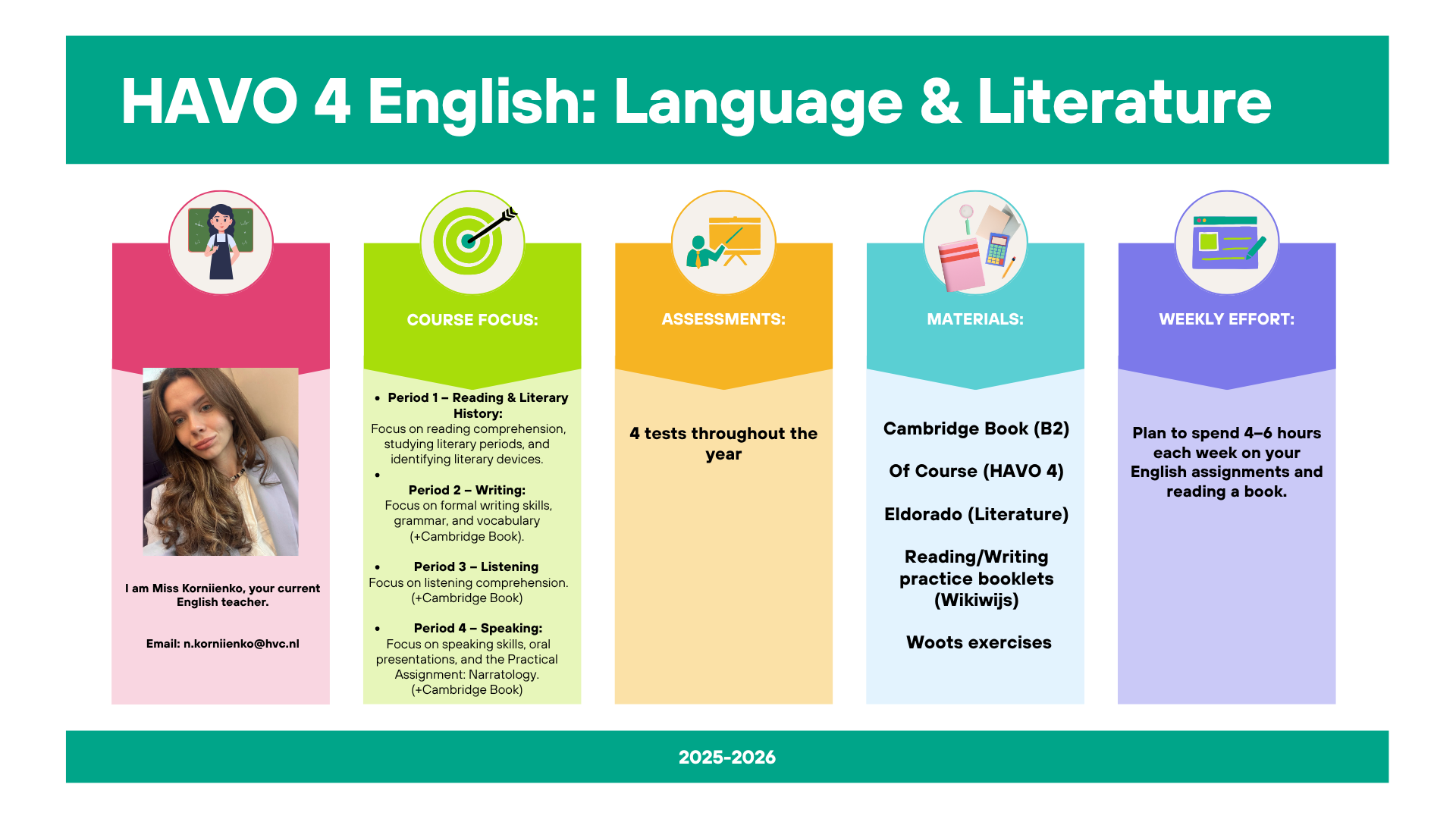
This year, we will explore both English language skills and literature through a structured, four-period program. Each period focuses on a different set of skills, helping you develop a well-rounded understanding of English:

  • Period 1 – Literary History and Reading Skills:
    You will work on reading comprehension and learn about the key periods in English literature. You will also practice identifying literary devices and understanding their use in texts.

  • Period 2 – Writing:
    This period focuses on formal writing skills, including letter writing and exercises from the Cambridge book. You will also study grammar and vocabulary to improve your writing accuracy.

  • Period 3 – Listening and Viewing:
    You will develop your listening and viewing skills, using resources like Woots exercises and Cambridge materials. You will learn to understand spoken English in different contexts and answer questions based on what you hear or watch.

  • Period 4 – Speaking:
    This period emphasizes speaking skills. You will complete a Practical Assignment: Narratology, practice oral presentations, and continue to work on grammar and vocabulary from the Cambridge book.

Throughout the year, you will also have reading assignments from the Reading Practice Booklet and other texts, as well as opportunities to apply literary knowledge in exercises and assessments.


Annual Planner (2025–2026)

Period Topic / Skills Activities / Materials Assessment / Test Weighting
Period 1 Reading + Literary History

- El Dorado Literary History: key concepts

- Wasp Reporter: 4 texts

- Reading Course Materials Wikiwijs

Written test in exam week:

- Reading comprehension passages

- Literary history knowledge + literary devices

1x
Period 2 Writing + Cambridge

- Partyboekje: Writing exercises

-Cambridge Book: Chapter 1

Written test in exam week:

- Formal letter writing

Cambridge: Grammar and vocabulary from Chapter 1

1x
Period 3 Listening & Viewing + Cambridge

- Woots: listening and viewing exercises

- Cambridge Book: Chapter 2

Written test in exam week:

- Listening and viewing section with questions

Cambridge: Grammar and vocabulary from Chapter 2

1x
Period 4 Speaking + Cambridge

- Narratology Project

- Cambridge Book: Chapter 3

Speaking:

-Practical Assignment: Narratology

Cambridge: Grammar and vocabulary from Chapter 3

1x Speaking 1x Cambridge


99.900+ English Language Stockillustraties, royalty-free vector  illustraties en clipart - iStock | Learning english, Blackboard

General Course Materials

Literature Reading List (2 books)

You’ll read two books this year!


Instructions:

One you’ll do independently, and the other we’ll read together as a class (in Period 3 or 4).

So you only need to choose one book yourself!
 

123,000+ Girl Reading Books Stock Photos, Pictures & Royalty-Free Images -  iStock | Boy and girl reading books

Reading Assignments

HAVO:

Je leest dit jaar 2 boeken.

1 doen we gezamenlijk in Periode 3/4.

Je kiest uit de volgende opdrachten welke je wil doen. 


Opdracht 1:  Recensie

Zoek twee recensies van het door jou gelezen werk. Je zou voor een positieve en een negatieve recensie kunnen kiezen. Recensies kun je  in LiteRom vinden nadat je inlogt met Magister. Indien je in LiteRom geen recensies van jouw boek kunt vinden, overleg je met de docent.


Maak de volgende opdrachten:

1.  Noteer uit beide recensies drie argumenten.  

2.  Noteer uit beide recensies een argument dat je kunt weerleggen. Onderbouw de

weerlegging uitgebreid.  

3.  Welke nieuwe inzichten hebben deze recensies jou gegeven? Leg je antwoord

uit.  

4.  Noteer wat je te weten bent gekomen over het leven en het werk van de schrijver

na het lezen van de recensies. Zoek meer informatie over het leven van deze

auteur. Welke informatie was van toegevoegde waarde geweest voor deze

recensies?

5.  Vervang bij elke recensie een citaat door een ander citaat uit het boek dat jij ook

passend vindt op deze plaats in de recensie. Noteer het paginanummer


Opdracht 2: PowerPointPresentatie

Je maakt een Powerpoint met verschillende dia’s, met door jou ingesproken uitleg bij elkedia. Op je dia’s zelf staan vooral steekwoorden en afbeeldingen (dus geen lappen tekst!)

Verplicht:

-Dia 1: titel, schrijver, aantal bladzijdes

-Dia 2: stel je hoofdpersoon voor en andere belangrijke personages

-Dia 3: Korte samenvatÝng van het verhaal (inclusief het einde)

-Dia 4: Mening over het verhaal (dus wat je van het boek vond) met twee argumenten en

twee voorbeelden

-Dia 5: Moeten je kijkers dit boek juist wel of niet lezen? Beschrijf kort waarom wel/ niet


Opdracht 3: Opdracht leesdossier: boekendoos maken

Voor deze opdracht heb je een schoenendoos nodig. Je gaat namelijk een boekendoos maken van het door jou gelezen boek. Je maakt de gehele opdracht in het ENGELS.


Wat ga je doen?

  • Lees een boek van de boekenlijst of doe een voorstel voor een boek dat jij graag zou willen lezen.


  • Maak een korte samenvatting van de inhoud van het boek. In de samenvatting staat:
    • wie de hoofdpersoon is
    • wat de belangrijkste gebeurtenis is
    • hoe het boek afloopt

De samenvatting moet in begrijpelijke taal geschreven zijn (eigen woordgebruik). De samenvatting is rond de 200-300 woorden en in het ENGELS.

  • Onder de samenvatting schrijf je jouw mening over het boek. Hiervoor gebruik je twee beoordelingswoorden (uit je lesboek, onderdeel fictie). Deze mening onderbouw je uiteraard met argumenten en je geeft voorbeelden uit het boek (SExI - Statement - Explain - Illustrate). Je mening telt minimaal 150 woorden.

Je plakt de samenvatting mét je eigen mening aan de binnenkant van de deksel van de schoenendoos.


  • In de schoenendoos verzamel je tien voorwerpen die een belangrijke rol in het verhaal spelen. Aan elk voorwerp bind je een kaartje, waarop je aan de ene kant uitgebreid uitlegt welke rol het voorwerp in het boek speelt en waarom jij vindt dat dit voorwerp belangrijk is voor het verhaal.
    Aan de andere kant van elk kaartje komt een citaat van meerdere zinnen uit het boek waarin het voorwerp genoemd wordt. Je zet het nummer van de bladzijde waar je de tekst gevonden hebt op het kaartje erbij.
    Voor alle duidelijkheid:
    • mensen zijn geen voorwerpen!
    • plaatjes van voorwerpen mag je niet gebruiken.


  • De buitenkant van de schoenendoos versier je met plaatjes die iets zeggen over het boek.
  • Op de deksel plak je een kopie van de voorkant van het boek. De titel en de schrijver/schrijfster moeten duidelijk te zien zijn. Ook schrijf je jouw naam en klas erop.


Period 1- Literature and Reading Comprehension

Period 1 (Weekly Planner)

In this period, we focus on reading.


Week 5 (21-26 sept) Week 6 (29 sept - 3 okt) Week 7 (6-10 okt) Week 8 (13-17 okt) HERFSTVAKANTIE (20-24 okt) Week 9 (27-31 okt) Week 10 (2 dagen) (3-4 nov)  

TOETSWEEK (5-11 nov)

LET OP:

DE TOETS IS IN DECEMBER!

Wasp Reporter : Humanoid Robots. Maken oefeningen 57 en 58. Bij oefening 57 kun je gewoon je wasp reporter open laten en het stuk lezen en de antwoorden opzoeken. Maak uit het leesboekje alle vragen bij tekst 1 Summer Camp: Unplugged or Unfair?. De vragen staan ONDER tekst 2. Wasp reporter: Faulty Thinking. Maken oefeningen die op wikiwijs staan onder het kopje : Vragen Faulty Thinking. Lezen uit El Dorado Basisboek: H2. Ga op wikiwijs naar het kopje literatuurgeschidenisboeken en open het bestand "Wat je moet weten literatuurgeschiedenis. Maak een definitielijst + voorbeeld van alles wat bij "5 behandelde begrippen"staat.   Maak uit het leesboekje alle vragen bij tekst 2 Think millennials have it tough? For 'Generation K', life is even harsher Ïn de les leren voor de toetsweek. Leer al je begrippen van El Dorado en alles inzake Beowulf en the Canterbury Tales.   Toets over Literatuugeshiedenis (zie bestand op wikiwijs) en teksten lezen en vragen beantwoorden.


Period 1 (Learning Targets)

Learning Targets – Literature

  • I can identify and apply a range of literary devices (such as metaphor, simile, hyperbole, personification, etc.).

  • I can describe the main characteristics of the Old English Period and the Early Middle Ages.

Learning Targets – Reading Comprehension

  • I can identify the main idea and supporting details in a text.

  • I can make inferences and conclude a text.

  • I can understand and explain literary devices used in a text (e.g., metaphor, simile, personification).

  • I can summarise a text in my own words.

  • I can answer comprehension questions accurately, using evidence from the text.

  • I can compare and contrast information from different texts.

Test 1

The test during the Period 1 exam week consists of:

  • Reading passages and answering questions about them (Begrijpend lezen).

  • General knowledge of literary history from the Eldorado books (Literatuurgeschiedenis).


Wat je moet kennen: El Dorado Literatuurgeschiedenis – BASISBOEK


Hoofdstuk 1

Prehistorie (voor 50 v. Chr.)

  • Kelten → kwamen naar Europa vanuit Zuidoost-Azië.

  • Germanen → leefden in het huidige Duitsland, Nederland en België.
    (Leuk weetje: Engels is ook een Germaanse taal.)

Oude Geschiedenis (50 v. Chr. – 500 n. Chr.)

  • Romeinen → hadden een sterke expansiedrift, ze wilden hun rijk steeds verder uitbreiden.
    Engeland maakte in deze periode deel uit van het Romeinse Rijk.

  • Grieken → richtten zich vooral op de ontwikkeling van hun cultuur.

Vroege Middeleeuwen (500 n. Chr. – 1100 n. Chr.)


Hoofdstuk 2:


Voor Hoofdstuk 2 maak je zelf een begrippenlijst.
In deze lijst noteer je:

  1. Elk begrip dat je moet kennen,

  2. De definitie ervan,

  3. En een voorbeeld.

Let op voor de toets:

  • Je moet de definitie van elk begrip kunnen geven.

  • Als je een stukje tekst krijgt, moet je kunnen herkennen welk begrip daarbij hoort.


+ Key Literary Terms


Alliteration

Alliteration is the repetition of the same sound at the start of a series of words in succession whose purpose is to provide an audible pulse that gives a piece of writing a lulling, lyrical, and/or emotive effect.

This paragraph is an example of alliteration..

Repetition

Repetition refers to the use of the same word or phrase multiple times and is a fundamental poetic technique.

Metaphor

Metaphor is a common poetic device where an object in, or the subject of, a poem is described as being the same as another otherwise unrelated object.

A beautiful example can be seen in the first stanza of The Highwayman by Alfred Noyes, in the line:

‘The moon was a ghostly galleon tossed upon cloudy seas…’

Simile

Simile is a common poetic device. The subject of the poem is described by comparing it to another object or subject, using 'as' or 'like'. For example, the subject may be 'creeping as quietly as a mouse' or be 'sly, like a fox.'

Hyperbole

Hyperbole, a figure of speech that is an intentional exaggeration for emphasis or comic effect. Hyperbole is common in love poetry, in which it is used to convey the lover's intense admiration for his beloved.

Personification

Personification is a poetic device where animals, plants or even inanimate objects, are given human qualities – resulting in a poem full of imagery and description.

For example: ‘the daffodils are dancing in glee.’

Imagery

If you’ve practiced or studied creative writing, chances are you’ve encountered the expression “paint a picture with words.” In poetry and literature, this is known as imagery: the use of figurative language to evoke a sensory experience in the reader. When a poet uses descriptive language well, they play to the reader’s senses, providing them with sights, tastes, smells, sounds, internal and external feelings, and even internal emotion. The sensory details in imagery bring works to life.


Literature Course Materials

Literary Terms to Practice

Literary Terms to Practice

  1. Simile – comparison using “like” or “as.”

  2. Metaphor – direct comparison without “like” or “as.”

  3. Personification – giving human qualities to non-human things.

  4. Alliteration – repeating the same initial consonant sound.

  5. Hyperbole – extreme exaggeration.

  6. Irony – the opposite of what is expected or said.

  7. Imagery – language that appeals to the senses (sight, sound, smell, taste, touch).

  8. Repetition – repeating words or phrases for emphasis.

Task A: Identify the literary device

Write which term is used.

  1. Her smile was as bright as the sun.

  2. The wind whispered through the trees.

  3. He ran a million miles to get to school on time.

  4. Brave bears battle boldly.

  5. Time is a thief.

  6. “Great, another exam,” she said while rolling her eyes.

  7. The warm smell of cinnamon filled the kitchen.

  8. Never give up. Never stop trying.

Task B: Create your own examples

Write one original sentence for each literary term.

Task C: Match the definitions

Match the description with the correct term.

a. A comparison using “like” or “as.”
b. A comparison without “like” or “as.”
c. Strong exaggeration.
d. Giving human qualities to something non-human.
e. A contrast between what is expected and what happens.
f. Repeating the same beginning sounds.
g. Language that appeals to the senses.
h. Repeating words or phrases for effect.

Reading Course Materials

In this section, you will focus on developing your reading comprehension and literary understanding. You will work with a variety of texts, including classic and contemporary literature, newspaper articles, and exercises from your Reading Practice Booklet.

Reading Practice

Text 1

Are we losing the art of conversation?


Preparation Circle the correct definition of each word in CAPITALS.

Look at the word in context to help you.


1. Parents message at the dinner table or use social media during the SCHOOL RUN.

a. driving children to school

b. children running in a race at school

c. children taking part in a school competition


2. It’s as if we can’t bear to miss out on what our online BUDDIES are up to …

a. celebrities

b. friends

c. enemies


3. … so we JUGGLE the real and online world.

a. ignore

b. improve

c. do several things at once


4. The speaker made a VALID point.

a. interesting

b. difficult to disagree with

c. complicated and contradictory


5. Parents post on social media while cooking dinner or waiting at a RED LIGHT.

a. traffic light

b. street light

c. zebra crossing


6. I don’t think addiction to social media is such an ISSUE for my generation.

a. connection

b. expression

c. problem


7. We send tiny SNIPPETS of conversation or emoticons to each other when texting.

a. big pieces

b. small pieces

c. insults, rude words


8. This superficial conversation is replacing IN-DEPTH face-to-face interaction.

a. never-ending

b. superficial

c. deep and detailed


Are we losing the art of conversation?

We asked four people who watched an online talk on technology and communication by Sherry Turkle for their opinions.

A

The talk certainly gave me plenty of food for thought about the way we communicate these days and how technology is changing our behaviour. People are constantly multitasking, whether it be emailing during meetings or texting in the checkout queue. I really believe it’s affecting the way we relate to each other and it’s not just in the workplace. Kids fade into the background as parents message at the dinner table or post on social networks during the school run. It’s as if we can’t bear to miss out on what our online buddies are up to, so we juggle the real and online world. My greatest concern is that we don’t give our brains a chance to switch off. It’s these precious moments when we actually process information that helps us make important decisions.

B

It was a fascinating talk and the speaker really hit the nail on the head with a couple of things. Take parental influence, for instance. How can we expect teenagers not to text while doing their homework when they witness their parents posting on social media while cooking the evening meal or waiting at a red light? She also made a valid point about people wanting to be in two or several places at once. So they switch back and forth between their real-life and online conversations. I see it all the time with my teenage daughter and her friends. They arrange to meet and then sit together in silence while each one engages in a different conversation online.

C

So much of what the speaker said rang true. I honestly believe there’s a danger that the more connected we are, the more isolated we feel. I don’t think this is such an issue for my generation who’ve lived without technology for so long. We know how to be alone and, more importantly, we know that it’s OK to be alone. But the under 20s are another kettle of fish. They’re so busy communicating that they never experience the feeling of solitude and run the risk of not learning how to enjoy their own company. In addition, they’re learning conversation through messages that can be edited and changed at the expense of learning the art of real conversation in real time with the person in front of you.

D

I’m not sure to what extent I agree that people are more alone, but the way we communicate has certainly evolved. We send tiny snippets of conversation or emoticons to each other and I wonder how much this actually allows us to really understand one another. This superficial conversation is replacing in-depth face-to-face interaction with its pauses, intonation and sentiment. The speaker makes a good point about how we’re getting used to conversing with machines like Siri or robots, which are totally devoid of any experience of human life. But despite such limitations, we seem to be expecting more from technology and less from each other.


Are we losing the art of conversation?

Which person, A, B, C or D ...

8 items remaining

1. shares A’s view that we simultaneously spend our time in different worlds?

2. has a similar opinion to C about the importance of conversational skills without technology?

3. gives an example of how people can be simultaneously together and alone?

4. agrees with B that online communication is having an impact on family relationships?

5. disagrees with C about people feeling more isolated?

6. mentions how decision-making skills could be affected by technology?

7. shares D’s opinion that the nature of conversation has changed?

8. agrees with A that times without any communication are valuable?


2. Check your vocabulary: matching Complete the sentences to match the expressions from the text with their meanings. Write a–h next to the numbers 1–8.

… a. they say exactly how something is.

… b. it seems to be true.

… c. they are less important than before.

… d. the first thing harms the second thing.

… e. it’s completely different from something else.

… f. you change between two ideas.

… g. it doesn’t have something that you would normally expect it to have.

… h. it makes you think.


1…….. If something gives you food for thought,

2…….. If someone fades into the background,

3…….. If someone hits the nail on the head,

4…….. If you switch back and forth,

5…….. If something rings true,

6…….. If something is another kettle of fish,

7…….. If you do something at the expense of something else,

8…….. If something is devoid of something,

Text 2

Down the YouTubes


Fully Functioning Human (Almost) by Melanie Murphy (Hachette, £12.99)

1. The books coming out now are dominated by YouTube celebrities, better known in marketing speak as 'Influencers'. The names change ─ Melanie Murphy, Grace Victory (No Filter), Arden Rose (Almost Adulting) and Emma Blackery (Feelgood 101) ─ but the books they churn out are remarkably similar: they're essentially a 300- page humblebrag, an inane hybrid of me-me-memoir, life guide and second-hand self-help.

2. Every story is better for a bit of redemption and so our Influencers all begin by going back to when they weren't influential and everything was shit. They were socially awkward, suffered from eating disorders, had body image issues and spent too much time online. But then, in an astonishing turnaround, they somehow regained their confidence, spent a lot of the right kind of time online and ended up being the one thing all young women should aspire to be: a YouTube Influencer with x million subscribers and an ambassadorial role with a major cosmetics company.

3. This creates a problem, however, when it comes to promoting a book: what's brought these YouTubers all their followers in the first place is that they've already laid themselves bare. They've spumed out all the confessionals they have to confess over several years of ten-minute vlogs that anyone can watch free of charge. What, then, to put in the book?

4. Melanie Murphy 15________ that time-honoured space-filler, writing about writing. "For ages, I had no idea how to begin ─ I mean, how do you spark off a whole book about the absolute fool that is yourself?" she says, almost as if she concedes she has nothing to say but has been told by her agent to write a book because she has 50m followers who might buy it.

5. She then embarks on a protracted aside in which she suggests the best thing any of her readers on the search for massive vlogging empowerment could do is go and buy a different book: it was reading The Secret, Rhonda Byrne's frighteningly influential self-help guide, that changed Mel's life.

6. The vital thing, one that she stresses throughout, is that despite having lots of YouTube followers and her life appearing to be completely perfect, she's not perfect: "It's important that you know that now I am literally typing this while sitting on the toilet, having a poo," she confesses (failing to note that she is metaphorically squeezing one out too).

7. But it's that over-sharing that quickly gets her in trouble, when she describes the life of an Influencer: she gets money from advertisements on YouTube, she is "lucky enough" to work with various brands and sometimes she gets paid "to simply show up somewhere and talk about my social media experiences".

8. You do wonder if those who are being influenced by these Influencers realise they're not just doing the blog, vlog, and now the book because sharing, connecting with people, talking about it, makes the world a better place. It's also about making these authors money and that, dear reader, is why they've bothered to write a book at all. Time to unfollow.

adapted from a review in Private Eye, 2017


13. What is the point made about ‘Influencers’ in paragraphs 1 and 2?

A They are committed to their followers and want to do good.

B They are grateful that the internet has made them less self-conscious.

C They are self-centred and produce books with identical storylines.

D They are vulnerable youngsters who are trying to avoid attention.


“This creates a problem, however, when it comes to promoting a book”

(paragraph 3)

14. What is the problem for these ‘Influencers’?

A They actually have nothing new to tell.

B They are used to earning money easily.

C They have followers who clearly dislike reading.

D They lack the patience for doing market research.


15 Which of the following fits the gap in paragraph 4?

A denies herself

B falls back on

C is ignorant about

D makes fun of


16 Geef van de volgende citaten uit alinea 2 tot en met 5 aan of deze

ironisch bedoeld zijn door de schrijver van het artikel.

Noteer ‘wel’ of ‘niet’ achter elk nummer op het antwoordblad.

1 “in an astonishing turnaround” (alinea 2)

2 “This creates a problem, however, when it comes to promoting a book”

(alinea 3)

3 “she has 50m followers who might buy it” (alinea 4)

4 “She then embarks on a protracted aside” (alinea 5)


“(failing to note that she is metaphorically squeezing one out too)”

(paragraph 6)

17 What is the function of this remark?

The writer wants to

A express how much he/she dislikes the book written by Melanie

Murphy.

B give an example of the topics Melanie Murphy discusses in her book.

C make clear why he/she admires Melanie Murphy’s honesty and

openness.

D point out that some bits in Melanie Murphy’s book are quite distasteful.


18 Which conclusion about Influencers do paragraphs 7 and 8 lead up to?

A They are mainly driven by financial gain and not worthy of attention.

B They are talented but tend to overexpose themselves in the media.

C They have an important role in this world dominated by technology.

D They lack the skills to keep audiences interested in them for long.

Text 3

Exam - 2020


The raw and the clicked


1. THERE is "a huge difference between being late and being too late," said Dalton Philips, the boss of Morrisons, on November 21st, as he announced the launch of the British grocer's online-shopping service. Morrisons' competitors have been selling broccoli and baby food via the internet for more than a decade. Britain's fourth-largest grocery chain had shunned e-commerce as a profit-sapping distraction. It paid with falling market share and the defection of some of its best customers to Tesco, the country's biggest grocer, and Ocado, an online-only supermarket.

2. Morrisons' change of heart will be noticed beyond Britain. Grocery is the biggest category in retailing but the most resistant to the advance of online shopping. Even in Britain, where it has gone furthest, it may account for just 5% of sales this year. But it is growing fast everywhere.

3. Grocers have held back for good reasons. Like many bricks-andmortar merchants they fret that online commerce will shrivel sales in stores but not the costs associated with them. Grocery, with its tiny margins, adds complications. Virtual shopping-carts contain dozens of low-value items, which must be stored at different temperatures. Retailers can either get in-store staff to pick them off the shelves, which becomes disruptive as volumes rise, or build dedicated warehouses, which is costly. So are home deliveries: even in thickly settled Britain each one costs grocers around £10 ($16), but shoppers typically pay little more than £3.

4. Consumers are also wary. Many want to examine fresh produce before they buy it. They recoil when online grocers deliver "substitutions" instead of what they ordered. Many shoppers try grocery websites but "get discouraged", says David Shukri of the Institute of Grocery Distribution in London. Yet to shun online is to risk losing grocers' best customers: prosperous families and those with children.

5. Among pioneers there have been spectacular wipeouts. California's Webvan expanded at breakneck speed, pampered customers with services like home delivery within half-hour slots, lost control of costs and collapsed in 2001. Its demise deterred imitators. In Britain Ocado has yet to make much money after more than a decade. Tesco claims its online operation, with nearly half the British market, is profitable. But it uses "murky" accounting for the cost of stores, where much of the produce is picked, says Andrew Gwynn of Exane BNP Paribas, an investment bank.

6. "It really is a prisoner's dilemma and you can't afford not to play," says Chris Biggs of BCG.


adapted from The Economist, 2013


Text 4

The raw and the clicked


5. Which of the following can be concluded about Morrisons from paragraph 1?

A It copied its rivals’ e-business models for its internet shops.

B It only went for e-commerce when it was faced with disappointing results.

C Its reasons for refraining from selling online were valid.

D It was one of the first grocery chains to sell fresh produce online. “e-commerce as a profit-sapping distraction” (alinea 1)


6. In welke alinea wordt dit punt uitgewerkt? Noteer het nummer van deze alinea._______________

7. Which of the following is in line with the content of paragraph 2?

A Selling food online has so far proved to be a largely ineffective marketing tactic.

B The general increase in online sales that is predicted will probably not extend to groceries.

C The impact of Morrisons becoming an online seller will be greatest within the UK.

D There will be a substantial worldwide rise in online grocery shopping in the coming years. “Grocers have held back for good reasons.” (alinea 3) 


8. Geef van elke van de volgende redenen om terughoudend te zijn aan of deze in alinea 3 of 4 wordt genoemd.

1 Winkels moeten hun personeel er opnieuw voor opleiden.

2 De bezorgkosten voor online gekochte levensmiddelen zijn hoog.

3 Online klanten kopen vooral aanbiedingen en kiezen minder vaak voor producten waar de winkelier goed aan verdient. 4 Sommige kopers zijn ontevreden omdat de verse producten op de website mooier lijken dan ze in werkelijkheid zijn. Noteer “wel” of “niet” achter elk nummer op het antwoordblad.


9 What is the goal of paragraph 5?

A to demonstrate that companies cannot afford to stay away from the internet

B to illustrate that the timing of starting an online business is of great importance

C to make clear that selling food through the internet remains a risky practice

D to point out that big players in the market will eliminate the smaller web shops 


10. “… you can’t afford not to play,” (alinea 6) 

In welke twee alinea’s staat expliciet genoemd wat de gevolgen zijn van niet online gaan? Noteer de nummers van deze twee alinea’s. 

______________________________________

Exam 2018 (1)

Period 2 - Writing

Period 2 (Weekly Planner)

Period 2 – Writing

In this period, you will learn to write formal letters and understand the conventions you need to follow.
Additionally, we will start working with the Cambridge book, completing Chapter 1.


+ Exercises you need to do from Chapter 1 of the Cambridge book:

Op blz 6-7 maak je oefening 2,3,5 (+
grammar reference p 140!)

Op blz 10 maak je oefening 1 ( je kent het verschil tussen de present simple en de present continuous en kan deze ook vormen)

Op blz 11 maakj e opgaves 7 ( je kent de phrasal verbs die in de oefening staan met TAKE)

Op blz 13 maak je opgaves 1 en 2 (je kent het verschil in gebruik tussen used to en would)

Op blz 140 staat een duidelijke uitleg over Adverbs of Frequency. Maak daarbij ook de volgende oefening

Week 1 (wo 12-vr 14 nov) / Startweek
Week 2 (17-21 nov)
Week 3 (24-28 nov)
Week 4 (1-5 dec)
Week 5 (8-12 dec)
Week 6 (15-19 dec)
KERSTVAKANTIE
(22-26 dec)                                           
KERSTVAKANTIE
(29 dec-2 jan)                                                   
Week 7 (5-9 jan)
Week 8 (12-16 jan)
Di: DEADLINE DAY
WO: Start TOETSWEEK.               
TOETSWEEK (tot en met di 20 jan)
INFORMATIE TOETS
TOETSDUUR                         
 
Bestudeer in het Partyboekje de pagina’s 2 t/m 5 voor de uitleg over de onderdelen van een formele brief. Op pagina 6 en 7 maak je je eerste schrijfopdracht.
Lees je boek!
Je schrijfopdracht 1 moet af zijn.
Uit het Cambridge Book (B2 first Gold) moet je Unit 1: Bands and fans bestuderen en op blz. 10 maak je oefening 1 ( je kent het verschil tussen de present simple en de present continuous en kan deze ook vormen).
Lees je boek!
Uit het Partyboekje maak je schrijfopdracht 2 op de pagina’s 8 t/m 10.
Uit het Cambridge Book  Op blz 11 maak je opgaves 4 en 7 ( je kent de phrasal verbs die in de oefening staan met TAKE)
Lees je boek!
Je schrijfopdracht 2 moet af zijn.
Uit het Cambridge Book: Op blz 13 maak je opgaves 1,2, 4 (je kent het verschil in gebruik tussen used to en would).
Lees je boek!
Uit het Partyboekje maak je schrijfopdracht 3 op de pagina’s 11 en 12.
Uit het Cambridge book: .Op blz 140 staat een duidelijke uitleg over Adverbs of Frequency. Maak daarbij ook de volgende oefening.
Lees je boek!
Je schrijfopdracht 3 moet af zijn.
Uit het Cambridge book: Op blz 6-7 maak je oefening 2,3,5 (+
grammar reference p 140).
Lees je boek uit en begin aan de opdracht (Wikiwijs:Reading Assignments).
 
 
Review:
Partyboekje p. 22–25
Cambridge Book p. 15
Zorg ervoor dat je opdracht na het lezen van het boek volledig af is.
Herhaling en voorbereiding voor de toets: werk alle onderdelen zorgvuldig door.
-Formeel brief
Cambridge (Unit 1):
Grammar:
-Present Simple and Continuous;
-Present habit: used to/get used to;
-Habit in the past: used to/would;
Vocabulary:
-Free time activities;
-Phrasal verbs with TAKE;
-Adverbs of Frequency;
 
De toets bestaat uit twee delen:
1) Tijdens de toets moet je een formele brief schrijven.
2) Daarnaast moet je de grammatica en woordenschat uit hoofdstuk 1 van het Cambridge-boek (B2 First) goed beheersen.
90 minuten

Period 2 (Learning Targets)

Test 2

The test takes place in period 2 and consists of two parts:


1) You have to write a formal letter on the spot.
2) You need to know the grammar and vocabulary from Chapter 1 of the Cambridge book.

Writing Course Materials

Period 3 - Listening

In Period 3, we will work on our listening and viewing skills.
On woots.nl, you can find all the practice materials to complete.

First, you need to register in class on Woots!

For Cambridge, we will start working on Chapter 2.


+ Exercises you need to do from Chapter 2 of the Cambridge book:

Op blz 17 opgaves 5,6,7,8,9,10 (je kunt van een noun -zelfstandig naamwoord- een adjective -bijvoegelijk naamwoord- maken. Dus je weet dat bij care bijvoorbeeld careful hoort).

Op blz 19 opgave 6  (je kent de 8 phrasal verbs uit het artikel en weet hun betekenis)

Op blz 20 alle opgaves (1 tm 3) (je weet het verschil tussen een adjective -bijvoegelijk naamwoord- en een adverb -bijwoord- in vorm en betekenis)

Op blz 22 opgaves 3,4,6 en 7. (je weet wanneer je de ing vorm moet gebruiken of wanneer je de infinitief moet gebruiken. Je kunt ook de vormen zelf maken)

op blz 25 opfaves 1 tm 5 (hier kun je alle dingen van hierboven nog een keer oefenen).

Period 3 (Weekly Planner)

Period 3 (Learning Targets)

Test 3

Period 4 - Speaking

This period focuses on speaking skills.
You will demonstrate this by completing the Practical Assignment: Narratology.

Additionally, we will work on Chapter 3 of the Cambridge book.


Period 4 (Weekly Planner)

Period 4 (Learning Targets)

Speaking Course Materials

  • Het arrangement HVX - Engels - 4H is gemaakt met Wikiwijs van Kennisnet. Wikiwijs is hét onderwijsplatform waar je leermiddelen zoekt, maakt en deelt.

    Laatst gewijzigd
    11-11-2025 10:33:46
    Licentie

    Dit lesmateriaal is gepubliceerd onder de Creative Commons Naamsvermelding 4.0 Internationale licentie. Dit houdt in dat je onder de voorwaarde van naamsvermelding vrij bent om:

    • het werk te delen - te kopiëren, te verspreiden en door te geven via elk medium of bestandsformaat
    • het werk te bewerken - te remixen, te veranderen en afgeleide werken te maken
    • voor alle doeleinden, inclusief commerciële doeleinden.

    Meer informatie over de CC Naamsvermelding 4.0 Internationale licentie.

    Aanvullende informatie over dit lesmateriaal

    Van dit lesmateriaal is de volgende aanvullende informatie beschikbaar:

    Toelichting
    HVX-Lesmateriaal Engels- 4H (2025-2026)
    Eindgebruiker
    leerling/student
    Moeilijkheidsgraad
    gemiddeld
  • Downloaden

    Het volledige arrangement is in de onderstaande formaten te downloaden.

    Metadata

    LTI

    Leeromgevingen die gebruik maken van LTI kunnen Wikiwijs arrangementen en toetsen afspelen en resultaten terugkoppelen. Hiervoor moet de leeromgeving wel bij Wikiwijs aangemeld zijn. Wil je gebruik maken van de LTI koppeling? Meld je aan via info@wikiwijs.nl met het verzoek om een LTI koppeling aan te gaan.

    Maak je al gebruik van LTI? Gebruik dan de onderstaande Launch URL’s.

    Arrangement

    IMSCC package

    Wil je de Launch URL’s niet los kopiëren, maar in één keer downloaden? Download dan de IMSCC package.

    Voor developers

    Wikiwijs lesmateriaal kan worden gebruikt in een externe leeromgeving. Er kunnen koppelingen worden gemaakt en het lesmateriaal kan op verschillende manieren worden geëxporteerd. Meer informatie hierover kun je vinden op onze Developers Wiki.