Kennisbank Engels hv456

Kennisbank Engels hv456

Kennisbank Engels

Inleiding

Welkom bij de Kennisbank Engels hv456.
Over de belangrijkste grammatica-onderwerpen vind je op deze website uitleg en oefeningen.

Om van start te gaan kies je hiernaast het Grammaronderdeel.
Kies vervolgens één van de beschikbare items. Het item opent zich in een popup.

Deze Kennisbank is het best te bekijken met:
- Google Chrome
- Mozilla Firefox
- Safari

Veel succes.

Grammar

Adjectives (non) gradable

Adjectives - (non)gradable

An adjective describes a noun. It comes before the noun.  
It’s a beautiful building.  

We describe adjectives as gradable and non-gradable.
That means that we can or cannot make them stronger or weaker with an adverb.  

For example, we can say  

  • This book is very interesting.
  • Don’t talk to Jenny, she’s very angry.
  • The exercise was quite hard.

To make the adjective stronger we can use  extremely, very, really, a bit. 
To make the adjective weaker, we can use not very and quite.

  • Sorry, I can’t stop, I’m extremely busy.

Non-gradable adjectives cannot be made stronger or weaker.
Non-gradable adjectives already describe a quality that is extreme. For example, freezing, exhausted, starving.

  • The food was absolutely superb.

You can use really with gradable and non gradable adjectives. 

But you can use adverbs such as absolutely, really, totally, completely or utterly to emphasis the adjective.
E.g. It’s absolutely freezing here.


Superlatives of adjectives - 2

Beware: Do not confuse adjectives and adverbs.
2-syllable adverbs ending in -y form their superlative with the words the most.

Of all the people I know my father drives the most quickly (quickliest).

Other adjectives with two syllables:
Other 2-syllable adjectives: use the most with the unchanged adjective

The most boring thing about ESL class is doing grammar exercises.
My sister is the most careful person I know.

Exceptions
The superlative of some shorter 2-syllable adjectives can be formed with -est.
- simple - simplest
- clever - cleverest
- narrow - narrowest

To be sure which comparative method to use, you will need to consult a good dictionary.

Superlatives of adjectives - 3

Adjectives of three syllables or more:
Adjectives with 3 or more syllables: use the most with the unchanged adjective

Some people think that Russian is the most difficult language.
Albert Einstein was the most intelligent person in history.
My most enjoyable class is English.

Irregular forms
Following are two common irregular comparative/superlative forms:

good - better - the best
bad - worse - the worst

Comparatives of adjectives

Comparatives of adjectives - 1


Comparative is the name for the grammar used when comparing two things.

The two basic ways to compare are using as ... as or than. She's twice as old as her sister.
I'm almost as good in maths as in science.
Russian is not quite as difficult as Chinese.

It's much colder today than it was yesterday.
This grammar topic is easier than most others.
I find science more difficult than mathematics.


Comparisons with as ... as versus comparisons with than:
When comparing with as ... as, the adjective does not change.
When comparing with than, however, some changes are necessary.

Comparatives of adjectives - 2


Comparing with than depends on the number of syllables the adjective has:

Adjectives of one syllable:
1. syllable adjectives: add -er to the adjective

My sister is much taller than me.
It's colder today than it was yesterday.


Note: If the word ends: consonant-vowel-consonant, then the last consonant is usually doubled in the comparative.
big - bigger, fat - fatter, hot - hotter

Adjectives of two syllables ending in -y:
2. syllable adjectives ending in -y: change the -y to -ier

She's looking happier today.
This grammar topic is easier than the last one.
Why is everyone else luckier than me?

Comparatives of adjectives - 3


Beware: Do not confuse adjectives and adverbs.
2-syllable adverbs ending in -y must be compared with the word more.

I drive more quickly (quicklier) than my brother.

Other adjectives with two syllables:
Other 2-syllable adjectives: use more with the unchanged adjective

The shops are always more crowded just before Christmas.
Is there anything more boring than reading about grammar?
My sister is more careful with her writing than I am with mine.


Exceptions to this rule
The comparative of some shorter 2-syllable adjectives can be formed with -er.
- simple - simpler
- clever - cleverer
- narrow - narrower

To be sure which comparative method to use, you will need to consult a good dictionary.

Comparatives of adjectives - 4


Adjectives with three syllables or more:
Adjectives with 3 or more syllables: use more with the unchanged adjective

Russian grammar is more difficult than English grammar.
My sister is much more intelligent than me.
I find maths lessons more enjoyable than science lessons.

Formal forms of the pronouns after comparisons:
Many educated English speakers prefer to use the Subject form of Pronouns plus a verb rather than the Object form without a Verb in comparative sentences, especially in formal situations.
They say, for example, My sister is taller than I am.
The alternative, omitting the verb as in the following examples, is considered to be even more formal and is avoided by most British English speakers: My sister is taller than I.

Discussion

Discussion - 1

Look at the following skills.
You will need them to be good at discussions and debates.

  • Thinking from the point of view of your listeners.
  • Convincing people.
  • Speaking in public.
  • Arguing with people.
  • Using facts and statistics.
  • Keeping your cool, not getting irritated.
  • Reacting to what other people say quickly.
  • Listening.
  • Summarizing.
  • Asking questions.


How good do you think you are? Choose between 'Bad', 'OK' or 'Good'?

Discussion - 2

Discussions made easy

Step 1: Think about it

  • Think about the issues.
  • Predict what the other people might say in favour or against.
  • Consult people who know more about the subject.

Step 2: Decide what to do and do what you decided to do

  • Make notes.
  • Give your opinion.
  • Listen carefully, let people finish.
  • Summarize if you don't understand.

Step 3: Think about it again

  • Draw a conclusion and summarize.

Discussion - 3

Phrases to help

Starting a discussion

  • Now, where shall we start?
  • May I have your attention?
  • Would you like to give us your opinion?

Ending a discussion

  • I thank you all for your views.
  • Let's continue our discussions later.

Asking for an opinion

  • What do you think of this?
  • How do you feel about .... ?
  • Tell me what you think about ....

Discussion - 4

Phrases to help

Giving your opinion

  • In my opinion ....
  • I'd like to point out that .....
  • I couldn't (dis)agree more.

Arguiing something

  • It is clear to me that …..
  • You will agree with me that …..
  • I am sure I am right when I say …..

Asking for an explanation

  • What exactly do you mean?
  • I don’t quite understand what you mean.
  • Could you say that in other words?

Future tense

Future continuous

The future continuous tense is made up of the simple future tense of the verb to be (shall/will be) + a present participle (verb + -ing).

  • will + present participle: We will be doing our homework.


We use the future continuous tense:

  • For an action that lasts a period of time in the future.
    I will be working all day tomorrow.
  • For an action that has been planned.
    They will be visiting their grandparents this summer.
  • To express an action that will be in progress at a certain or specified time in the future.
    We will/shall be watching TV by the time you get home.
    This time next week, I shall/will be sitting on a plane.
    Will they be coming at 6 p.m. tomorrow?
  • For an action which will happen as a matter of routine or as scheduled (without intention).
    You will be working with Abigail and Michael when you do project work again.
    The London train will be departing from platform 5 at 9.30 a.m.

Future continous-2

Sometimes there is little or no difference between the future continuous tense and the simple future tense.

  • He will be having lunch with us.
  • He will have lunch with us.

More than one way is possible to express a future action, and often they have similar meaning.

  • Some students will be arriving late.
  • Some students will arrive late.
  • Some students are arriving late.

Future - present continuous and going to

Present continuous and going to

We can often both of these to talk about plans and arrangements in the future.

We’re going to visit the museum.
Jane’s meeting her friend for a coffee first.
We’re joining her in the museum coffee shop.

We usually use going to when we are talking about our personal intentions and when we don’t say when this will happen.

I’m going to visit the museum shop. (I intend to visit the museum shop sometime in the future).
I’m visiting the museum shop after the tour. (After the tour tells us when).


Going to and will
We can use both:

- To talk about future facts and inevitable events
- To make predictions about the future: use going to when there is evidence.

It’s going to rain – look at the black clouds.

‘will’  with verbs like think, expect, imagine

I think future buildings will be 2km high.

We use to talk about decisions we make at the time of speaking.

I’ll open the door for you.

We use going to  when we made the decision before speaking.

I’m going to do my homework this afternoon.

Future perfect

The future perfect is a verb tense used for actions that will be completed before some other point in the future.
We use the future perfect tense:

  • When we want to say that an action will already be complete.
    To do that we often use a time phrase: by this time next week, by this time tomorrow, by now, in 2 years’ time and so on.

The future perfect tense is made up of the simple future tense of the verb to be (shall/will be) + have + past participle.

   will + have + past participle


Example:

  • ​By the time that happens, well over half of the world's coral reefs will have vanished forever.


Inversions

Inversions - 1

Inversion means putting the verb before the subject.
It is a technique in which the normal order of words is reversed, generally for emphasis or special effect.
The sentence will be more noticeable and unusual. It will also sound quite formal.
Inversions are more common in written English than in spoken.

Example 1: I had never visited Egypt.
Example 2: Never before had I visited Egypt.
In example 2 the inversion is used to emphasise the fact that in your whole lifetime
you had not visited Egypt.

It can be sometimes difficult to remember when inversion is or can be used.
See on page 2 when inversions - in normal everyday English - are used.

Inversions - 2

  • After negative adverbial expressions
    Under no circumstances can we work with people under the age of 16.
    In no way can that man be held responsible.
    At no time, did the boss say she would give you extra shifts.
    Not until I read my name did I believe I passed the exam.
  • After seldom, rarely, never and little
    Seldom have I seen such an impressive view.
    Rarely did she ask for any help.
    Never before I had felt so afraid.
    Little did we imagine how good the play would be.
  • After hardly, scarcely, no sooner when one thing happens after another
    Hardly had I started my run when it started to rain.
    Scarcely had we sat down for dinner when she received an urgent text.
    No sooner had I finished one project than I had to start another one.
    Note that after hardly and scarcely we use when, and no sooner than.
  • After adverbial expressions beginning with only and not only
    Only after the meeting did we realize the importance of the topic.
    Not only was the work interesting, it was also very well paid.

Irony

Irony - 1

There are several forms of irony, all commonly used by writers and performers.
Irony can be humorous or tragic, and often both. When irony is used, the reader or audience will often feel ‘in on the joke’, usually to the exclusion of others involved: something is communicated that is different from what is being said, or is happening.

Verbal irony
Verbal irony (spoken or written) is a phrase that states something other than the evident truth, creating a ‘gap’ between what the speaker is saying and what the listener understands is really being said. Often it will be used to emphasise or make light of an undesirable situation.

Sarcasm
Sarcasm is a variant of verbal irony. It is characterised by a bitter, unemotional tone and is often intended to make the person at whom it is directed feel bad.

Situational irony
This is where the reader senses a contrast between something that might be expected to happen and what actually happens, either in real-life or fiction. The reader will often feel this reveals a truth. Its effect may be funny, tragic or both.

Irony - 2

Read the following examples:

  • ‘Brilliant idea of yours to go out for a walk’, when it is raining.
  • ‘Well, that was really smart,’ to someone who has just dropped their keys down a drain.
  • ‘Really, you are too kind,’ to a person who pushes in front of you in a queue.
  • I swear, I'm going to kill my boss one of these days. (overstatement)

Examples situational irony

  • Members of one political party investigate the ethics of members of the other.
  • Christopher Reeve starred in films as Superman but became paralysed after an accident.
  • A fire station burns down while the fire-fighters are out getting a cat out of a tree.

Modal verbs

Modal verbs - 1

Modal verbs are auxiliary verbs that express ideas like

  • ability
  • possibility
  • obligation and advice

They are always followed by the simple form of a verb (infinitive).
Examples of modal verbs are: should have / might have / must have / could have

Ability
Lets start with modals of ability. We use can, be able to and could to show that someone has (or doesn’t have) an ability to do something.
Example:
Alan can swim well.
Paul could speak Chinese when he was a child.

Modal verbs - 2

Possibility
Let’s learn about expressing possibility now. The verbs may, might and could show possibility now and in the future.
In this case, they have the same meaning. Look at this conversation.
Example:
A: My mother said that it may snow tomorrow.
B: Really? It might snow?! That’s great! I could make a snowman or go for a “snow” walk.
A: Don’t get too excited. If the temperature is high, it may not snow. It may rain.
B: Well, I guess I could still go for a walk in the rain.

Obligation and Advice
We can use verbs such as 'must' or 'should' to say when something is necessary or unnecessary, or to give advice.
Example:
- Children must do their homework.
- You should stop smoking.

To form past modals we use modal + have + past participle.

Passive voice

Passive voice - 1

Form
We use the active form to say what the subject does.
For example:
- I speak English every day at work.
- I repaired that flat tire on the care.

We use the passive form to say what happens to people and things, to say what is done to them.
For example:
- English is spoken here.
- The car is being repaired.

We form the passive like this: to be + past participle.

Present simple: Diamonds are found in South Africa.
Past simple: The goods were delivered yesterday.

Passive voice - 2

Use
We use the passive when it is not important who does the action,
or when we don't know who it is:
For example:
This castle was built in the 16th century (we don't know who built it).

We also use the passive because we have been talking about something,
and not the person who did it. We use 'by' to say who does/did the action.
For example:
This film was made in 1956. It was directed by Hitchcock.

3. Active and passive

Passive verbs have the same tenses as active verbs:

  Active Passive
Present simple: She cleans the room. The room is cleaned every day.
Past simple: He cleaned the room yesterday. The room was cleaned yesterday.

Past continuous

Past continuous - 1

Je gebruikt de past continuous om aan te geven dat iemand iets in het
verleden aan het doen was of dat iets op een bepaald moment in het verleden
aan de gang was.

Je gebruikt altijd de verleden tijd van het werkwoord 'to be': was of were.
En je maakt van werkwoord de vorm op '-ing'.

Voorbeelden:

  • I was reading a book.
    Ik was een boek aan het lezen.
     
  • Lisa was dancing with Jake
    Lisa was met Jake aan het dansen.

  • They were cleaning the car.
    Zij waren de auto aan het schoonmaken.

Past continuous - 2

Ook in vraagzinnen en ontkennende zinnen kun je de past continuous gebruiken:


  Vraagzin Ontkenning
I was working. Was I working? I wasn't working.
You were working. Were you working? You weren't working.
He was working. Was he working? He wasn't working.
We were working. Were we working? We weren't working.
They were working. Were they working? They weren't working.

Past perfect

Past perfect - 1

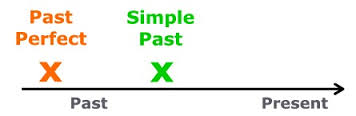
The Past Perfect tells us about something that happened before another action in the past.
It can also show that something happened before a specific time in the past (putting emphasis only on the fact, not the duration).
For example:

  • I had never seen such a high mountain before I went to Switzerland.
  • I did not have any money because I had lost my purse.
To form the past perfect use ‘had’ + the past participle of the verb.


For regular verbs, in the past perfect simple you use a form of 'have' and add “ed” behind the verb.
For irregular verbs, use the past participle form.
See a list of irregular verbs in this link (the third column): irregular verbs


See the next page for examples.

Past perfect - 2


Examples

- The storm destroyed the sandcastle that we had built.

- When she went out to play, she had already done her homework.

- My brother ate all the cake that our mum had made.

- The doctor took off the plaster that he had put on six weeks before.

- The waiter brought a drink that I had not ordered.

- I could not remember the poem we had learnt the week before.

- The children collected the chestnuts that had fallen from the tree.

- Had he phoned Angie before he went to see her in London?

- She had not ridden a horse before that day.

- Before I came here, I had spoken to Jack.

- I was late for work because I had missed the bus.

- We admired the picture that Lucy had painted.

Past perfect continuous

Past perfect continuous - 1

De past perfect continuous gebruik je als je praat over iets dat duurde tot
het moment in het verleden waar je het over hebt.
Je maakt de past perfect continuous met het hulpwerkwoord 'had' gevolgd door 'been'
+ een werkwoord in de '-ing'vorm.

Voorbeelden:

  • When they finally arrived, I had been waiting one hour.
    Toen ze eindelijk arriveerden, had ik een uur lang gewacht.

  • John had been taking quite a few driving lessons, but he gave up.
    John heeft best een aardig aantal autorijlessen gehad, maar hij is gestopt.

Present perfect simple or Present perfect progressive?

Present perfect simple or present perfect progressive? - 1

Both tenses are used to express that an action began in the past and is still going on or has just finished. In many cases, both forms are correct, but there is often a difference in meaning.
- Present Perfect Simple: mainly express that an action is completed or emphasise the result.
- Present Perfect Progressive: emphasise duration or continuous course of an action.

Result or duration?
Do you want to express what has happened so far or how long an action has been going on yet?


Present Perfect Simple Present Perfect Progressive
Result
(what / how much / how often)
Duration
(how long)
I have written 5 letters. I have been writing for an hour.

Present perfect simple or present perfect progressive? - 2

Emphasis on completion or duration?
Do you want to emphasise the completion of an action or its continuous course?


Present Perfect Simple Present Perfect Progressive
Emphasis on completion Emphasis on duration
I have done my homework. I have been doing my homework.
(meaning homework is completed now) (meaning that is how I spent my time)


Permanent or temporary?
If an action is still going on and we want to express that it is a permanent situation, we would usually use the Present Perfect Simple.


Present Perfect Simple Present Perfect Progressive
Permanent Temporary
James has lived in this town for 10 years. James has been living here for a year.
(meaning he is a permanent resident) (meaning a temporary situation)

Presentation

Presentation - 1

Sometimes you will be asked to do a presentation in class.
Do you hate it, or are you indifferent? If you’re not into it, it may help you to develop some strategies to make life easier.

Presentations made easy

Step 1

  • Analyse your audience.
  • Brainstorm about the topic.
  • Set your aim: what do you want to achieve?
  • List your main points on a card.

Step 2

  • Do some background reading. Make notes.
  • Make cards with keywords.
  • Determine the order of your cards.
  • Write a linking-word at the bottom of each card.

Presentation - 2

resentations made easy

Step 3

  • Practise.
  • Check.
  • Present.

Step 4

  • Listen to or watch your presentation.
  • Think about the feedback you received.
  • Decide how to improve in the future.


Relative clauses

Relative clauses - 1

A clause is a part of a sentence.
A relative clause gives us information about the person or thing that the speaker is talking about.

Example:
The boy who sits next to me ... (who sits next to me tells us which boy)
People who live in Australia ... (who live in Australia tells us which kind of people)

Relative clauses - 2

relative pronoun use example
which subject or object pronoun for animals and things It was the neighbour’s dog whichbarked in the middle of the night.
which referring to a whole sentence This is the report, which some people don't like.
whose possession for people, animals and things Yesterday I talked to a boy whose mother writes short stories.
It was an old house, whosebasement had been flooded.
where subject or object pronoun for people and places The hotel where we stayed was in front of the sea.
that subject or object pronoun for people, animals and things in defining relative clauses (who or which are also possible) The charity commission wrote the report that upset some people.

Relative clauses - 3

There are two types of relative clause: defining and non-defining.
Both add extra information to a sentence. Read the example sentences.

Non-defining Defining
The man, who has a moustache, is my grandfather. I’m going to wear those shoes that I bought yesterday.
The video clip, which stars Monty Bishop, will be online tomorrow. The woman who lives on the second floor is a doctor.
My Mum, whose sister lives in New York, is on holiday at the moment. My aunt works for a school which is for special needs children.
The train, which was the first of its kind, is now in a museum.  

Simple past

Simple past - 1

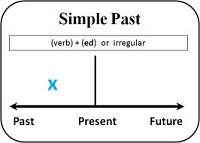
Simple past is also called past simple.
The simple past is used in the following situations:

- The simple past expresses an action in the past taking place once, never, several times.
- It can also be used for actions taking place one after another
  or in the middle of another action.

For regular verbs, in the simple past you just add “ed” behind the verb.
For irregular verbs, use the past form.
See these examples:

  • choose - chose
  • go - went
  • see - saw
  • have - had
  • do - did
  • be - was

See a list of irregular verbs in this link (the second column): irregular verbs

Simple past - 2

Use of Simple Past
- action in the past taking place once, never or several times
Example: He visited his parents every weekend.
- actions in the past taking place one after the other
Example: He came in, took off his coat and sat down.
- action in the past taking place in the middle of another action
Example: When I was having breakfast, the phone suddenly rang.
- if sentences type II (If I talked, …)
Example: If I had a lot of money, I would share it with you.

Exceptions in spelling example
After a final 'e' only ad 'd' instead of 'ed' Love - loved
Final consonant after a short, stressed vowel, a vowel is doubled Admit - admitted
Final 'l' after a consonant is doubled. Travel - travelled
Final 'y' afer a consonant becomes 'i'. Hurry - hurried

Simple past - 3

Signal words of Simple Past

- yesterday
- ..... ago (Two minutes ago)
- In ..... (In 1990 ...).
- The other day
- Last .... (Last Friday)
- If .... (If I studied, I would pass)
  If in combination with would + infinitive (whole verb).


Examples
Yesterday it rained.
She visited her friend in 2012.
We saw the film last week.
The football match started an hour ago.
If I won the lottery, I would buy a big house.

Simple past - 4

Past simple questions

To create a question in past simple we normally put DID at the beginning of the question, then add a subject (the person or thing that does the action) followed by the base form of the verb and only then add the rest of the sentence.

We don’t use DID in questions that have the verb To Be or Modal Verbs (can, must, might, should etc.).


Examples

affirmative negative question
He answered a question. He did not answer a question. Did he answer a question?
He went to school. He did not go to school. Did he go to school?
I bought bread. I did not buy bread. Did I buy bread?
They travelled to London. They did not travel to London. Did they travel to London?
You said. You did not say. Did you say?
They taught. They did not teach. Did they teach?
We gave. We did not give. Did we give?
The hotel was very nice. The hotel was not very nice. Was the hotel nice?

Simple past or Past perfect

Simple past or Past perfect? - 1

We use Simple Past if we give past events in the order in which they occured.
However, when we look back from a certain time in the past to tell what had happened before, we use Past Perfect.

Do you just want to tell what happened some time in the past or do you want to tell what had happened before/up to a certain time in the past?

Signal words


Simple past Past Perfect simple
first already
then up to then
  before that day


Examples:
- Jane got up at seven. She backed her bag and then she went to school (simple past).
- Before her fourth birthday, Jane had never been to school (Past Perfect Simple).

Simple past or Past perfect? - 2

Simple past Past Perfect Simple
Second column of irregular verbs

Example: I spoke
had + third column of irregular verbs

Example: I had spoken
Regular verbs: infinitive + ed

Example: I worked
Regular verbs: form of have + infinitive + ed

Example: I had worked


For the irregular verbs, use this link: irregular verbs

Simple present

Simple present - 1

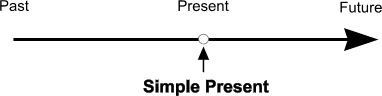
Simple present is also called present simple.

The simple present is used in the following situations:

- It expresses an action in the present taking place once, never or several times
  (repeated or regular actions).
- For actions that are set by a timetable or schedule.
- The simple present also expresses facts in the present.
- For habits.

Simple present - 2

Simple present be
- am with the personal pronoun I
- is with the personal pronouns he, she or it (or with the singular form of nouns)
- are with the personal pronouns we, you or they (or with the plural form of nouns)


  affirmative negative question
I I am. I am not. Am I?
he/she/it He is. He is not. Is he?
you/we/they You are. Your are not. Are you?


Examples:

I am hungry. I am not hungry. Am I hungry?
You are Sam. You are not Sam. Are you Sam?
He is here. He is not here. Is he here?
It is okay. It is not okay. It is okay?

Simple present - 3

Simple present have
- have with the personal pronouns I, you, we und they (or with the plural form of nouns)
- has with the personal pronouns he, she, it (or with the singular form of nouns)
- have got is also used in the simple present in British English.


  possitive negative question
I/you/we/they I have got.
I have.
I have not got.
I do not have.
Have I got?
Do I have?
he/she/it He has got.
He has.
He has not got.
He does not have.
Has he got?
Does he have?


Examples

he He has a beard. He does not have a beard. Does he have a beard?
we We have a car. We do not have a car. Do we have a car?
she She has got a sister. She has not got a sister. Has she got a sister?
they They have got money. They have not got money. Have they got money?

Simple present - 4

Simple present Other verbs (than be and have)

  • the infinite verb (play) with the personal pronouns I, you, we and they
    (or with the plural form of nouns)
  • the verb + s (plays) with the personal pronouns he, she, it
    (or with the singular form of nouns)


  affirmative negative question
I/you/we/they I play. I do not play. Do I play?
he/she/it He plays. He does not play. Does he play?


Exceptions:
- The verbs can, may, might, must remain the same in all forms. So don't add 's'.
 Example: he can, she may, it must
- Verbs ending in 'o' or a sibilant ('ch', 'sh', 's', 'x') add 'es' instead of 's'.
 Example: do - he does, wash - she washes
- A final 'y' after a consonant becomes 'ie' before 's'.
 Example: worry - he worries (But after a vowel not: play - he plays)

Simple present or Present progressive?

Simple present or Present progressive? - 1

Use the Simple Present or Present Progressive? Look at the following rules and signal words: - In general or right now?
- Do you want to express that something happens in general or that something is
  happening right now?
- Do you want to express that something is arranged for the near future?
- Or do you refer to a time set by a timetable or schedule?


Simple Present Present Progressive
in general
Rick plays football every Monday.
right now
Look! Rick is playing football now.
present actions happening one after another
First Rick plays football, then he watches
TV.
several actions happening at the same time
Rick is playing football and Anne is
watching.
daily routine
Bob works in a restaurant.
limited period of time
Jenny is working in a restaurant this week.
paction set by timetable/schedule
The film starts at 8 pm.
arrangement for the near future
I am going to the cinema tonight.

Simple present or Present progressive? - 2

Use the Simple present or Present Progressive?


Simple Present Present Progressive
Signal words
always
every
normaly
usually
sometimes
never
at the/this moment
today
(right)now
Listen
Look!

Simple Present: Asking Questions

Simple present: Asking questions - 1

If you want to turn regular sentences into question sentences you simply add the verb ‘to do’.
After the verb ‘to do’ you always use the simple present.

Positive sentence: Question sentence:
I read a book. Do I read a book?
You listen to music. Do you listen to music?
He watches TV at night. Does he watch TV all night?
She calls her mum. Does she call her mum?
It barks all night. Does it bark all night?
We talk all the time. Do we walk all the time?
You walk in the park. Do you walk in the park?
They sleep in separate beds. Do they sleep in separate beds?

Simple present: Asking questions - 2

If you want to make question sentences with the verb ‘to be’, simply switch the subject and
the verb.

I am a student. Am I a student?
You are a student. Are you a student?
He is a teacher. Is he a teacher?
She is a journalist. Is she a journalist?
It is a book. Is it a book?
We are mechanics. Are we mechanics?
You are pilots. Are you pilots?
They are musicians. Are they musicians?

Simple present: Asking questions - 3

A question sentence can also start with an auxiliary verb.
Some of the most used auxiliary verbs are:
Shall, Will, Should, Would, Could, Can, May

Positive sentence: Question sentence:
I may read a book. May I read a book?
You will go to the park. Will you go to the park?
He should watch his back. Should he watch his back?
She could call her mother. Could she call her mother?
It can fetch a stick. Can it fetch a stick?
We shall talk after class. Shall we talk after class?
You should walk home. Should you walk home?
They may sleep in the guestroom. May they sleep in the guestroom?

Simple present: Negations

Simple present: Negations - 1

Question sentence: Answers:
Do I read a book? No, I do not read a book/No, I don't read a book.
Do you listen to music ? No, you do not listen to music./No, you don't listen to music.
Does he watch TV? No, he does not watch TV./No, he doesn't watch TV.
Does she call her mum? No, she does not call her mum./No, she doesn't call her mum.
Does it bark all night? No, it does not bark all night./No, it doesn't bark all night.
Do we talk all the time? No, we do not talk all the time./No, we don't talk all the time.
Do you walk in the park? No, you do not walk in the park./No, you don't walk in the park.
Do they sleep in here? No, they do not sleep here./No, they don't sleep here.

Simple present: Negations - 2

Question sentence: Answers:
Am I a student? No, I am not./I'm not.
Are you eleven years old? No, you're not./No, you aren't./No, you are not.
Is he a teacher? No, he's not./No, he isn't./No, he is not.
Is she a journalist? No, she's not./No, she isn't.
Is it a book? No, it's not./No, it isn't.
Are we mechanics? No, we're not./No, we aren't.
Are you a pilot? No, you're not./No, you aren't.
Are they musicians? No, they're not./No, they aren't.

Simple present: Negations - 3

Question sentence: Answers:
May I read a book? No, I may not read a book.
Will you go to the park? No, you will not/won't go to the park.
Should he watch his back? No, he should not/shouldn't watch his back.
Could she call her mother? No, she could not/couldn't call her mother.
Can it fetch a stick. No, it can not/can't fetch a stick.
Shall we talk after class? No, we shall not/shan't talk after class.
Should you walk home? No, you should not/shouldn't walk home.

Skimming and scanning

Skimming and scanning - 1

If you’re taken an English exam you’re going to encounter different reading tasks that will require either Skimming,  Scanning or reading the whole text. It’s important that you know what this mean in order to do the task correctly. 

You probably regularly read newspapers, magazines, adverts, letters, emails, instructions and blogs. Without realizing it, you use strategies when you do that. You might have got in the habit of using some strategies that don’t really work well for you.

Practice these steps.

Step 1: Think about it.

  • What kind of text is it? What's the subject?
  • What do I know about the subject?
  • What is the purpose of the text?
  • What do I want or have to find out?
  • What do I have to do with the text?

Step 2: Decide what to do.

  • I'll skim (glance over it).
  • I'll scan (look for specific information).
  • I'll read the whole text..

Skimming and scanning - 2


Step 3: Do what you decided to do.

  • Skimming: Read heading, pictures, captions. Read introduction and conclusion. Read first and last sentences of paragraphs.
    Reading rapidly in order to get a general overview.
  • Scanning: Find numbers, names, places, etc. Answer questions. Look for key words in questions and scan the passage for the same key words. Answers are usually found around the key words. 
    Look for answers to only one question at a time. Scan separately for each question.
    Reading rapidly in order to find specific facts.
  • Read: Highlight topic sentences (sentences opening paragraphs).
    Underline key words. Circle linking words. Make notes. Answer questions.
    Remember; this is going to be far more time consuming than scanning or skimming!

Step 4: Think about it again.

  • Were my predictions correct?
  • Have I missed anything?
  • Go back to previous steps if you need to.
  • Look words up in a dictionary.

Skimming and scanning - 3

Tip!

Read as much as possible
Reading is a skill, like swimming or playing football.
Something you get better at by practising.
The more you read, the better you’ll get at it!

Speed read
Speed up. In exam situations you will often need to read a text more quickly than before.
Practise reading texts quickly: you can time yourself.
For example, give yourself 3 minutes to read 300 words, then give yourself 2 minutes to read 300 words,
then try in 1 minute.
You can repeat this idea with the same text at first, but then try it with different texts as you get better at it.

Don't freeze
Remember, in an exam you aren’t allowed to ask someone or look up a new word.
If you don’t know a word, and you can’t guess a general meaning from the other words around it, then skip it, don’t waste time!

Superlatives of adjectives

Superlatives of adjectives - 1

In the superlative you talk about one thing only and how it is the best, worst, etc.
You do not compare two things. The following guidelines apply to the superlative:

Adjectives with one syllable:
1-syllable adjectives: add -est to the adjective (plus the)

My sister is the tallest in our family.
Yesterday was the coldest day of the year so far.


Note: If the word ends: consonant-vowel-consonant, then the last consonant is usually doubled in the superlative.
big - biggest, fat - fattest, hot - hottest

Adjectives of two syllables ending in -y:
2-syllable adjectives ending in -y: change the -y to -iest (plus the)

The richest people are not always the happiest.
Which do you think is the easiest language to learn?
She's the luckiest person I know.

Superlatives of adjectives - 2

Beware: Do not confuse adjectives and adverbs.
2-syllable adverbs ending in -y form their superlative with the words the most.

Of all the people I know my father drives the most quickly (quickliest).

Other adjectives with two syllables:
Other 2-syllable adjectives: use the most with the unchanged adjective

The most boring thing about ESL class is doing grammar exercises.
My sister is the most careful person I know.

Exceptions
The superlative of some shorter 2-syllable adjectives can be formed with -est.
- simple - simplest
- clever - cleverest
- narrow - narrowest

To be sure which comparative method to use, you will need to consult a good dictionary.

Superlatives of adjectives - 3

Adjectives of three syllables or more:
Adjectives with 3 or more syllables: use the most with the unchanged adjective

Some people think that Russian is the most difficult language.
Albert Einstein was the most intelligent person in history.
My most enjoyable class is English.

Irregular forms
Following are two common irregular comparative/superlative forms:

good - better - the best
bad - worse - the worst