Thema 6: (wan)Orde

Thema 6 - (wan)Orde


Hi kids,

In this Wikiwijs you can find all the documents you need for Thema 6: wan(Orde). First click on the tab called Course Outline (lesplanner) to see what you're going to do, and when you're going to do it.

At the beginning of every theme, the teacher will explain the Masterpiece assignment to you. Every theme will be set up as follows:

- 3 Basic lessons (notebook)

- 1 Selftest lesson (notebook)

- 1 Revision lesson - Catch Up or Get Ahead (notebook)

- 5 Skills lessons (laptop or notebook)

- 2 Masterpiece lessons - at the end of the second lesson you will hand in your Masterpiece.

At the end of this theme, you will also have a Basics Test. This will include the grammar of unit 4 and 5 (themes 5 and 6). Make sure you study the words, irregular verbs and grammar 3x every week. 

In case you finish early, you can start working on the Challenges and/or your Masterpiece. Always consult your teacher and let them know what you are doing.

Have fun!
Your teachers.

Het is belangrijk dat je alle documenten uit de Wikiwijs opent en opslaat op je computer in het mapje Engels. Zo kunnen we ook zonder internet aan de slag, kun je alles terugvinden en is je gemaakte werk (in de Cloud) ook op de juiste plek opgeslagen. Sla de Wikiwijs ook op in je favorieten. Zorg ervoor dat je een tekstverwerker (Word, Google Doc) en een goede PDF-reader (Foxit, Adobe) hebt.


Course Outline

Course Outline                                                                                                      Thema 6: (wan)orde

Click on this button to see this year's course outline. The document is subject to changes.

Course outline


You need to log in with your De Nieuwste School credentials.

Basics

Here you can find all the Basics documents you need. Open the Workbook and save it in your English folder on your laptop (in het mapje Engels op je laptop). You type your answers in a seperate Google Document or write them down in a notebook. Make sure you always have acces to your Google Document or make sure you always have your notebook with you!

You can find the Texts you need to read for the exercises from the Workbook in the document called 'Texts'. You can find the Grammar and Words you need to study in the documents called 'Grammar' and 'Words'. You can find all this information in your Coursebook too.

Good luck and have fun!


New Interface - Unit 5 - Lesson 21:

New Interface - Unit 5 - Lesson 22:

New Interface - Unit 5 - Lesson 23:

Video explanation - Past Simple

Bekijk bovenstaande video voor een uitleg over de Past Simple. Na het bekijken van de video kun je online oefenen met deze grammaticale structuur op:

https://www.ego4u.com/en/cram-up/grammar/simple-past

https://www.perfect-english-grammar.com/past-simple-exercise-8.html

https://www.englisch-hilfen.de/en/exercises/tenses/simple_past_mix.htm

Video explanation - Past Continuous

Bekijk bovenstaande video voor een uitleg over de Past Continuous. Na het bekijken van de video kun je online oefenen met deze grammaticale structuur op:

https://www.ego4u.com/en/cram-up/grammar/past-progressive

https://www.perfect-english-grammar.com/past-continuous-exercise-1.html

https://www.englisch-hilfen.de/en/exercises/tenses/simple_past_progressive.htm --> deze oefening gaat over het verschil tussen de Past Simple en de Past Continuous

Video explanation - Present Perfect

Bekijk bovenstaande video voor een uitleg over de Present Perfect. Na het bekijken van de video kun je online oefenen met deze grammaticale structuur op:

https://www.ego4u.com/en/cram-up/grammar/present-perfect-simple

https://www.perfect-english-grammar.com/present-perfect-exercises.html

https://www.englisch-hilfen.de/en/exercises/tenses/present_perfect_statements2.htm

Video explanation - Adverbs & Adjectives (bijwoorden en bijvoeglijk naamwoorden)

Bekijk bovenstaande video voor een uitleg over de adjectives en adverbs (bijvoeglijke naamwoorden en bijwoorden). Na het bekijken van de video kun je online oefenen met deze grammaticale structuur op:

https://www.ego4u.com/en/cram-up/grammar/adjectives-adverbs

https://www.perfect-english-grammar.com/adverbs-or-adjectives-exercise-1.html

https://www.englisch-hilfen.de/en/exercises_list/adjektiv_adverb.htm

Video explanation - Word order (zindsvolgorde in het Engels)

Bekijk bovenstaande video voor een uitleg over de woordvolgorder in Engelse zinnen. Na het bekijken van de video kun je online oefenen met deze grammaticale structuur op:

https://www.ego4u.com/en/cram-up/grammar/word-order

https://www.englisch-hilfen.de/en/exercises/word_order/sentences10.htm

Week 1&2 - Tranquillity Bay Reading

Abuse at Tranquility Bay                                                                                              MAVO/HAVO/VWO


Part 1 – Brainstorm

Before continuing with the text below, make groups of 4 students and think about these questions:

  1. Do you think people under 18 should be punished the same as adults when they break the law?
  2. Should people under 18 be sent to prison, when they break the law? Why (not)?
  3. If people under 18 are sent to prison, how should they be treated there? What would a regular day look like for them?
  4. If people under 18 are very difficult at home, should their parents send them somewhere to change their behaviour?

After having talked about these questions in your group, discuss them in class.


Part 2 – Tranquillity Bay

Those of you unaware of what Tranquility Bay is, it is a facility for (pre-)teens and teens in Jamaica under the umbrella of the World Wide Association of Specialty Programs and Schools (WWASPS), an American-based organisation. Parents that don’t know what to do with their troubled teens can send their children to Tranquility Bay.

There have been hundreds of accounts of abuse there. In class we're going to read a letter sent by a mother in which she talks about the abuse at Tranquility Bay. During Skills Lab week 3 we're going to watch a BBC documentary to see if we agree with their way of doing things. Answer the pre-reading questions before reading the text.


Pre-reading questions                                                                                                      MAVO/HAVO/VWO

Use the Wikipedia page about Tranquility Bay to answer the following questions. https://en.wikipedia.org/wiki/Tranquility_Bay

1. Waar bevond Tranquility Bay zich?
3. Van wanneer tot wanneer was de faciliteit in gebruik?
4. Vanaf welke jonge leeftijd werden sommige kinderen al door hun ouders naar Tranquility Bay gestuurd?
5. Waarom werd Tranquility Bay uiteindelijk gesloten?
6. Welke bekende Amerikaanse politica heeft zich met de sluiting bemoeid volgens de Wikipedia pagina?


In onderstaande tekst staan een aantal woorden die (waarschijnlijk) onbekend voor je zijn. Zoek eerst de betekenis van deze woorden op zodat het lezen van de tekst makkelijker gaat.

English

Dutch

English

Dutch

Facility


Pinned down


Unaware


Restraint


Neatly folded


Pending


Bruises


Medical neglect


Embassy


Occured


Agencies


Requests


Abused


Blamed


Indicated


Self-infliction


Shattered


Assured


Als je tijdens het lezen nog andere moeilijke woorden tegenkomt, zoek dan de vertaling hiervan op.


Part 3 – Tranquillity Bay


Abuse at Tranquility Bay - text


In February, families flew in to visit their kids at Tranquillity Bay. Cindy is one of the mothers who went to visit her son, Mike. She brought her teenage daughter, Ashley with her.

When they arrived at the facility they were turned away because some were wearing sleeveless shirts. The parents were unaware there was a dress code for them. They had to take the long ride back to their hotels to change. When they came back they were allowed on the property. While they were sitting around the pool a boy stepped out onto the balcony overhead and threw down a neatly folded piece of paper. Ashley, Mike’s sister, picked up the note while her mother, Cindy, looked up at the boy. He pulled up his shirt and Cindy saw bruises on his shoulders, under his armpits, and on his back. Cindy also saw another boy looking through the glass who had a metal plate in his mouth. Other parents witnessed this as well.

Cindy read the boy’s letter . “… Please I am begging to get this note to the American Embassy because there are no staff here that will do anything … please please get this to the embassy so that I can talk to them ...”
In his letter he also wrote to his own mother, telling her: “… The staff then threw me down and started hitting my head over and over on the floor. One staff dropped his pen and the other staff picked it up and started to stab me in the right shoulder. While all this was happening other staff were punching me and hitting me with my sandals …”

Cindy forwarded the boy’s letter to CAICA. CAICA immediately contacted agencies in Jamaica - the American Embassy, Child Welfare, Unicef, the Ministry of Education and Youth – and the State Department. CAICA provided these agencies with Declarations, a copy of the boy’s letter, and the names of the boys who were being abused. Cindy indicated the facility claims no fault.

Cindy, Ashley, and Mike had some time alone together. While they were down at the beach – an activity Mike said they are never allowed to do during his stay at Tranquillity Bay - Mike told Cindy that children were being abused there - that the boy with the full jaw plate in his mouth had his upper left jaw shattered. He had been pinned down on the floor by several staff and was “smacked” in the face with staffs’ walkie-talkies. According to Mike, staff claimed that during the restraint the boy’s face bounced off the floor, breaking his jaw. The American Embassy said there is a pending investigation into this incident. Mike said injured kids are taken away from the facility when the Embassy comes for a visit. Mike also talked about medical neglect. He complained to staff that he was having difficulties breathing and he thought his nose was broken, but staff called him a liar telling him nothing was wrong.

Before this incident occurred Cindy had made it clear to Tranquillity Bay that she did not want surgery performed on her son in Jamaica unless it was an absolute emergency. She told them if he needed surgery she would have him brought back to the US. They did not listen to her requests and had the surgery performed on her son in Jamaica without her knowledge.

While he was at the beach with his mom and sister, Mike was sunburned on his shoulders – shoulders that barely ever saw sunlight. Cindy could not understand why Mike was so upset. When he calmed down he told her he would be blamed for self-infliction of wounds and his levels would be dropped. Cindy did not believe this could possibly happen and explained to staff that Mike did not inflict this upon himself, that he did wear sunscreen, and that the reason he burned was probably because his shoulders hadn’t seen much sunlight in nearly two years. Staff assured her they would not drop his levels.

Cindy learned Mike’s levels were dropped and he was frightened. He wanted to talk to his dad and said he feared for his life.

Frightened to return to the facility Cindy decided to take her younger daughter and fly back to the US. Before leaving Jamaica she said she contacted a transport company to pick up her son - Sunrise Transport out of Utah. The driver went above and beyond the call of duty to pick this child up and return him to his mom, all in the course of a day.


Exercise                                                                            MAVO/HAVO/VWO

Put these events from the text in the correct order.

a. Cindy read the boy’s letter
b. They had to go back to their hotel to change
c. Families flew to Tranquillity Bay
d. Mike told Cindy about abuse at the facility
e. A boy threw a piece of paper to them
f. They were turned away because they wore inappropriate clothing
g. Mike was picked up from Tranquillity Bay
h. Cindy saw bruises on the boy’s shoulder, armpits and back
i. Mike was afraid his levels would be dropped if the staff saw his sunburned shoulders
j. The boy’s letter was sent to CAICA
k. Cindy, Ashley and Mike went to the beach

1.

2.

3.

4.

5.

6.

7.

8.

9.

10.

11.


Questions                                                                                                                      MAVO/HAVO/VWO

1. Voor wie is Tranquility Bay bedoeld en waarom sturen ouders hun kinderen naar Tranquility Bay toe?

2. Waarom mochten Cindy, Ashley en de andere ouders het terrein van Tranquility Bay in eerste instantie niet op? Mochten ze vervolgens wel naar binnen?.

3. Op welke drie plekken zag Cindy dat de jongen gewond was?

4. ‘Cindy also saw another boy looking through the glass who had a metal plate in his mouth.’
Was Cindy de enige ouder die dit gezien heeft? Schrijf het gedeelte uit de tekst waaruit je antwoord blijkt over.

5. “… The staff then threw me down and started hitting my head over and over on the floor. One staff dropped his pen and the other staff picked it up and started to stab me in the right shoulder. While all this was happening other staff were punching me and hitting me with my sandals …”

Schrijf in je eigen woorden op wat er met de jongen gebeurd is. Wat hebben de stafleden met hem gedaan?.

6. ‘CAICA provided these agencies with Declarations, a copy of the boy’s letter, and the names of the boys who were being abused. 'Cindy indicated the facility claims no fault.’

Wat wordt er met het dikgedrukte stukje tekst bedoeld? Vertaal dit gedeelte in je eigen woorden.

7. Hoe kwam één van de verwonde jongens aan een plaat in zijn mond? Wat was er gebeurd?

8. Waarom is Mike bang dat zijn verbrande schouders voor problemen gaan zorgen?

9. ‘Before this incident occurred Cindy had made it clear to Tranquility Bay that she did not want surgery performed on her son in Jamaica unless it was an absolute emergency.’
Heeft de leiding van Tranquility Bay zich aan dit verzoek gehouden? Citeer het gedeelte uit de tekst waar dit uit blijkt.

10. Had de man die verantwoordelijk was voor het transport van Mike terug naar Amerika goed zijn best gedaan? Citeer het gedeelte uit de tekst waaruit je antwoord blijkt.


Questions                                                                                                                        MAVO/HAVO/VWO

11. For the school newspaper you are writing an article about Tranquillity Bay. You want the article to be really good, so you decided to interview Mike, a Tranquillity Bay ‘survivor’. Make at least 5 interview questions for Mike and write them down.

12. Secondly I’d like you to exchange your piece of paper with a fellow student and answer each other’s questions. Try to be as authentic as possible.


Week 3 - Tranquillity Bay Watching

Tranquillity Bay: Locked up in Paradise.                                                                     MAVO/HAVO/VWO

Now we know more about the background of Tranquility Bay, we're going to watch a BBC documentary about the facility. The documentary was broadcast a few years ago on BBC 2.

Answer the following questions. The questions are in Dutch so you can answer them in Dutch as well. Good luck and have fun!

Link: http://www.youtube.com/watch?v=g9qrOlo61hE

Questions

1. Wat zijn de kosten voor Tranquillity Bay voor één schooljaar?

2. Wat zijn redenen om je kind naar Tranquillity Bay te sturen? Noem er twee.

3. Hoe werd Shannon (een van de ‘survivors’ van Tranquillity Bay) naar de jeugdinstelling gebracht? Hoe noemde Shannon en haar moeder dit proces?

4. Wanneer mochten kinderen op Tranquillity Bay met elkaar praten?

5. Wat krijgen leerlingen tijdens hun ontbijt, lunch en avondeten te horen? Wat moeten ze daarmee doen?

6. Wat deed één van de Tranquillity Bay studenten toen het haar allemaal teveel werd? Hoelang was zij toen op Tranquillity Bay?

7. Waarom liggen er studenten op de grond?

8. Hoe noemen ze dit fenomeen? (je mag de Engels naam geven)

9. Wat heeft de jongen gedaan die op de grond lag?

10. Hoe lang lag hij al daar?

11. Voorheen lagen leerlingen op handdoeken, nu op matjes. Waarom is dit?

12. Wat is er gebeurd met Shannons kin? Beschrijf hoe ze aan deze verwonding is gekomen.

13. Waarom hebben de bewakers op Tranquillity Bay Shannon niet meteen naar het ziekenhuis gebracht om gehecht te worden?

14. Hoeveel operaties heeft Shannon al gehad om de schade aan haar kaak te herstellen?

15. Hoelang duurde het voordat Shannon met haar moeder kon/mocht bellen?

16. Heeft Shannon toen verteld wat er met haar kaak gebeurd is? Waarom niet?

17. Vinden de ouders die in de documentaire aan het woord zijn het erg dat ze hun kinderen al zo lang niet meer hebben gesproken? Waarom denk je van wel/ niet?

Week 4&5 - UFOs

Week 4 & 5

The UFO                                                                                                                        MAVO/HAVO/VWO

Our society is very organized. You know exactly what you can and can't do and we have made up rules to keep everything in order. However, there's always discussion about whether or not there is life outside of our little planet. Would they have different societies? How would things work on Mars? And would they come over in UFO's to see what we're doing?

During this class, you are going to learn a bit more about UFOs. Perhaps, you don’t know that much about them yet, so you’re going to read a text about UFOs, watch a video about life on different planets and read a newspaper article about a strange object flying close to Earth.


Part A – The History of UFOs                                                                         MAVO/HAVO/VWO


The History of UFOs

Unidentified Flying Object (or “UFO”) is a term often used to describe lights or shapes in the sky. It was first used by the United States Air Force in 1952 to describe sightings of mysterious objects in the sky that could not be explained even after careful investigation. Nowadays, UFOs are spotted frequently, and feature in numerous movies and TV shows. Another popular name for such an object is, “Flying Saucer,” which refers to the round shape of many UFOs.

The first widely publicized UFO sighting was in 1947, by a pilot called Kenneth Arnold. After this event, there were more sightings of UFOs. Movies and TV shows began showing visitors from outer space, arriving on Earth in flying saucers. With the popularity of these images, many people claimed to have seen lights in the sky. Some experts believe that people simply think they see UFOs because of the influence of TV and movies.

However, experts guess that as little as 5% of these sightings could be called “unidentified.” Usually, these lights are made by aircraft, satellites, or weather balloons. Top secret air force activities during the Cold War may have been responsible for many of the UFO sightings in America and Europe. Although not actually aliens, the secretive nature of these flying objects is definitely unidentified.

Another popular idea on UFOs concerns the role of world governments. Specifically, people believe that the US government has discovered alien life and operates a “cover-up” to hide the truth from the public. The most widely believed cover-up is that of the Roswell Incident. In July, 1947, a UFO supposedly landed in Roswell, New Mexico, and was examined and hidden by government agents. There have been many investigations into the Roswell Incident, however, these reports always claim that no such event occurred.


Translate these words from the text:

English

Dutch

Describe


Sightings


Frequently


Feature


Claimed to have seen


Influence


However


Secretive


Cover-up


Examined


Answer these questions on ‘The History of UFOs’

1. What does the abbreviation UFO stand for?
2. The term UFO was first used in 1925. True/False
3. What is a Flying Saucer?
4. UFOs and Aliens were used on television before 1947. True/False
5. What do UFOs normally turn out to be instead of a UFO?
6. The Roswell Incident happened in the UK. True/False


Part B – Do Aliens Exist?                                                                                MAVO/HAVO/VWO

Video: https://www.youtube.com/watch?v=PpWP7GGjJ6k

Watch the video and answer these questions:

  1. Waarom is het goed mogelijk dat er buitenaards leven bestaat?
  2. Wat is er zo bijzonder aan Kepler-452B? Leg je antwoord uit en geef voorbeelden.
  3. Wat heeft leven nodig om op een planeet te ontstaan?
  4. Wat staat er zoal op de gouden plaat die aanwezig is op de Voyager 1? Geef voorbeelden.

Part C – Newspaper Article                                                                            MAVO/HAVO/VWO

Read the newspaper article below and finish the exercises.


Mysterious space object could be monitoring us  
16th December, 2017


Astronomers think that aliens could be listening to us on Earth. The astronomers look for signs of alien life beyond Earth. They are excited about a giant space object that just passed Earth. It is 800 meters long and 80 meters wide. The rock has many straight lines so it might not have come from nature. It could have been made by alien life. The scientists called the rock Oumuamua. This means 'messenger' in Hawaiian.


The astronomers first spotted Oumuamua travelling at great speed past Earth. It was about 85 times the distance to the Moon, which is very near if you think about the size of the universe. Oumuamua is the first object in our solar system that appears to come from another galaxy. Its high speed suggests it is outside the pull of the Sun. It is unlikely that Oumuamua proves that aliens exist. The rock is a unique event that could offer new secrets.


I – Difficult words

Schrijf minstens 5 moeilijke woorden op uit de tekst en zoek de vertaling.

English

Dutch


II – Mix and match

Combineer onderstaande zinsdelen uit de tekst.

  1. aliens could be listening to
  2. look for signs of alien life
  3. a giant space object that just
  4. The rock has many
  5. it might not have come
  6. It could have been made
  7. The scientists called the
  8. This means 'messenger'
  • rock Oumuamua
  • us on Earth
  • from nature
  • in Hawaiian
  • passed Earth
  • beyond Earth
  • by alien life
  • straight lines


III – Answer these questions

  1. What do astronomers do?
  2. What have the astronomers from the article found?
  3. Why do they think the object isn’t natural?
  4. Where does the object come from?
  5. Is this object proof for the existence of aliens?

Part D – Find other sources

Now that you have read a text about the history of UFOs, watched a video about whether aliens exist or not, and have read an article about an alien object close to Earth, it’s time for you to look for more information about aliens.

Go online and find other videos, articles and texts about aliens. Copy and paste the links to your sources here and briefly summarise what the article, video or text is about.

Make sure you make an effort to find good material, because you will need this information for your Masterpiece.

MAVO

  1. Vind minstens één video over aliens. Plak de link hier:
  2. Beschrijf kort waar de video over gaat, doe dit in het Nederlands.
  3. Vind minstens één Engels artikel over aliens. Plak de link hier:
  4. Beschrijf kort waar het artikel over gaat, doe dit in het Nederlands.

HAVO

  1. Find at least one video about aliens. Copy and paste the link here:
  2. Briefly summarise what the video is about, in English.
  3. Find at least one article about aliens. Copy and paste the link here:
  4. Briefly summarise what the article is about, in English.

VWO

  1. Find at least one video about aliens. Copy and paste the link here:
  2. Briefly summarise what the video is about, in English.
  3. Find at least two different articles about aliens. The articles have to come from different websites and have to be about different occurrences.
    • Link to article 1:
    • Link to article 2:
  4. For every article, briefly summarise what it is about.
    • Summary of article 1:
    • Summary of article 2:

Masterpiece

The Article

Now that you’ve learned more about UFOs and have looked for extra information by yourself, you’re going to write an article on them. First, you’re going to think of a title that has to do with UFOs. Make sure the title is catchy (pakkend) as that is how you’re going to attract people to read your article!

Secondly, you are going to give answers to different questions in each paragraph. Think of the structure of an article.

Also, I’d like the mavo students to be able to write a ‘regular’ paragraph (this is the minimum, you can ofcourse also write an enriched paragraph!). The havo/vwo students should try to write an ‘enriched’ paragraph. You can find examples below. Finished? Check your work with the checklist at the bottom of this exercise.

Example for “regular” paragraph 1:

The UFO comes from the planet Football. The planet is located in the Stewie-Belt galaxy. The planet is small. The planet is yellow, pink and green. The technology on the planet is advanced. There is IPOD tattoos, teleportation and robot house cleaners.

Example for “enriched” paragraph 1:

The UFO comes from the sporty planet Football. The planet is located in the Stewie-Belt galaxy located 3 billion quadrillion light years away, a distance too far for humans to ever venture. The planet is the size of an American football. From space, the planet is brown and white, seeing as the landscape is as brown as the colour of mud and the water is so white it would make the clouds on earth jealous.  The technology on the planet is far more than advanced. There is a teleportation machine at every street corner which makes travelling much more convenient. There are robot house cleaners to make sure you don’t have to ever clean again.


Task

In your article, you want to make sure you address the following subjects/questions in your paragraphs. But be careful; don't copy and paste the questions and just answer them! Make sure it is an actual story. After you’ve written your article, check your work with the checklist below.

Paragraph 1: About the planet
Which planet does the UFO come from?
Where is the planet located?
What size is the planet? (small, big…)
What colour is the planet?
The technology on the planet is ….. (advanced, non-existent, like ours, etc.)
What technology does the planet have? (There is….)

Paragraph 2: About the aliens
Who is inside the UFO?
What language do they speak?
How big are they?
What colour are they?
Describe what they look like (how many heads, how many hands, wings, antennas, etc.). Answer using 2 or more sentences.
Describe their personality (are they mean, peaceful, intelligent, vicious, etc.). Answer using 2 or more sentences.

Paragraph  3: Their intention
How long did it take them to get to earth?
Why did they come to earth? Answer using 2 or more sentences.

Paragraph 4: What happens
Where do they land (country, city, etc.)?
What is the first thing they do when they exit the UFO?
What do they do next?


Everyone writes an article in which they answer the questions above. However, every level has some other things to pay attention to. Also, you need to underline these grammatical structures in your text. This makes it easier for you, and your teacher, to see if you have included everything.

MAVO

In your text, you use at least:

  • 5 x adjectives to describe your aliens and their planet
  • 2 x adverbs to describe how they came to Earth
  • 1 x ‘to be going to’to talk about what is going to happen next
  • 2 x much / many / little / few in your general information

HAVO

In your text, you use at least:

  • 7 x adjectives to describe your aliens and their planet
  • 3 x adverbs to describe how they came to Earth
  • 2 x ‘to be going to’to talk about what is going to happen next
  • 3 x much / many / little / few in your general information
  • 2 x ‘(don’t) have to’ to talk about how aliens or people on Earth have to behave

VWO

In your text, you use at least:

  • 10 x adjectives to describe your aliens and their planet
  • 5 x adverbs to describe how they came to Earth
  • 3 x ‘to be going to’to talk about what is going to happen next
  • 4 x much / many / little / few in your general information
  • 2 x ‘(don’t) have to’ to talk about how aliens or people on Earth have to behave
  • 2 x must (not) / should (not) to give advice on how to deal with the situation


Help me!

De meeste leerlingen hebben al wat te maken gehad met de Engelse taal voordat ze aan de middelbare school beginnen, maar dat betekent niet dat het iedereen makkelijk af hoeft te gaan. Om je op weg te helpen met het maken van zinnen, het stellen van vragen en het leren van een vreemde taal, kun je op deze pagina verschillende ondersteuningstips vinden. Good luck!


Afbeeldingsresultaat voor learning english

Talen leren

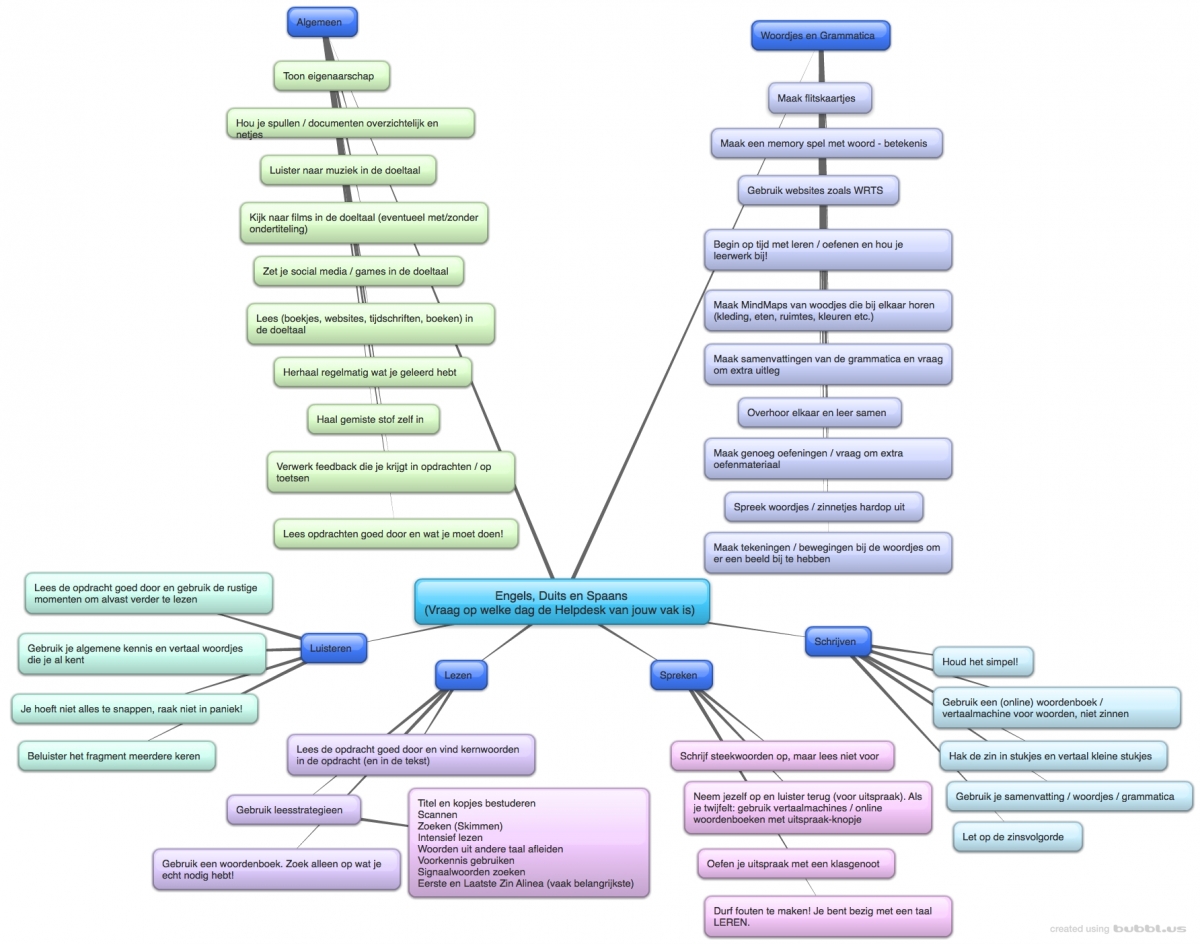
Een taal leren kan overweldigend lijken, maar gelukkig is het in kleinere stappen op te breken.

Kijk naar de afbeelding hieronder voor verschillende tips, manieren en werkvormen om de verschillende vaardigheden beter te beheersen.

Wij raden in ieder geval het volgende aan:

- leer 3x per week woorden in stukken. Deze woorden kun je vinden in onder 'Basics' en in je eigen woordenlijst.

- herhaal ook woorden die je vaker tegenkomt en gebruikt.

- lees opdrachten en Wikiwijs-pagina's altijd goed door.

- hoe meer Engels je in je leven tegenkomt, hoe beter. Kies voor Engelse audio/film, gebruik Engelse ondertiteling, lees een Engelse versie van een bekend boek. Engels Engels Engels, overal!

- vraag om feedback. Jouw expert kan meteen (herhalings)fouten eruit halen zodat je iets niet verkeerd aanleert.

- gebruik kennis van je klasgenoten.

Zelf zinnen maken

In het Engels is de woordvolgorde anders dan in het Nederlands. Het kan dus voorkomen dat je alle losse onderdelen en woorden om een zin mee te maken wel weet of hebt opgezocht, maar niet weet hoe je deze onderdelen met elkaar moet combineren. Hieronder wordt uitgelegd wat de basis zinsstructuur in het Engels is. Gebruik deze pagina steeds opnieuw als je zinnen moet leren formeren of om je Masterpiece te maken. Gebruik vervolgens de grammatica en woorden die je in de Basics lessen leert om steeds meer zinnen te maken en te experimenteren!


Om een simpele zin te maken heb je bouwblokken nodig. Ook in het Nederlands leren we zinnen ontleden om deze bouwblokken te herkennen. Tijdens de lessen leer je Engelse woorden die je hierbij kan gebruiken. Hieronder eerst een overzicht van de bouwblokken die we hebben en in het Engels op deze volgorde gebruiken:

- Onderwerp: wie of wat voert de actie uit/over wie of wat gaat het. In het Engels wordt het onderwerp in bevestigende en ontkennende zinnen altijd als eerst genoemd. Bij vragen komt het onderwerp altijd als tweede.

- Persoonsvorm/Werkwoorden/Gezegde: deze drukken de actie uit die plaatsvindt. Deze worden uitgevoerd door het onderwerp of hebben te maken met het onderwerp. In het Engels komen alle werkwoorden direct achter elkaar en noem je eerst de hulpwerkwoorden en dan het hoofdwerkwoord. Het hoofdwerkwoord is het belangrijkste werkwoord in de zin en het woord dat de actie het meest duidelijk uitdrukt, bijv. write (hoofdww). Het hulpwerkwoord kan verschillende vormen hebben, bijv. can/could/will/would/shall/should/may/might/must. Deze kunnen allemaal voor het hoofdwerkwoord komen en passen de betekenis van wat je zegt aan.

- Lijdend voorwerp: hangt samen met het onderwerp en de persoonsvorm/werkwoorden/gezegde. Het onderwerp van de zin kan de actie van het werkwoord uitvoeren met het lijdend voorwerp of het lijdend voorwerp is hetgeen waar de actie om draait. Dit heb je vaak nodig om een zin compleet te maken, bijv. I (onderwerp) need (ww) help (lijdend voorwerp). Je kan er ook achter komen wat het lijdend voorwerp is als je een vraag stelt met het werkwoord en het onderwerp. Bijv. What do I need? -> help.

- Meewerkend voorwerp: aan wie of wat, of voor wie of wat is het allemaal bedoelt. Hier komt in het Engels vaak 'to' of 'for' voor te staan. Bijv. I (onderwerp) need (ww) water (lijdend voorwerp) for my plant (meewerkend voorwerp).

- Plaats: waar speelt het zich allemaal af. Let hierbij goed op of je het juiste voorzetsel gebruikt hebt! Bijv. at my school = bij mij op school, on my school = bovenop het schoolgebouw.

- Tijd: wanneer speelt het zich allemaal af. Als je extra wil benadrukken wanneer het zich afspeelt, kun je de tijd ook helemaal vooraan in de zin noemen. Bijv. Next week, I'm going to walk home. This week, I'm going to bike.

Voorbeeld van een simpele zin:

Onderwerp – alle werkwoorden achter elkaar (belangrijkste achteraan) – wat - voor wie/wat – plaats – tijd

I              am painting      a picture             for my mom       in the garden     right now.


Om een uitgebreide zin te maken, kun je meer bouwblokken toevoegen en de bestaande bouwblokken vervangen met moeilijkere varianten. Hiermee kun je ook meer van je taalvaardigheid en taalbeheersing laten zien. Dit kan o.a. door synoniemen gebruiken om meer van je vocabulaire te laten zien.

Bouwblokken die je toe kan voegen om je zinnen complexer te maken hebben ieder een eigen functie en regels. Deze regels leer je gedurende leerjaar 1 en 2, maar zijn soms al eerder nodig. Hier zijn er een aantal die je kunt gebruiken.

Hieronder een overzicht van de bouwblokken die we hebben en in het Engels een uitgebreide zin maken:

- Zelfstandige naamwoorden: woorden waar je in het Engels de lidwoorden 'a' of 'an' voor kan zetten.

- Bijvoeglijk naamwoorden: zeggen iets over een zelfstandig naamwoord. Deze komen altijd direct voor het woord waar ze iets over zeggen en worden door een komma gesplitst als het er meerdere zijn, bijv. 'the great, big, beautiful book'.

- Bijwoorden zijn er in verschillende soorten en kunnen op verschillende plekken in de zin komen. De vuistregels hierbij zijn:

- Bijwoorden van frequentie: zeggen iets over hoe vaak iets gebeurt, bijv. always, usually, sometimes, often, never. Deze komen altijd áchter am/is/are/was/were en vóór alle andere werkwoorden.

- Bijwoorden van manier: zeggen iets over de manier waarop iets gebeurt, bijv. slowly, fast, hard.

- Bijwoorden van kwaliteit/intensiteit: zeggen iets over de kwaliteit of hoe erg waarmee iets gebeurt, bijv. well, badly, very, really.

Voorbeeld van een uitgebreide zin:

Onderwerp – alle werkwoorden achter elkaar (belangrijkste achteraan) en bijwoord op de juiste plek – wat beschreven met bijvoeglijk naamwoorden en synoniem - voor wie/wat met synoniem – plaats met bijvoeglijk naamwoord – tijd synoniem

I              am actually painting      a huge, realistic portrait             for my mother       in the beautiful garden     at the moment.


Afbeeldingsresultaat voor learning english sentences

Hulpzinnen

Hier heb je een overzicht van zinnen die je kan gebruiken om tijdens de Engelse les meer Engels te spreken en aan de expert te laten weten dat je het wel probeert, maar misschien nog lastig vindt. 

Leer deze zinnen uit je hoofd en gebruik ze!


Ik begrijp de zin niet: I don’t understand the sentence

Ik begrijp de vraag niet: I don’t understand the question

Ik weet het antwoord niet: I don’t know the answer

Ik kan het niet vinden: I can’t find it

Kun je dat herhalen: can you repeat that?

Ik vind dat … : I think that

Ik ben het ermee eens: I agree

Ik ben het er niet mee eens: I disagree

Preparing for the test

For the test of Unit 4 and 5, you need to study all the words (ENG-NL, NL-ENG). Also study the irregular verbs (infinitive, past simple, Dutch). You need to know and be able to use the following grammatical features and structures. Use the websites here for extra practice. Take a look at some of the explanatory videos on the Wikiwijs pages if you need to refresh your memory on the different structures.

- will / shall https://www.ego4u.com/en/cram-up/grammar/future-1-will/exercises

- adjectives / adverbs https://www.ego4u.com/en/cram-up/grammar/adjectives-adverbs

- reflexive pronouns https://www.ego4u.com/en/cram-up/grammar/pronouns/exercises?05

- gerund https://www.ego4u.com/en/cram-up/grammar/infinitive-gerund/exercises?21

- relative pronouns https://www.ego4u.com/en/cram-up/grammar/relative-clauses/exercises?02

- present perfect https://www.ego4u.com/en/cram-up/grammar/present-perfect-simple/exercises

- past continuous https://www.ego4u.com/en/cram-up/grammar/past-progressive

- past simple https://www.ego4u.com/en/cram-up/grammar/simple-past

- would / wouldn’t

- past simple vs present perfect https://www.ego4u.com/en/cram-up/grammar/simpas-preper/exercises

- place before time https://www.ego4u.com/en/cram-up/grammar/word-order 

- irregular verbs https://www.ego4u.com/en/cram-up/grammar/irregular-verbs 


Extra practice?

If you want to practise some more with the grammatical topics we've discussed (for example when they are difficult for you or to practise for a test), you have several options.

On this page there are a couple of website that you can use. With every website you can find a brief explanation of how they work.

On top of this page, you can also find a booklet with extra practise for all the grammatical topics we will learn in year 2. Download the booklet, print it, do the exercises and check them with your teacher to make sure you understand everything correctly.

Good luck!


Duolingo is an interactive learning format in which you train your listening and writing skills. You can practise a couple of minutes every day to quickly improve your English skills.

You can achieve goals and go to different levels to further improve your personal language skills.

Next to the desktop version, Duolingo also comes in an app for Android, iOS and Windows Phone.

A great way to improve your English and have fun at the same time!


Go to this website and click the button ´Grammar´ in the top left corner.

On the grammar page you can find many different grammatical topics. Click on the one you would like to practise. You can first read a short explanation about the topic and then you can do various exercises. When you are finished you can immediately check your work and see if you have done them correctly or not.


Same as with the previous website, go to this website and click the button ´Grammar Explanation´. On this page, you can also find and explanation of all the different grammatical topics.

If you click on ´Grammar Exercises´ you can practise with all the different grammatical topics. Here you can also check your own work and see how you´ve done.

There is also a button ´Tests´ and ´Complex Test´.


Quizlet is a fun way to train new vocabulary. You can use the website on your laptop or you can download the app for your Android, Windows or Apple device.

Same as with WRTS, you can upload your words to Quizlet and save them so you can use them later. Them difference with WRTS is that with Quizlet, you can do various (interactive) games to study your new words.

A great way to get to know your new vocabulary!

Extra reading practice

When you have some time left you can further improve your reading skills with one of these short articles. Reading is always a good way to expand your vocabulary and your grammatical knowledge.

These articles come with a couple of multiple choice questions as well as some open questions. The answers to the questions are included in the document to enable you to check your own work. When you read one of these articles, keep a list with difficult words to actively enlarge your vocabulary.

Choose a topic you like and have fun!

Up for a challenge?

If you're really good at English you might want to do more challenging exercises. That's why you can read the stories from the booklet (Short stories for Children). For every story you read you can do one of the exercises below.

Tell your Expert which story you've read, and hand in the exercises on paper.

Have fun!


Kies één opdracht uit de volgende lijst (eventueel op een apart vel papier). Je maakt deze opdracht in het Engels!.

a) Verzin een andere titel voor het verhaal en leg uit waarom die beter is.
b) Maak een tijdlijn waarin je de belangrijkste gebeurtenissen van het boek in de juiste volgorde plaatst.
c) Maak een advertentie voor iets dat in het boek voorkomt of dat ermee te maken heeft.
d) Schrijf een ander einde aan het verhaal (± 75 woorden).
e) Schrijf een stuk uit het dagboek van een hoofdpersoon (±75 woorden).
f) Schrijf een interview tussen jezelf en een hoofdpersoon. Schrijf ook de antwoorden van de hoofdpersoon op, zoals jij denkt dat die zullen zijn. In totaal schrijf je ± 5 vragen (en dus ook 5 antwoorden) op.